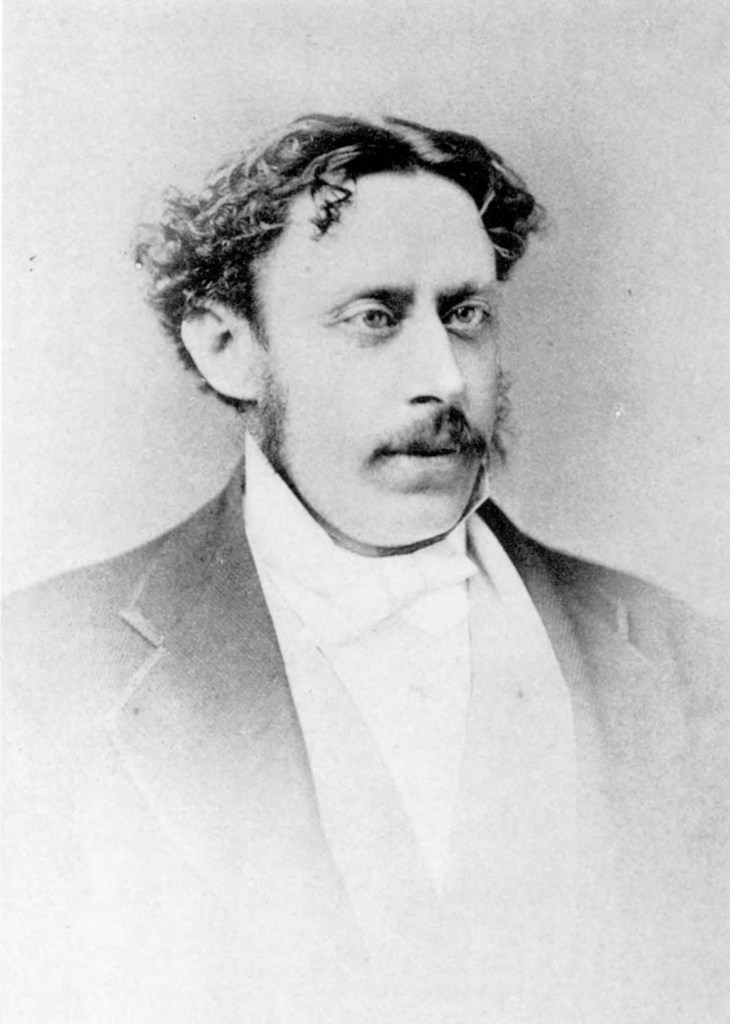
This blog was created to highlight the career of of the British-born, American architect Thomas Wisedell (1846-1884). From late 1868 through 1879, he worked with Calvert Vaux and Frederick Law Olmsted, designing architectural features for many of their early projects. With the 200th anniversary of the birth of Frederick Law Olmsted (April 26, 1822 – August 28, 1903) approaching, this seemed like the time to bring attention to Wisedell’s talents and establish his role within Olmsted’s office.
The first part of the blog will be about his training in the London office of Robert Jewell Withers (1824-1894) as well as his training in New York under Calvert Vaux, Jacob Wrey Mould and Frederick Law Olmsted.
The second part will be devoted to his work following the separation of Olmsted and Vaux in 1873, when Wisedell became Olmsted’s primary architect while also working as a hired draftsman in Calvert Vaux’ private practice.
The final part of the blog will be devoted to his partnership with Francis H. Kimball and their rise to become arguably the most important theatre architects in New York City of the early 1880’s. And with that said…. let’s begin.
Introduction
Thomas Wisedell was born on September 30, 1846 to John Edward and Eliza Wisedell in the parish of St. Botolph, Aldersgate, London. At that time, the Wisedell’s lived at 7 Long Lane where they operated a tobacco and coffee shop near the famed Smithfield Market. Throughout young Thomas’ childhood, the family moved between east and south London. Around 1856, the family opened their coffee shop at 242 Strand and the following year, a fire destroyed a large section of London near the Temple Bar. Though their store was spared, businesses throughout that part of London were adversely effected, and in the spring of 1862, the family filed for bankruptcy. Though this was a difficult period for the Wisedells, the coffee shop would become a hive a political, literary and artistic activity. Young Thomas obviously absorbed part of that culture and by the early 1860’s, must have displayed a proven aptitude for drawing and watercolor.
The Wisedell family’s financial woes would have coincided with the completion of Thomas’ schooling and it was about that time that he was either articled to (or simply hired by) the ecclesiastical architect Robert Jewell Withers (1824-1894). The timing of Thomas’ training was quite important. During the 1850’s and 60’s, the British architectural scene was anchored firmly in the Gothic Revival. Though the movement was still rooted in the somewhat dogmatic conservatism of the Ecclesiastical Society, it was quickly fracturing and transitioning into far more international and cosmopolitan designs, principally based on the design ideals of Owen Jones and John Ruskin as well as the French architect and theorist Viollet-le-Duc.
Besides those writers, architects were quickly expanding their vocabulary as the British would take the lead following the political turmoil that was happening throughout Europe in the late 1840’s and early 1850’s. As the British government began to gain power in places as far away as China, India and Africa, so too were artists and architects incorporating designs from those regions. The number of publications produced in England during this period is far too vast to list here, but the explosion of travel and archeology created an eclecticism arguably not seen in Europe since the rise of Venice as a center of power in the fourteenth and fifteenth centuries.
Photo Credit: Brown, G., Bushong, W., Glenn Brown’s History of the United States Capitol (Washington, D.C.: U.S. G.P.O., 2007): plate 321.
 The Architecture of Thomas Wisedell