One of the challenges that countless historians have faced is that of attribution. Since it was uncommon for draftsmen to sign the renderings or to be given credit, we very rarely know who actually created specific drawings or actually designed specific details. This is definitely the case when researching Robert Withers. Since we may never know which projects were entrusted to Thomas Wisedell it may be easier to understand his training by examining the influences that were informing British architects and designers at that time.
What is known about Thomas Wisedell is that his role was not to plan or design entire buildings but rather to skillfully design architectural ornament, an ability which would have been highly regarded in any architectural office of the day. Working for an architect of Withers’ caliber would have given Wisedell a solid understanding of Saxon, Norman and Gothic details needed for church restoration while also keeping abreast of the latest designs both ecclesiastical and domestic.
As noted in the last post, most of Withers’ early career was rooted in the Ecclesiastical Society and their understanding of English gothic architecture of the twelfth through the fifteenth centuries. By rooting architects in this archeological approach, the Society created a solid foundation for architects to understand the principles of Gothic architecture in relation to the liturgical needs of the church. For most historians, it was Augustus W. N. Pugin (1812-52) who initiated that approach to church design and gave the Gothic Revival movement its initial spark.
As Pugin was beginning his architectural career in the mid-late 1830’s and into the 1840’s, intellectual battles between the Tractarians at Oxford and the Ecclesiastical Society at Cambridge were also laying foundations for the Gothic Revival. While each university wrestled with issues of high and low church, respectively, both had the effect of re-establishing Catholic rites and rituals within the Anglican Church. It was the Ecclesiastical Society which focused on restoring and rebuilding existing churches while establishing guidelines for constructing new churches. Many of their tenants reflected the Fourth Lateran Council held in Rome in 1215 which highlighted the functions held in various parts of the church. Most importantly, it established importance of the chancel as the realm of the clergy. This led to the rebuilding of numerous Saxon and early Norman churches throughout England and Wales over the next century. In many cases chancels were added to existing churches or churches were completely rebuilt in a manner reflecting the new liturgical rules. With this in mind, it was quite natural for the Ecclesiastical Society to adopt Early English, first pointed churches of the thirteenth century as the ideal model for new Anglican churches.
Though this reliance on early English gothic did have the desired effect of re-establishing Anglican rites, it would also prove to be one of its greatest weaknesses. Following the defeat of Napoleon by Admiral Nelson at the Battle of Waterloo in 1815, the British were fast becoming the dominant force in Europe. By the 1840’s, British military as well as artists and writers were already traveling throughout Spain, North Africa (especially Egypt), Turkey, the Holy Lands and throughout India and China. With all of those images and goods coming back to England, it was not long before England would produce a writer and artist of such an intellectual vigor that all of England would search beyond its own boundaries for inspiration.
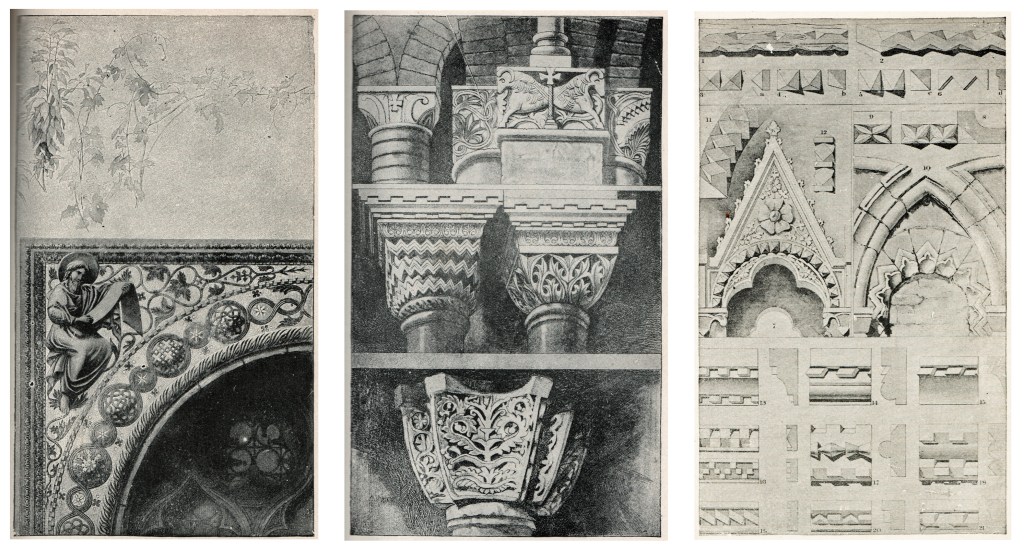
That person was of course, John Ruskin (1819-1900). With his book The Seven Lamps of Architecture of 1849, Ruskin laid out guiding principles for architects to follow. However, it was with his three volume set entitled The Stones of Venice (1851, 1853) that the British now had a focal point for their burgeoning empire to emulate. What made these books so compelling was not only Ruskin’s moralistic and intellectual arguments, but his rendering skills surpassed most artists and architects at that time.
Another of Ruskin’s influences was in being the critic who pushed the Pre-Raphaelite artists into the mainstream. Ruskin immediately appreciated their leanings toward the art of the late gothic/ early renaissance and their sense of style, color and texture would come to dominate British stained-glass and book illustrations well into the 1890’s.

Right: Title page to The Grammar of Ornament
Besides Ruskin, England also had Owen Jones (1809-1874) who, it can easily be argued, had an overall far greater impact than Ruskin in matters of design. Jones was a pioneer in too many fields to cover in this blog, but he would be instrumental in creating the intellectual foundations for both Pugin and Ruskin as early as 1835. Between 1836 and and 1842, he published Plans, Elevations, Sections, and Details of the Alhambra, the illustrations for which the printing process of chromo-lithography was invented. In 1851, Jones and Henry Cole were the driving forces behind the colors and displays of the Chrystal Palace in Hyde Park, the first World’s Fair. Suddenly, Britain had the entire world at its doorstep. With the success of the World’s Fair, Jones was tasked to create an encyclopaedia of design entitled The Grammar of Ornament as a textbook for the South Kensington School which was formed out of the profits generated by the Chrystal Palace. This immediately became the reference for artist, architects and designers and created a sophisticated understanding of color that continues to have timeless relevance.
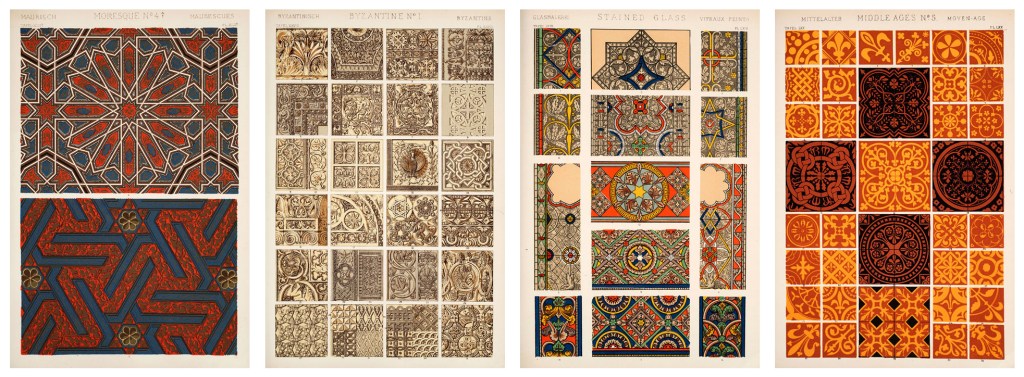
The entire book can be found at http://www.thegrammarofornament.com/
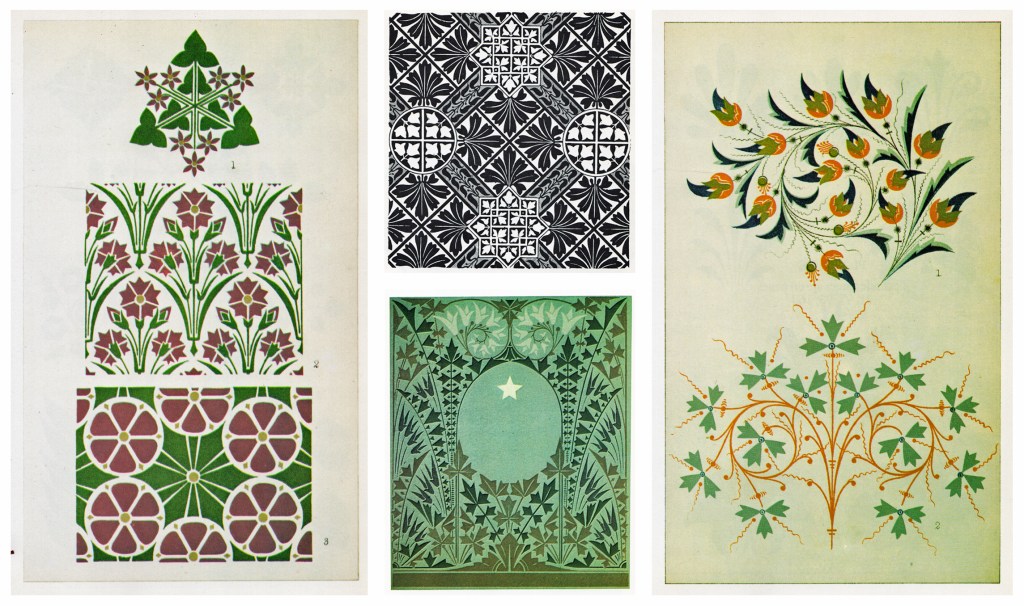
While Jones was putting together The Grammar of Ornament in the early 1850’s, he was also training students in his method of design and the one which would arguable have the greatest impact in the following decades would be Christopher Dresser (1834-1904). While The Grammar of Ornament was an encyclopaedia principally of man-made designs (my emphasis), Dressers’ early interests were in applying Owen Jones’ design ideas to the natural world. His studies in botany eventually led him to publish The Art of Decorative Design in 1862. Dresser would spend a lifetime designing, lecturing and publishing numerous books on design principles, but for the early 1860’s, and the early part of Thomas Wisedell’s training, it would be Dressers’ studies in designing from nature that would inform architects and designers of the period
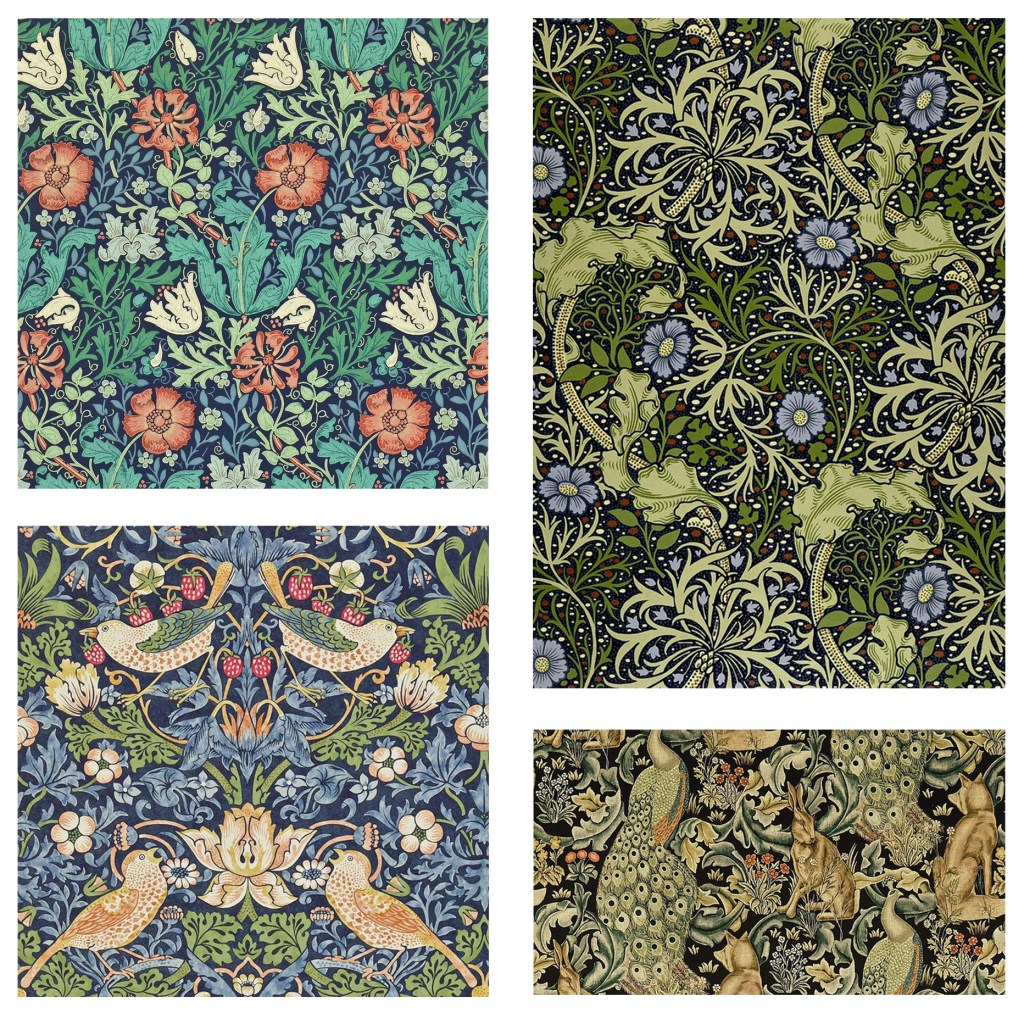
Another important designer that came to prominence in the early 1860’s was William Morris (1834-1896). Morris, Marshall, Faulkner & Co. was founded in 1861 and almost immediately became Britain’s leading decorative arts firm. Though they designed all types of domestic furnishings, it was through their designs for stained glass, wall papers and textiles where the influences of Jones, Dresser and the Pre-Raphaelites were easily discernible.
As for young Thomas Wisedell, this article only covers a small portion of the world of decorative arts that was going on around him. The 1860’s would prove to be an explosive period for British architecture and design. As a child he would have seen the 1851 World’s Fair and its later incarnation at Sydenham after 1854. He would have been to the South Kensington Museum which opened in 1857. He would have seen the International Exhibition of Industries and Art — a second world’s fair held in London in 1862. He would have witnessed the plethora of municipal buildings being constructed throughout the the United Kingdom in the late 1850’s throughout the 1860’s. He would have followed the famed competition for the Law Courts in London in 1866. He would have seen the Houses of Parliament upon its completion in 1867. He would have been exposed to the writings of Eugene-Emmanuel Viollet-le-Duc (1814-1879). And because of the status that R. J. Withers held, he would have met and been familiar with the leading British architects and designers of the day.
In the next article will be a list of projects (along with a few photos) designed within the office of Robert Jewell Withers between 1863 and 1868, the years of Thomas Wisedell’s apprenticeship.
 The Architecture of Thomas Wisedell