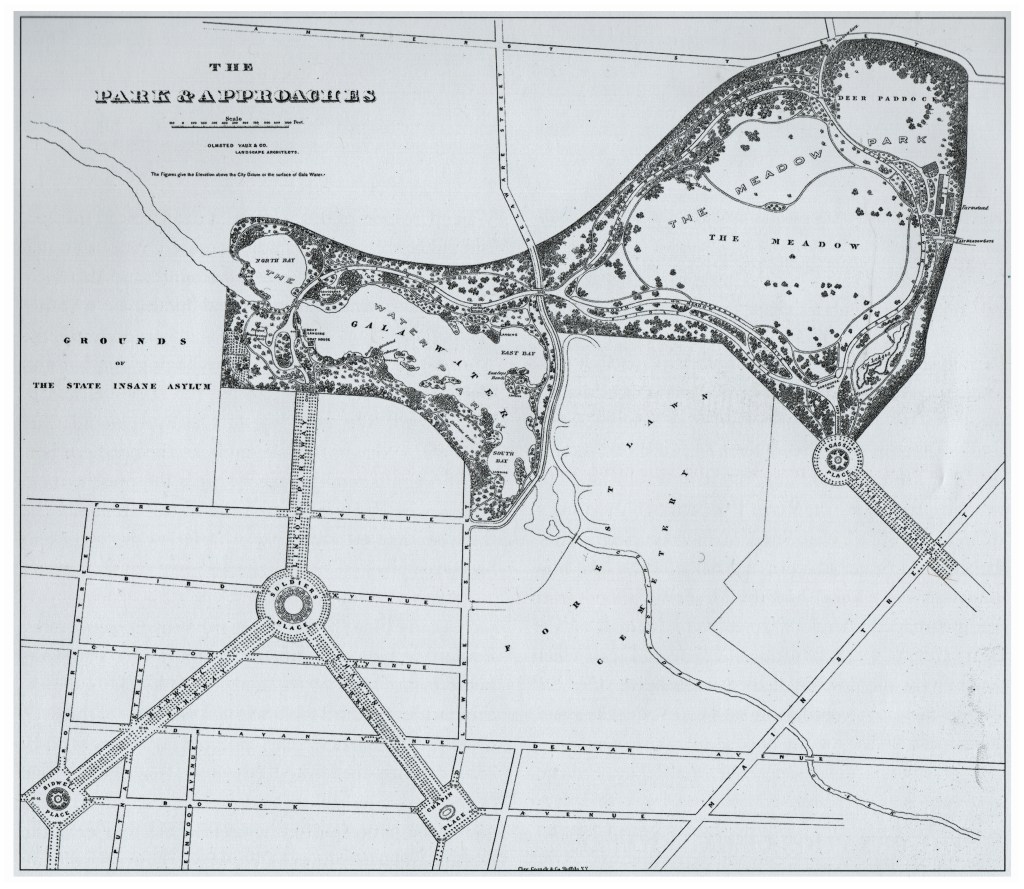
Delaware Park was the largest of three parks Olmsted & Vaux had designed for Buffalo. Construction began in 1869-1870 and in June of 1874, Frederick Law Olmsted was back in Buffalo giving recommendations for the next phase of the park’s construction. At the July 5th commissioners meeting, it was decided to procure plans and elevations of the necessary park structures from Calvert Vaux. Like Prospect Park (rather than Central Park), Delaware Park would have fewer architectural features creating an atmosphere of rest and relaxation as a respite from the city.
Over the next two months, Calvert Vaux and Thomas Wisedell completed the drawings for all of the Delaware Park’s principle buildings which included the Spire House (originally known as the Summer House and also known as the Spire-head House), the sheltered seats at the boat landing, the Boathouse, as well as the Farmstead (which may have been designed without Wisedell’s assistance).

The Spire-house was a 12-sided (dodecagon) building which took its name from distinctly conical roof. The building sat on a stone platform designed as a 35-foot wide octagon. The interior of the building measured 12-feet in diameter with an open truss ceiling which taped to almost 42-feet in height. The building was also designed to accommodate about 80 people with seating along 10 sides on the exterior and 8 sides on the interior. Though the color scheme was never specified, it probably used a similar palate of creamy tones accented with red, green and black, similar to Parade House as well as the Concert Grove House and Pavilion in Brooklyn.
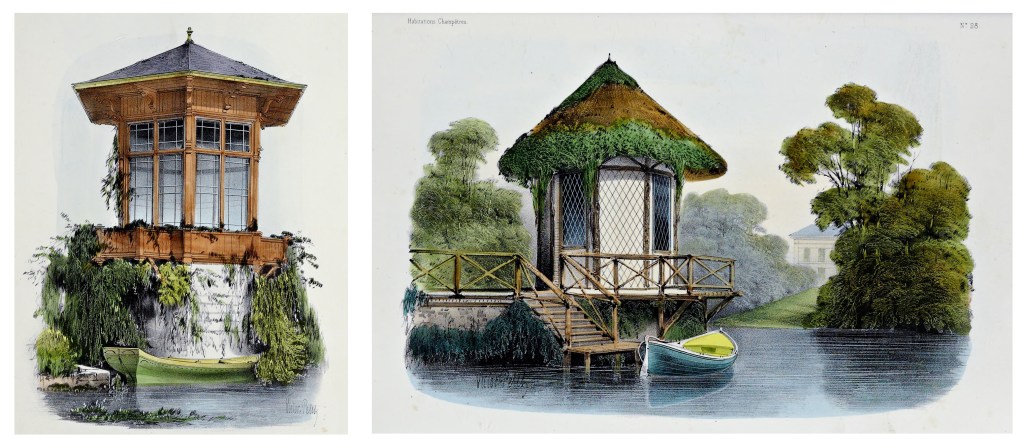
The influence of the contemporary European architecture had been alluded to in previous posts. Like much of Vaux’ work (before partnering with Olmsted) while working with Andrew Jackson Downing and then with Frederick Clarke Withers in the 1850’s, many of his landscape designs and buildings can be directly tied to earlier publication in France By Victor Petit (1817-1874), especially with Habitations Champetres, originally published in 1848, and again in 1855 and 1860.
Petit’s publications may have offered the inspiration for the idea of the building, but under Vaux and Wisedell, the effect is very different. Circular and multi-sides building have been constructed for thousands of years (see note 1 below), but the style of the Spire-house is clearly Indo-Islamic rather than French and building of 6, 8, 12 or 16 sides were quite common in Turkey under Byzantine and Seljuk rule.
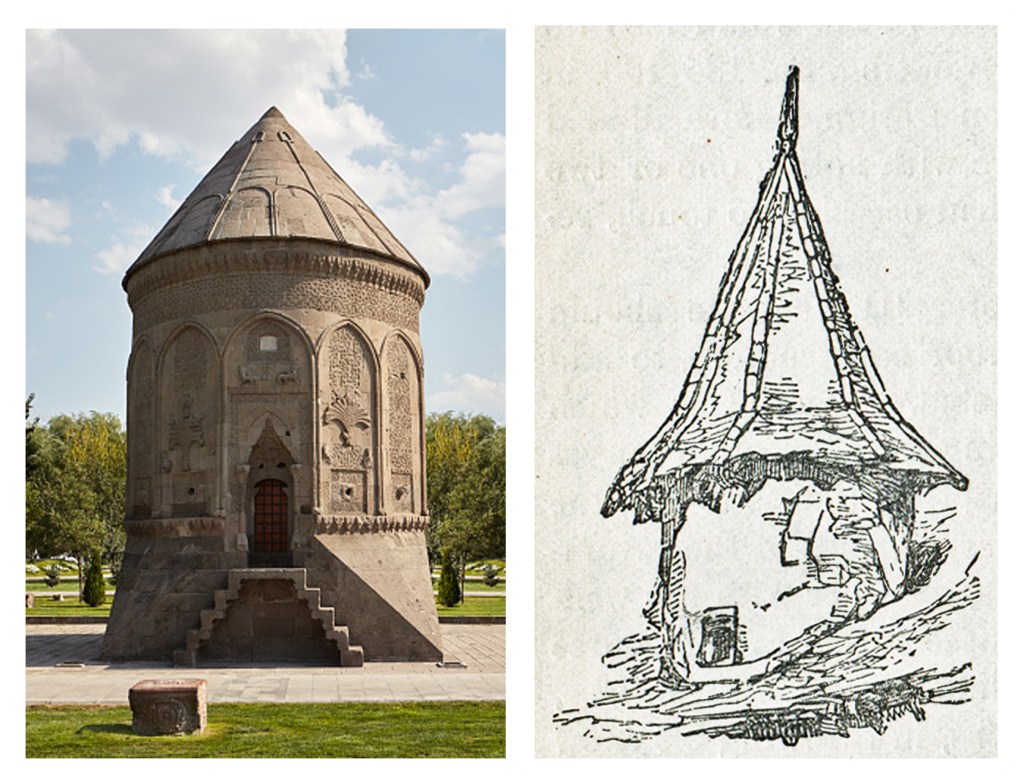
Right: Figure XXXVII from Stones of Venice, vol. I. Example of conical roof originally developed in China
which later became commonly used on German and Swiss domestic architecture.
This building predominately used multi-foiled arches at the entrance and windows in a style borrowed from the northern provinces of India, columns which reflected contemporary French designs and round dials set in square panels reflecting a Venetian and Mamluk precedence. John Ruskin’s Stones of Venice of 1851 may have been one of the more influential sources for Vaux and Wisedell. Though that publication is mostly credited for the revived interest in Venetian Gothic architecture, it was also instrumental in the Lombardic and Romanesque revivals as well as architecture and designs stemming from the Mamluk Sultanate of the 13th – 16th centuries. Especially in England the United States, all of these revivals (among others) were were happening simultaneously in the 1870’s.
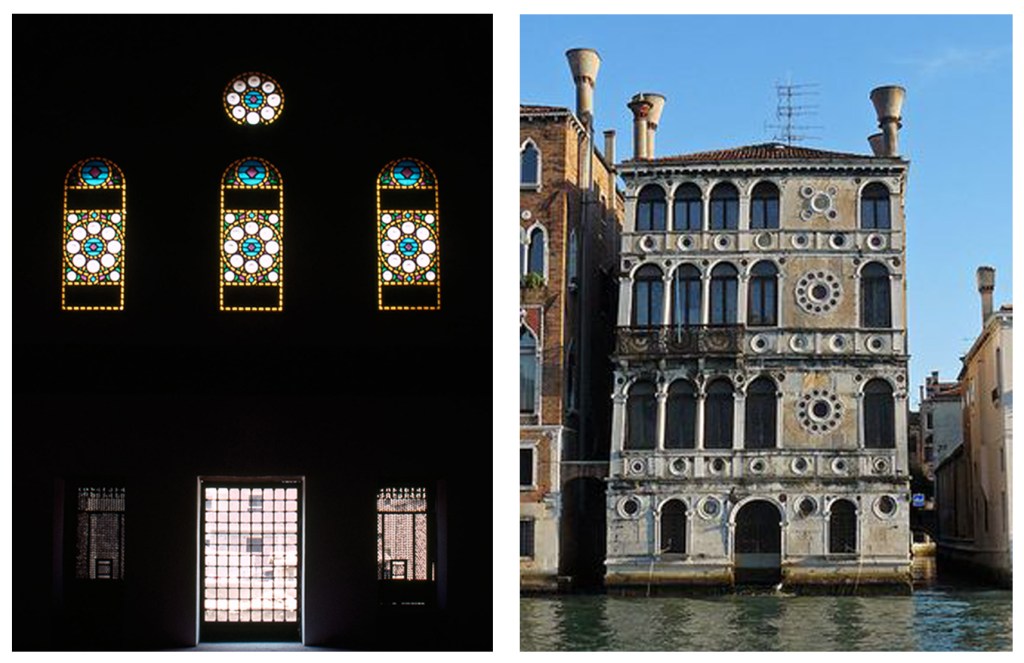
Right Palazzo Dario, Venice, 1479-86.
Ruskin had spelled out the Mamluk’s direct role with the development of Venetian Gothic as well as a crucial link between Europe and the Holy Lands. To underscore the Mamluk’s role, he used the Ca’ Dario, the 15th century palazzo where he stayed during his trip to Venice in 1846. Historian Deborah Howard has identified the 14th century palace of Sayf al-Din Beshtak al-Nasiri (Beshtak Palace) in Cairo as one of the most likely sources for the large dials on the Ca’ Dario’s facade. Giovanni Dario was a Venetian diplomat who had made trips to Cairo in 1473 and 1477 and then began remodeling his palazzo in 1479 (see note 2 below).
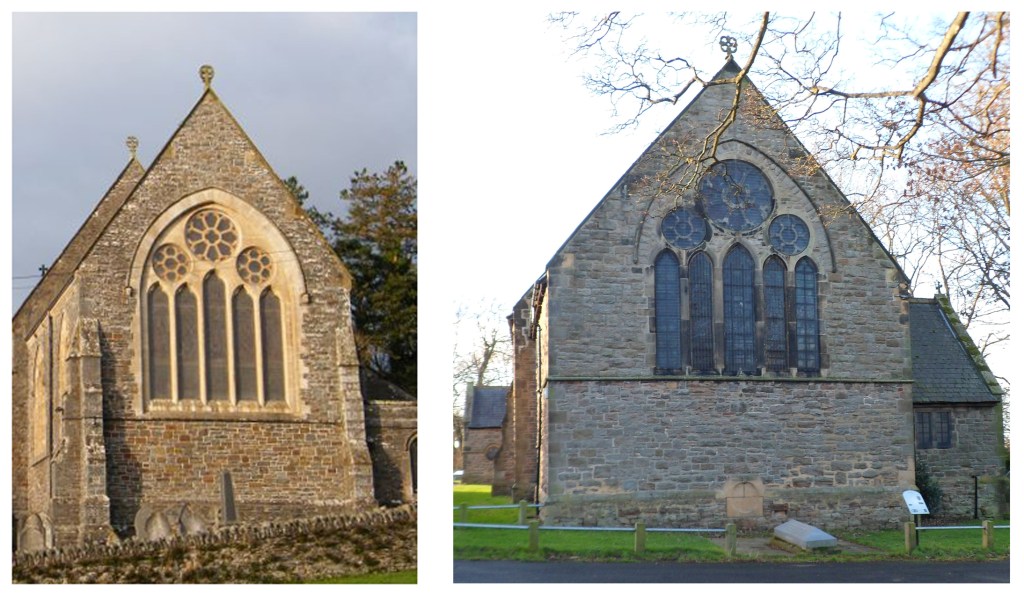
Right: Chancel window, St. Mary’s, Coxhoe, England (1867-1868).
As for Thomas Wisedell, the panels with a single circle surrounded by eight smaller circles was also a design feature in the windows of St. Peter’s, Lampeter and St. Mary’s, Coxhoe, both designed in 1867 while working with Robert Jewell Withers.
By late August and early September 1874, plans for the Spire-house were sent to Buffalo and on September 24th, Edward Hager (ca. 1841-1919) was awarded the contract for construct the Spire-house as well as the sheltered seats to be located at the boat landing. For some unknown reason, however, Hager lost the contract and the Spire-house was then constructed by John R. Monroe, who finished the building in early November at a cost of $1,000.00. The sheltered seating which was constructed by Hager, however, will be the subject of the next posting….
Note 1 — The oldest known octagonal building is the Temple of the Winds, erected around 100 b.c. in Athens, Greece. That building survives because it was constructed of stone, however, it is also known that there was much older wooden structures built in India and China (and probably elsewhere) that have not survived. Even the so-called neolithic and bronze-age “roundhouses” were often constructed with strait walls between the posts, forming a multi-sided building laid out in a circular manner.
Note 2 — The architect and builder of Dario’s remodeling is usually attributed to Pietro Lombardo (ca. 1435-1515) since the same circular dials are also found on Santa Maria dei Miracoli (The Miracle Church) designed by Lombardo and constructed between 1481 and 1489.
Further Reading:
- Annual Reports of the Buffalo Park Commissioners. 1869-1878 (Buffalo, N.Y.).
- The Papers of Frederick Law Olmsted. Volume VI: The Years of Olmsted, Vaux & Company 1865-1874 (Baltimore, MD: Johns Hopkins University Press, 1992).
- Darke, Diana, Stealing from the Saracens: How Islamic Architecture Shaped Europe (London: Hurst & Co., 2020).
- Hillenbrand, Robert, Islamic Architecture: Form, Function and Meaning (New York: Columbia University Press, 1994).
- Howard, Deborah, The Architectural History of Venice (New Haven and London: Yale University Press, 1988, 2004).
- Howard, Deborah, Venice and the East: The Impact of the Islamic World on Venetian Architecture 1100-1500 (New Haven and London: Yale University Press, 2000).
- Kowsky, Francis, R, editor, The Best Planned City: The Olmsted Legacy in Buffalo (Buffalo: The Burchfield Art Center, 1992).
- Kowsky Francis R., The Best Planned City in the World: Olmsted, Vaux, and the Buffalo Park System (Amherst and Boston: University of Massachusetts Press, 2013).
- Kowsky, Francis R., Country, Park & City: The Architecture and Life of Calvert Vaux (New York and Oxford: Oxford University Press, 1998).
- Petit, Victor, Habitations Champetres: Recueil de Maisons, Villas, Châlets, Pavillons, Kiosques, Parcs et Jardins (Paris : Monrocq Frères, 1848).
- Ruskin, John, The Stones of Venice vols. I, II, III (New York: Hurst & Co., 1851, 1853).
 The Architecture of Thomas Wisedell