
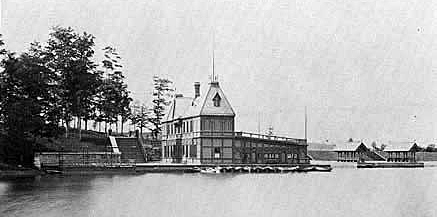
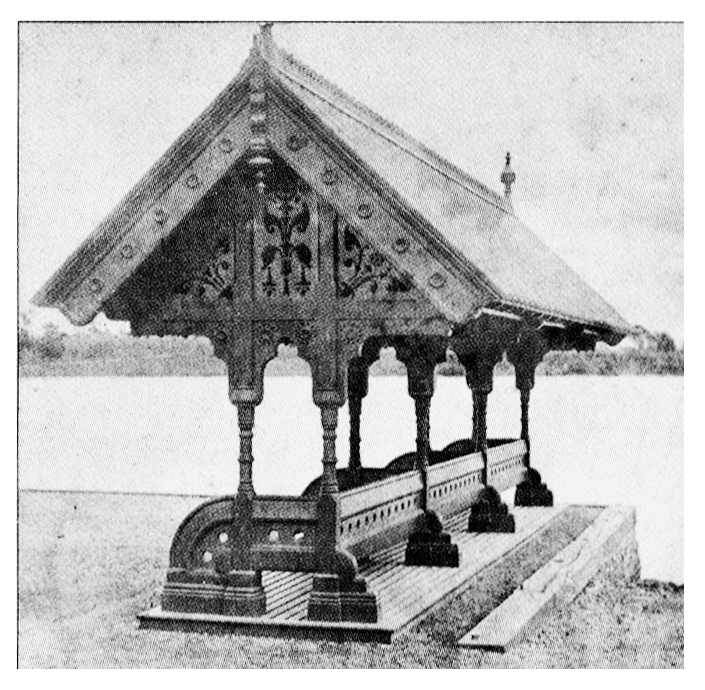
The overall design for the covered seats showed Vaux’ ideas while the detailing and ornamental work reflected the talents of Thomas Wisedell. The structure combined Indo-Islamic details with simple geometric patterns. The roof and eaves had been typical of Vaux’ domestic designs of the 1850’s with its basic, flat design punctured with simple, geometric shapes — examples of which were scattered throughout his book Villas and Cottages which was originally published in 1857. One of the earliest known examples of its use in in the house Vaux designed in 1853-54 for the painter Jervis McEntee, whose sister Mary married Calvert Vaux while the house was under construction in 1854.
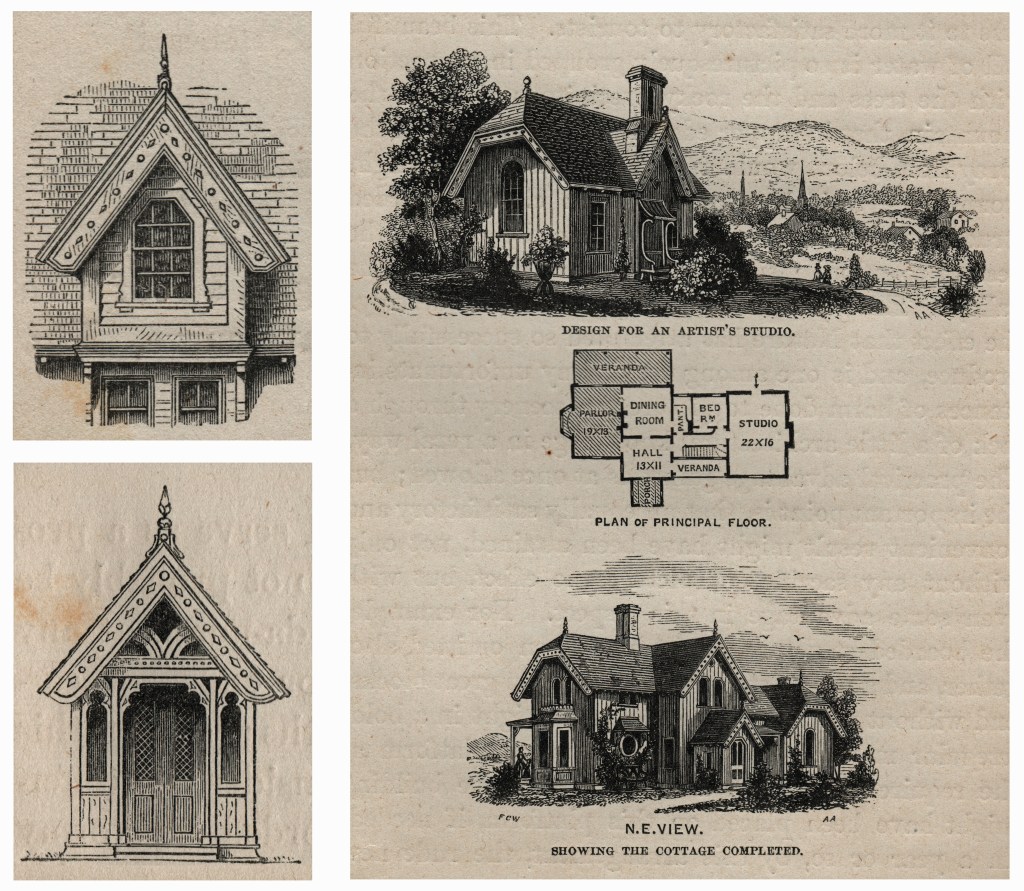
Right: Jervis McEntee House and Studio from Villas and Cottages.
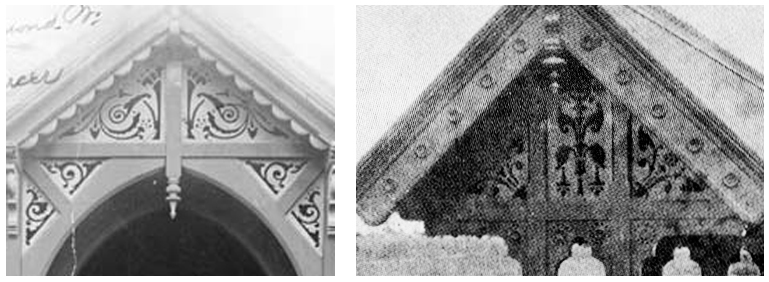
Right: Detail of gable from the covered seating, Delaware Park, Buffalo, N.Y. (1874).
Like the earlier Concert Grove House in Brooklyn, this gable also had rectangular and triangular panels with floral patterns cut with a scroll-saw. Though the idea and theme is the same, when comparing the scroll-work in the two structures, it is easy to see that the patterns used in the earlier Concert Grove house principally rely on lines and curves while the seating at Buffalo used, simpler, bolder patterns. There may be a couple reasons why Vaux and Wisedell made that change. First, the gable used on the Concert Grove House was much larger and higher, capturing a lot more natural light, thus the details of the pattern would show much better than the smaller and more intimate scale of that used in Buffalo. Second, Thomas Wisedell had clearly relied on Christopher Dresser’s The Art of Decorative Design of 1862 when designing the patterns for the Concert Grove House, and as the illustration below shows, was still referencing that book when designing the Spire-house. In 1873, a year before Vaux and Wisedell designed the covered seating for Delaware Park, Dresser published his follow-up entitled The Principles of Decorative Design where he expanded on the ideas laid out in his earlier tome, but added many more images showing bolder, silhouetted patterns.
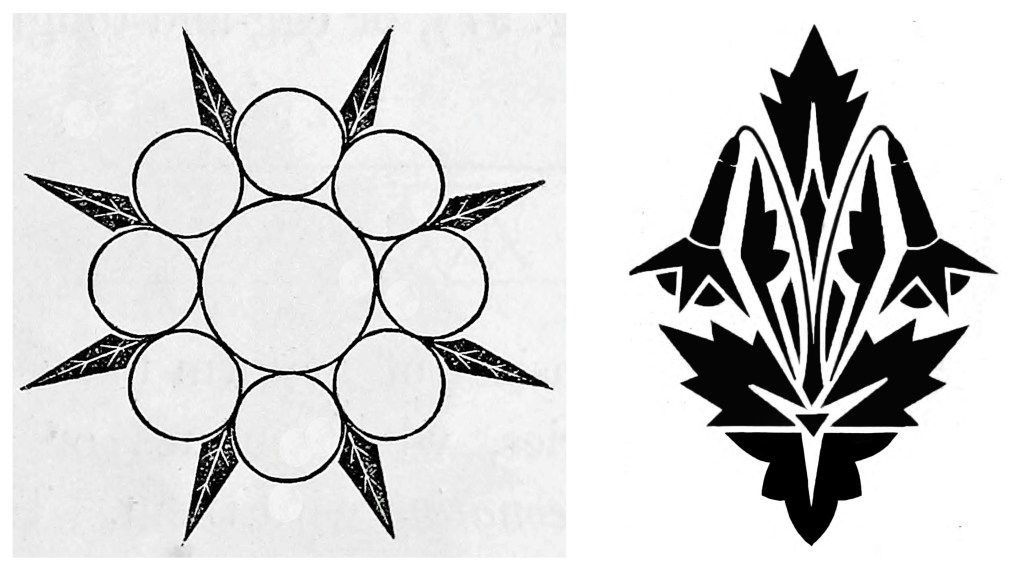
Right: Figure 16 from The Principles of Decorative Design by Christopher Dresser (1873).
Edward Hager was given the contract to erect the sheltered seats at the boat landing on September 24, 1874, though at that time he was still a relatively unknown carpenter/ builder. Hager had immigrated from Germany to Buffalo at the age of 10 around 1851. After serving in the Civil War, he began working independently, taking on small repair jobs (mostly for the city) and the park structures appear to be one of the largest contracts he had been awarded. In January of 1875, he was elected as the Commissioner of Public Buildings and it is easy to imagine that the immediate popularity of the sheltered seats (which had been completed in early December 1874 at a cost of $565.00) played a role in winning that election.
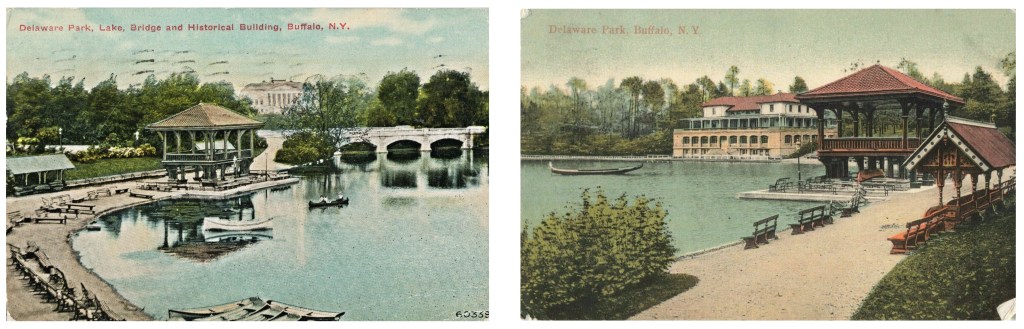
and new placement of the sheltered seats along the grassy knoll.
By 1891, the boat landing had to be rebuilt and enlarged and three years later, a large wooden bandstand was erected at the site. It was during that period when the sheltered seats were moved to the footpath where that sat until they were eventually demolished sometime it the 1930’s or 40’s.
The Boathouse which was designed at the same time as the sheltered seating and the Spire-house in Delaware Park will be the subject of the next post…..
Further Reading:
- Annual Reports of the Buffalo Park Commissioners. 1869-1895 (Buffalo, N.Y.).
- The Papers of Frederick Law Olmsted. Volume IV: The Years of Olmsted, Vaux & Company 1865-1874 (Baltimore, MD: Johns Hopkins University Press, 1992).
- Dresser, Christopher, The Art of Decorative Design (London: Day & Son, 1862).
- Dresser, Christopher, Principles of Decorative Design (London : Cassell, Petter, & Galpin, 1873).
- Kowsky, Francis, R, editor, The Best Planned City: The Olmsted Legacy in Buffalo (Buffalo: The Burchfield Art Center, 1992).
- Kowsky Francis R., The Best Planned City in the World: Olmsted, Vaux, and the Buffalo Park System (Amherst and Boston: University of Massachusetts Press, 2013).
- Kowsky, Francis R., Country, Park & City: The Architecture and Life of Calvert Vaux (New York and Oxford: Oxford University Press, 1998).
- Vaux, Calvert, Villas and Cottages. A Series of Designs Prepared for Execution in the United States (New York: Harper & Brothers, Publishers, 1857).
 The Architecture of Thomas Wisedell