
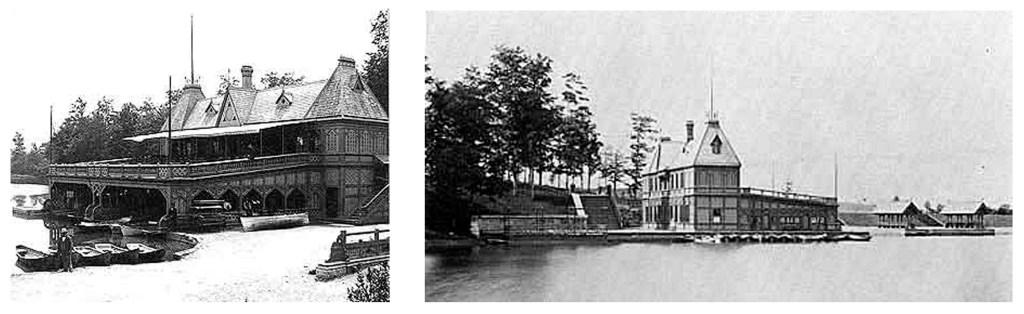
Within days of Edward Hager being awarded the contract to construct the sheltered seating at the boat landing as well as the original contract to erect the Spire-house, John R. Munroe (1828-1916) was awarded the contract to erect the Boathouse and refectory in Delaware Park. It was perhaps at that time when the park commissioners decided to have Munroe erect the Spire-house rather than the less experienced Edward Hager.
Munroe was originally from Lancaster, England where he had also apprenticed as a carpenter. Shortly after his marriage in 1850, he and his wife Mary along with his father and sister immigrated to Buffalo and two years later, he opened his own business. By the time he was hired to erect the boathouse, Monroe was operating one of the largest planing mills in Buffalo and has also erected some of the earliest cast iron building in the city. Just a few days before winning the boathouse job, Monroe (with J. R. Hamilton) had just completed a an extensive renovation of the Federal Building in Buffalo, a Renaissance Revival building which was originally constructed in 1854-55 to the designs of Ammi B. Young (1798-1874).
Vaux’ design was for a two-story refectory connected to a one-story boathouse. Like most of Vaux’ buildings from this period, the overall design of the building relied on French precedence while its detailing incorporated features that reflected Indo-Islamic patterns.
The two-story Refectory measured 16′ x 60′, was designed with pavilions at each end and a central gable containing a clock. The building was principally painted in a light olive tone with dark olive used to highlight the horizontal and vertical wood trim. Red and black was used to highlight more delicate features.
The ground floor was dedicated to services such as the kitchen, pantry, store rooms for the boatmen, and the men’s lounge. On the second floor were men’s and ladies lounges, a confectionery, and on open-air umbra that open out to the terraced rooftop over the boat house which measured 60′ wide and 35′ deep. The Refectory and boathouse officially opened on Saturday, July 3, 1875.
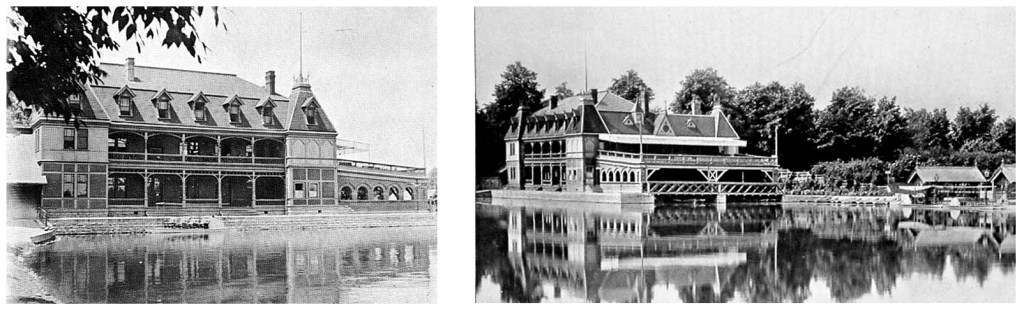
When the Boat house was originally constructed, it was designed principally to accommodate the needs of the boaters and refectory was actually more like a concession stand than an actual restaurant. Initially, it was thought that a restaurant would be built elsewhere in Delaware Park, but in 1883 it was decided to enlarge the Boat house with the addition of two dining floors, each measuring 30′ x 60′ which opened onto verandahs overlooking the lake. Plans by Eugene L. Holmes were accepted in the early summer and construction began on September 1st. The ground floor opened on Christmas day and the rest of the building was completed in April of 1884.
Though Calvert Vaux was not consulted for the addition to the Boat-house, Eugene Holmes clearly relied on the the building’s existing design which was basically continued throughout the addition. This was clearly not the first instance of E. L. Holmes being inspired by Vaux and Wisedell since just prior to designing the Boat-house addition, Holmes had completed the Lake View House (1882) at the Front in Buffalo as well as the new building for the Falconwood Club on Grand Island (1882-1883), both of which echo the ornate verandah found at the Parade House.
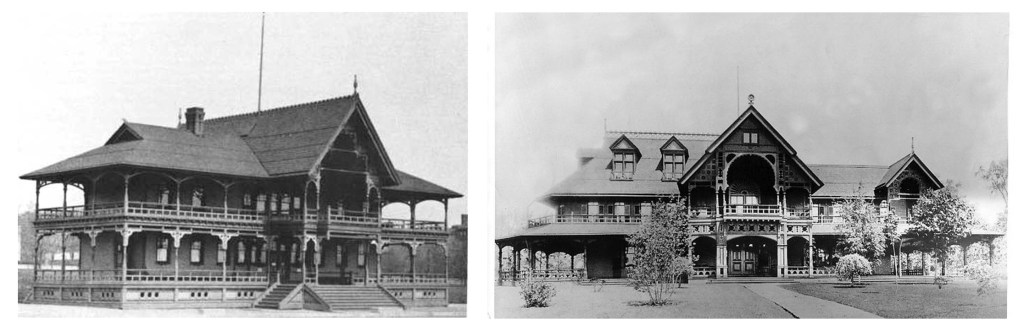
Though Calvert Vaux and Frederick Law Olmsted had dissolved their partnership in 1872, they continued to complete the numerous commissions for parks, gardens, cemeteries, and public buildings which were still in progress. Wisedell’s work in Buffalo would be the last park structures he would design as an associate architect under Olmsted & Vaux. Besides the work in Brooklyn and Buffalo, Wisedell also worked for Calvert Vaux principally as a draftsman while at the same time he also worked for Frederick Law Olmsted, especially as the principle designer of the architectural features surrounding the U. S. Capitol in Washington D.C. as well as the Washington monument in Baltimore, Maryland.
Further Reading:
- Annual Reports of the Buffalo Park Commissioners. 1869-1900 (Buffalo, N.Y.).
- The Papers of Frederick Law Olmsted. Volume IV: The Years of Olmsted, Vaux & Company 1865-1874 (Baltimore, MD: Johns Hopkins University Press, 1992).
- Kowsky, Francis, R, editor, The Best Planned City: The Olmsted Legacy in Buffalo (Buffalo: The Burchfield Art Center, 1992).
- Kowsky Francis R., The Best Planned City in the World: Olmsted, Vaux, and the Buffalo Park System (Amherst and Boston: University of Massachusetts Press, 2013).
- Kowsky, Francis R., Country, Park & City: The Architecture and Life of Calvert Vaux (New York and Oxford: Oxford University Press, 1998).
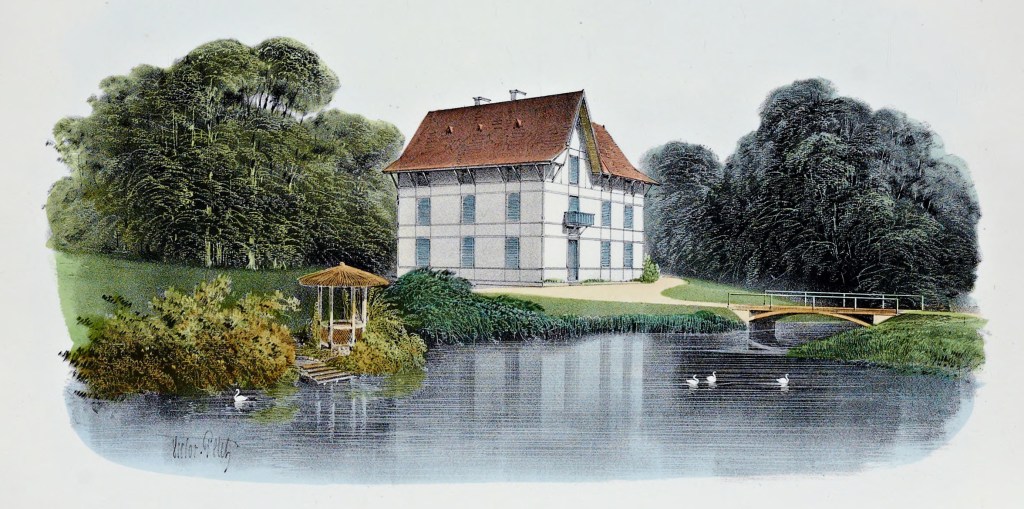
- Petit, Victor, Habitations Champetres: Recueil de Maisons, Villas, Châlets, Pavillons, Kiosques, Parcs et Jardins (Paris : Monrocq Frères, 1848).
 The Architecture of Thomas Wisedell