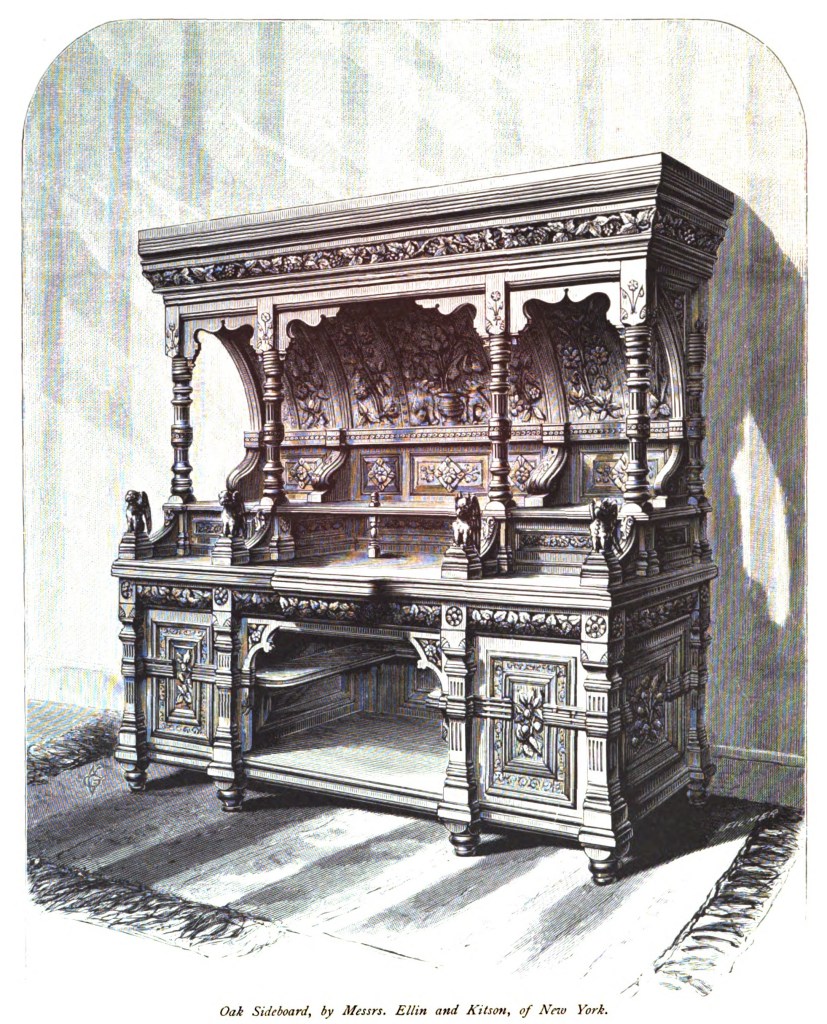
Besides the architectural competition for the Centennial Exposition, Thomas Wisedell had also designed a Jacobean/ Early Georgian style sideboard which was carved and constructed by the firm Ellin & Kitson and displayed with contemporary furniture at the fair. It was Robert Ellin’s firm who had also carved the stonework at the Concert Grove in Prospect Park which had been designed by Wisedell between 1870 and 1872 and completed in 1874.
The inspiration for the sideboard’s design may possibly be found in Christopher Dresser’s book Principles of Decorative Design, published in 1873. Dresser illustrated a Gothic-Revival styled sideboard designed by A.W.N. Pugin as an example of the proper way to incorporate carved panels into furniture. Though Dresser was not a fan of carved ornament, he did feel that it was best used in recessed, decorative panels while the structural members should be minimally decorated.
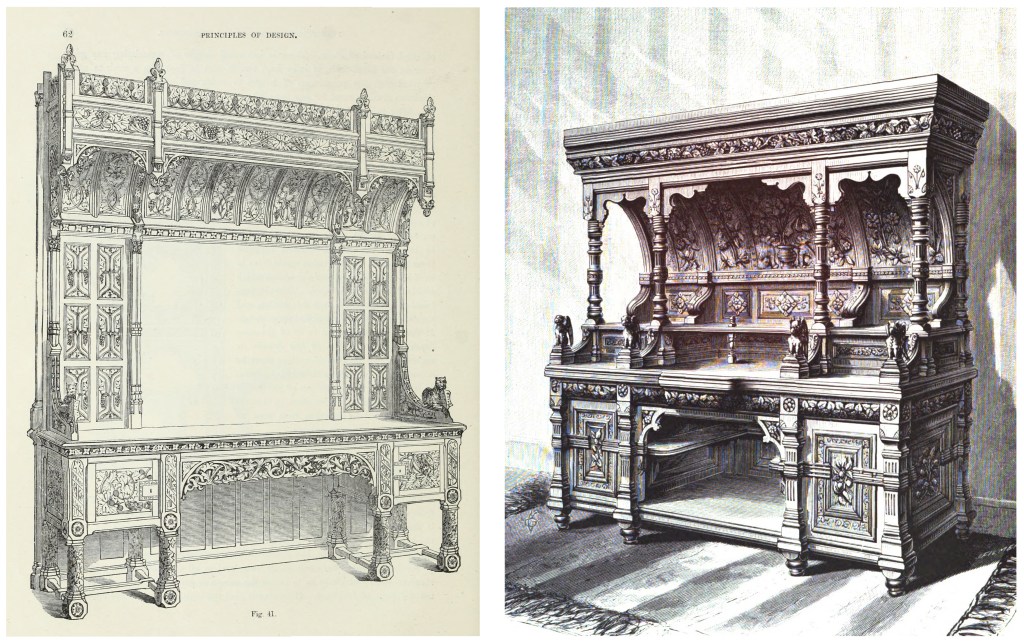
Right: Sideboard designed by Thomas Wisedell, ca. 1874.
Its inspiration from Pugin is quite clear, but rather than Gothic, Thomas Wisedell utilized turning, carving, incising and planing in a manner that was clearly meant to display a variety of styles and techniques. With that, he also displayed an array of stylistic features showing Dresser’s use of flowers, grasses and vases in the upper panels and leafy borders and panels carved with fruits and garlands in high relief in the lower panels showing his reliance on the Baroque designs of Grinling Gibbons (1648-1721). To this day, Gibbons is still considered one of the greatest designers and carvers of the early Georgian or Baroque period in England. Both Thomas Wisedell and Robert Ellin would have been familiar with Gibbons’ extensive work in England. Curiously, shortly before Thomas Wisedell began designing the musical tribute panels at the Concert Grove in Prospect Park, Gibbon’s work at Petworth House in Sussex, England was being restored in the late 1860’s and early 1870’s by the architect Anthony Salvin.
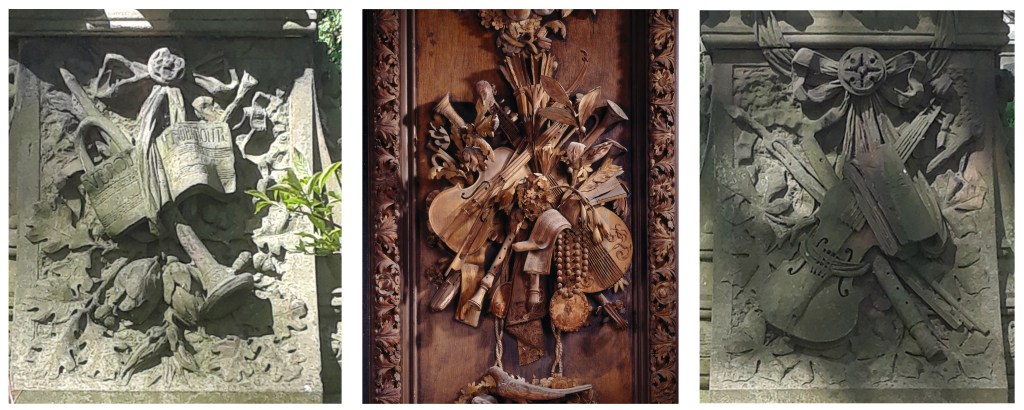
Center: Musical panel from Petworth House designed and carved by Grinling Gibbons, ca. 1688-91.
Further Reading:
- Dresser, Christopher, Principles of Decorative Design (London, Paris & New York: Cassell, Petter & Gilpin, 1873).
- Esterly, David, Grinling Gibbons and the Art of Carving (London: Victoria and Albert Museum, 2013).
- Ferris, George T., Gems of the Centennial Exposition: Consisting of Illustrated Descriptions of Objects of an Artistic Character, in the Exhibits of the United States, Great Britain, France, Spain, Italy, Germany, Belgium, Norway, Sweden, Denmark, Hungary, Russia, Japan, China, Egypt, Turkey, India, etc., etc., at the Philadelphia International Exhibition of 1876 (New York: D. Appleton & Co., 1877).
- Oughton, Frederick, Grinling Gibbons and the English Woodcarving Tradition (Fresno, CA: Linden Publishing, 1999).
 The Architecture of Thomas Wisedell