In March of 1873, Congress voted to extend the size of the grounds surrounding the U. S. Capitol building and Edward Clark, the Architect of the Capitol, was asked to design a plan for the expanded grounds. Clark immediately declined, stating, “not having any practice or pretensions to skill as landscape gardener, I earnestly recommend that a first-class artist is this line may be employed to plan, plant, and lay out these grounds.”
Shortly after Clark declined to redesign the Capitol grounds, Vermont Senator Justin S. Morrill (1810-1898) contacted Frederick Law Olmsted, asking for a plan to improve the recently enlarged grounds. Later that year, Olmsted visited Washington and immediately began focusing on the grounds on the east side of the Capitol as well as the problematic positioning of the Capitol and the sloping hill to the building’s west. Olmsted was back in Washington in January 1874 when he presented ideas about smoothing out the grounds on the east side and creating a large open space in front of the Capitol. To the west, he recommended increasing the size of the terrace, bringing it into proportion with the grandeur of the building, especially since the building had recent addition of the house and senate wings as well as the massive dome. In terms of planning, Olmsted opted against a single perspective with formal gardens common in European palaces, rather, Olmsted felt that the landscape on each side should create grand vistas from multiple vantage points through the use of circular and diagonal streets and paths in the landscape.
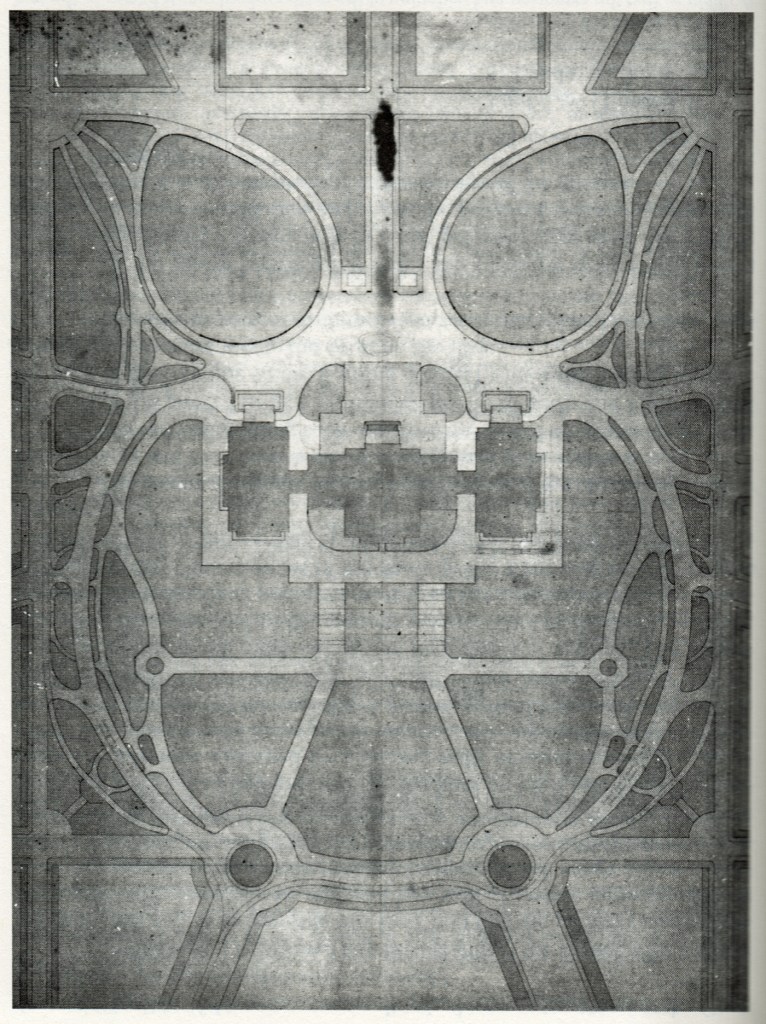
Olmsted was formally hired in March 1874 and after several trips to Washington, he presented an initial, skeletal plan with general recommendations which were approved by Congress on June 23, 1874 with an appropriation of $200,000. On the east plaza (top of the rendering), Olmsted planned for new lighting, fountains and seating facing the Capitol building. On the western grounds (bottom of the rendering) were to be stone perimeter walls. What may have been the most important part of this plan though was his idea to increase the width of the western terrace from thirty to fifty feet wide while adding two broad staircases leading to a new carriage entrance. This gave the building formal entrances on each side with the intention of focusing the building towards the west rather than the east, giving greater emphasis to the National Mall which had been landscaped by Andrew Jackson Downing and Calvert Vaux in the early 1850’s.
The following month (July 1874) Olmsted was back in Washington with Thomas Wisedell. Since Thomas Wisedell had proven himself quite effective in designing stonework for Prospect Park and Washington Park in Brooklyn, Olmsted naturally turned to him to render plans and design architectural features while he hired George Kent Radford as the project’s consulting engineer and placed John A. Partridge in charge of implementing the plan.
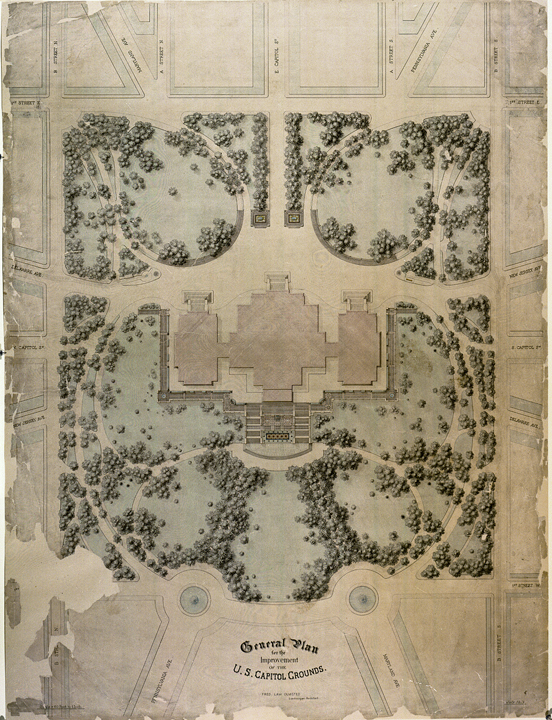
Rendering by Thomas Wisedell, September 1874.
During July and August 1874, Thomas Wisedell created all of the drawings for the architectural features to be placed in the east plaza while he also worked out the plans for a new terrace which would wrap around the north, south and west sides of the Capitol. With most of those designs in place by late August, he then turned his attention to refining Olmsted’s ideas into a single plan which Olmsted then presented to Congress in January 1875.
Numerous postings to follow will focus on the architectural features designed by Thomas Wisedell for the east plaza.
Further Reading:
- The Papers of Frederick Law Olmsted. Volume VII: Parks, Politics and Patronage 1874-1882 (Baltimore, MD: Johns Hopkins University Press, 2007).
- Brown, Glenn, History of the United States Capitol vols. I and II (Washington, D.C.: U.S. Government Printing Office, 1900, 1903).
 The Architecture of Thomas Wisedell