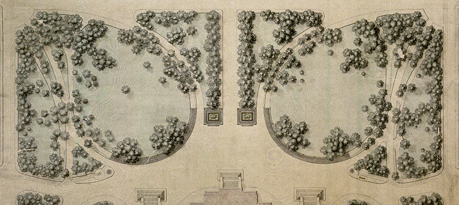
While Thomas Wisedell was busy preparing the map of Olmsted’s plan in the summer and fall of 1874, he was also designing the architectural features for the plaza on the east side of the Capitol building. During that period, existing buildings were removed and work had begun on regrading the property and laying gas and sewer lines. Though there are very few records to date Wisedell’s designs, much can be inferred from the progress of construction recorded in the congressional minutes.
A detail of Olmsted’s plan shows areas shaded in dark grey which highlighted new architectural features including two large rectangular fountains in the center with semi-circular seating lit by ornamented bronze lampposts. Though quite hard to discern, what is also on this plan were six massive, granite lamp-piers used to light the Capitol building at night, two flag posts and an iron settee.
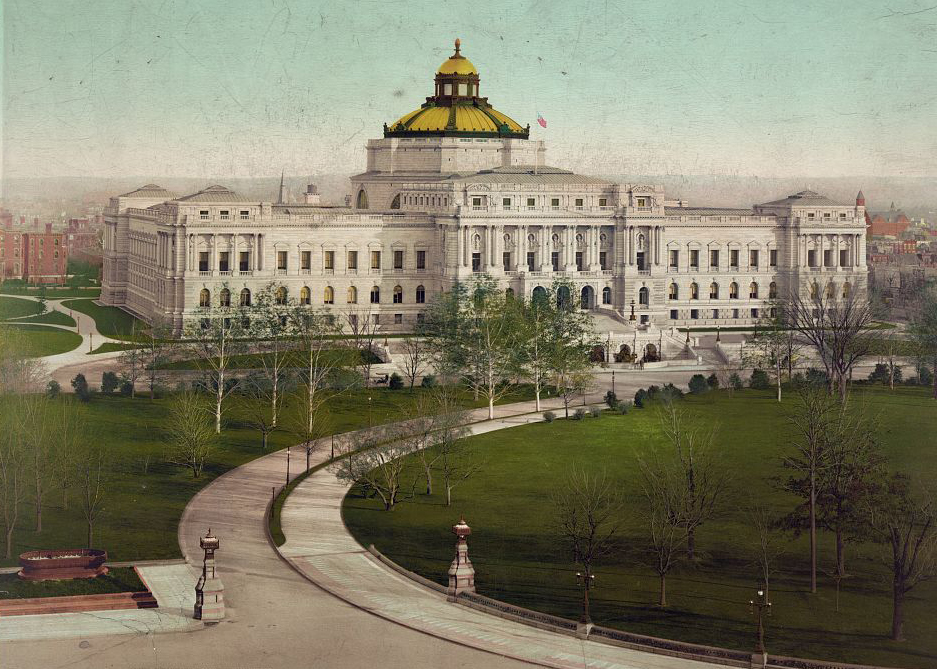
The lamp-piers stood thirteen feet, three inches tall and were constructed of alternating courses of bluestone and polished Passamaquoddy red granite capped with large, bronze lamps. This was a unique, biotite granite embeded with quartz and came from the newly organized Maine Red Granite Company located near Red Beach, Calais, Maine at the mouth of the St. Croix River in Passamaquoddy Bay, a smaller bay within the large Bay of Fundy. That company was also created with the most up-to-date equipment and was soon polishing granite for other nearby quarries. Robert Ellin was one of the company’s founders and it was his firm, Ellin, Kitson & Co., who was hired to construct the lamp-piers. Since the Maine Red Granite Company was created in 1874 and incorporated in January of 1876, the lamp-piers and fountains (which will be covered in a later post) were actually some of the first objects erected from that building material. With the lamp-piers in place by the summer of 1876, they may have played a role in the Maine Red Granite Company being awarded a prize for this material at the Centennial Exposition of 1876 in Philadelphia.
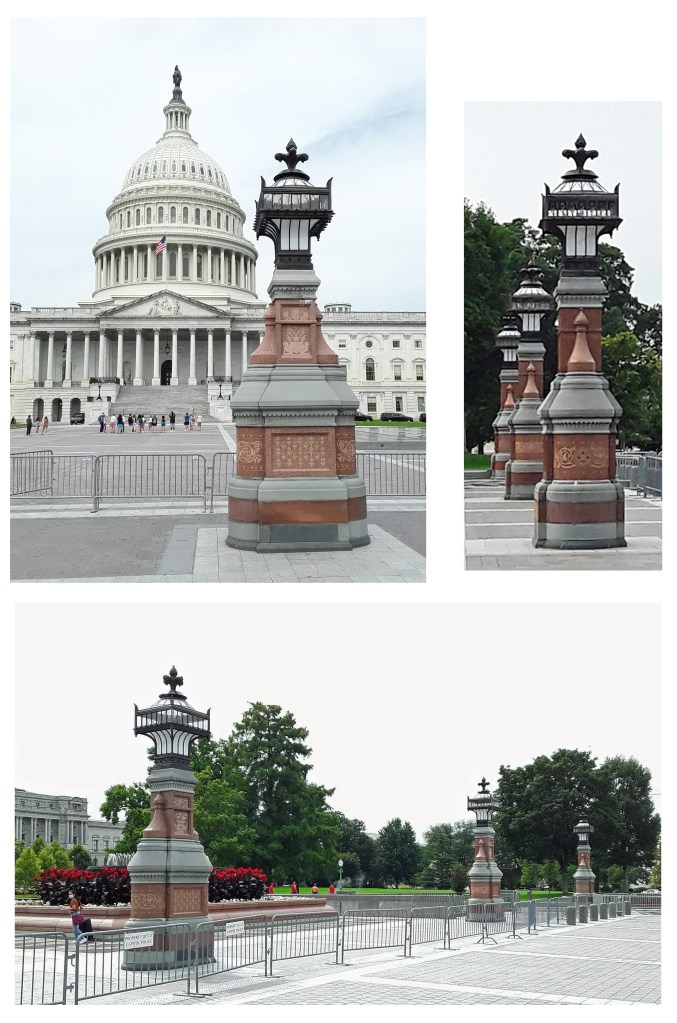
The lamp-piers were designed in an original blend of gothic and Indo-Islamic influences and etched with natural motifs reminiscent of carvings from Northern India as well as the designs of Christopher Dresser and Charles Eastlake. Many of the individual parts reflect earlier designs found in Brooklyn’s Prospect Park, such as the buttress piers on the Nethermead Arches. Though there are clear influences from Calvert Vaux, the design of lamp-piers clearly shows Thomas Wisedell developing a unique style by synthesizing the major design trends of the early-mid 1870’s.
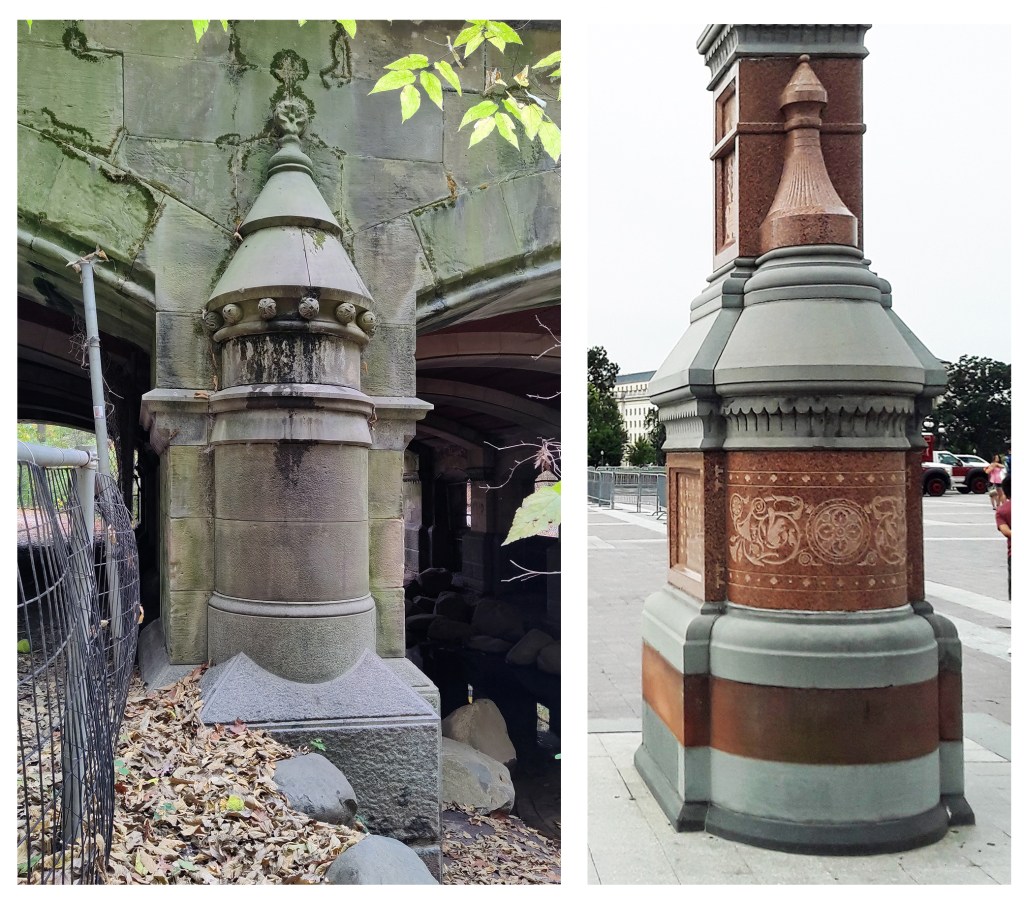
Right: Buttress on the Lamp-piers, Washington, D.C.
Further Reading:
- The Papers of Frederick Law Olmsted. Volume VII: Parks, Politics and Patronage 1874-1882 (Baltimore, MD: Johns Hopkins University Press, 2007).
- Brown, Glenn, History of the United States Capitol vols. I and II (Washington, D.C.: U.S. Government Printing Office, 1900, 1903).
- Keim, DeBenneville Randolph, Keim’s Illustrated Handbook. Washington and Its Environs: A Descriptive and Historical Hand-Book to the Capitol of the United States of America. 6th ed. (Washington, D.C.: DeB. Randolph Keim, Publisher, 1875).
- Weeks, Christopher, AIA Guide to the Architecture of Washington, D.C., 3rd ed. (Baltimore and London: Johns Hopkins University Press, 1994).
 The Architecture of Thomas Wisedell