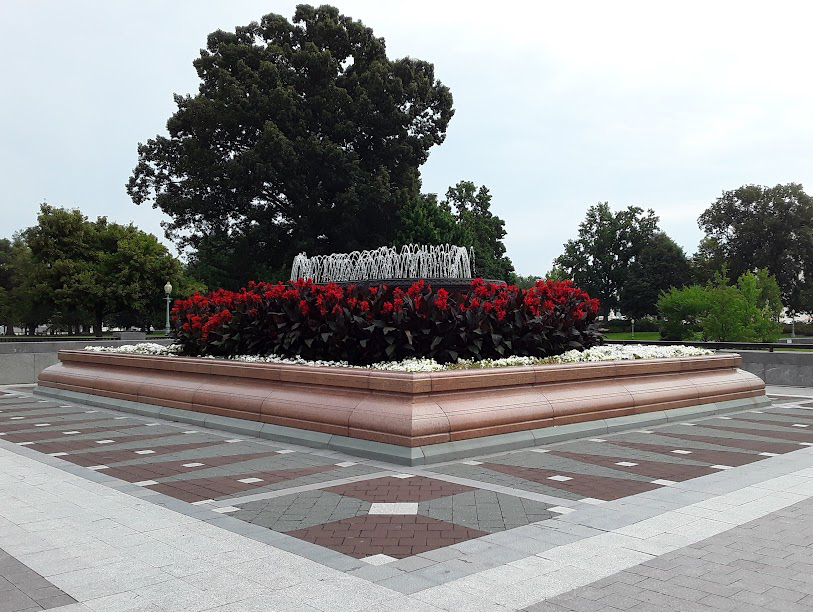

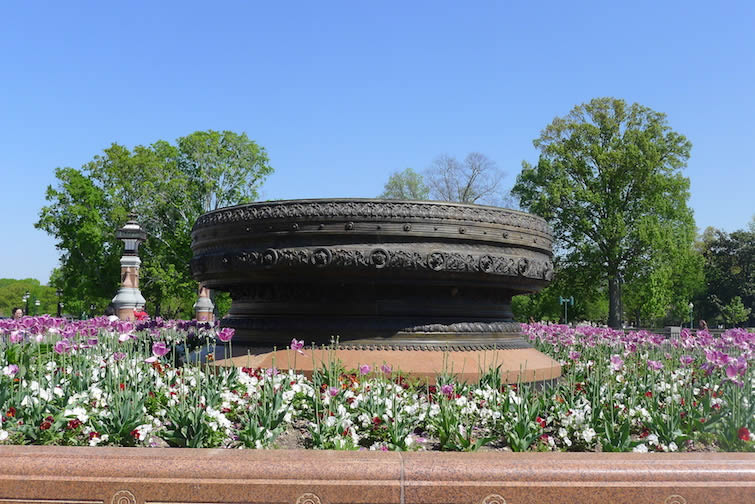
Near the granite lamp-piers are a pair of bronze fountains which sit in the center of red, Passamaquoddy granite planters, each measuring 30′ x 40′. The bronze fountains were designed as rectangular pedestal bowl with rounded ends, also known as a capsule shape. Though the bold shape is quite impressive, the stacked layers of ornament truly give the fountains their character. Fountains had been designed for Olmsted & Vaux’ various parks, principally by Jacob Wrey Mould and/ or Calvert Vaux. These, however, are a completely unique design and show Thomas Wisedell developing his own distinctive sense of ornamentation.

Like previous park structures in Brooklyn and Buffalo designed by Wisedell, the fountains also combined designs from India with the Baroque carvings of Grinding Gibbons and contemporary British designers like Owen Jones and Christopher Dresser. What is different with the fountains, however, is that their style was created by stacking horizontal courses, with no two courses being repeated. This way of designing was common in the tombs and temples of Northern and Western India which had been well documented in the preceding decades. Though Thomas Wisedell would have been fully aware of that documentation, the design sources appear to stem from his readings of Owen Jones’ The Grammar of Ornament.
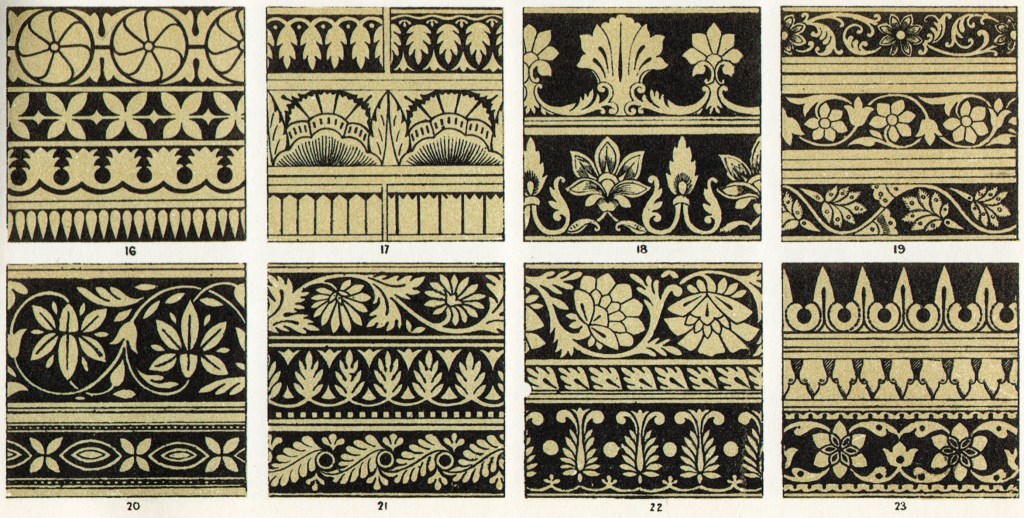
Jones had compiled most the patterns for the Grammar of Ornament during the 1851 World’s Fair at the Chrystal Palace in London and also at the 1855 Exposition Universelle in Paris. In that book, Jones had published about 175 designs of Indian and Hindu origin. However, rather than publishing archeological details, Jones drew from contemporary designs from India used in cast iron, brass vessels, rugs and fabrics which had been displayed at the two fairs. Besides the motifs inspired by Indian sources, Wisedell also incorporated a simple wave pattern which was illustrated with Greek design — a pattern which Owen Jones had copied from Greek vases in the collection of the British Museum.
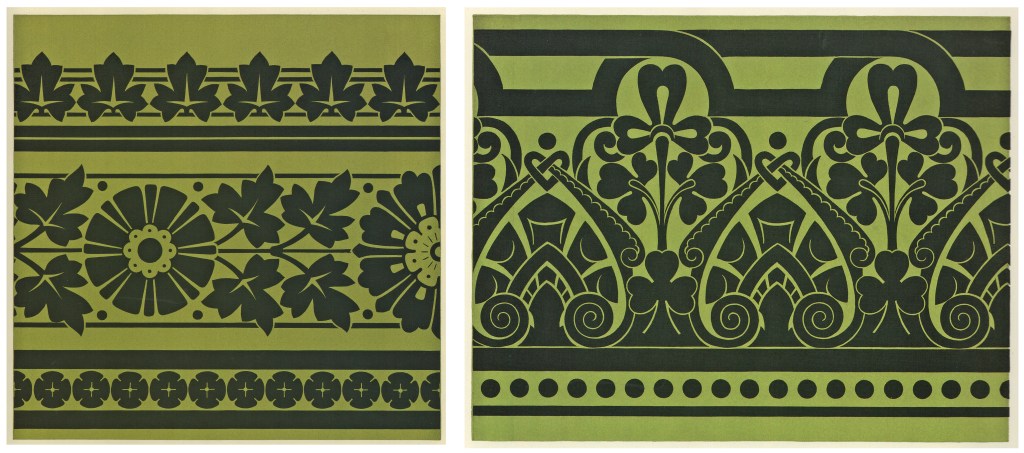
Besides Owen Jones, Thomas Wisedell also seems to have gleaned ideas from Christopher Dresser’s Studies in Design, a book that was published in 1874, just as Thomas Wisedell was designing the fountains.
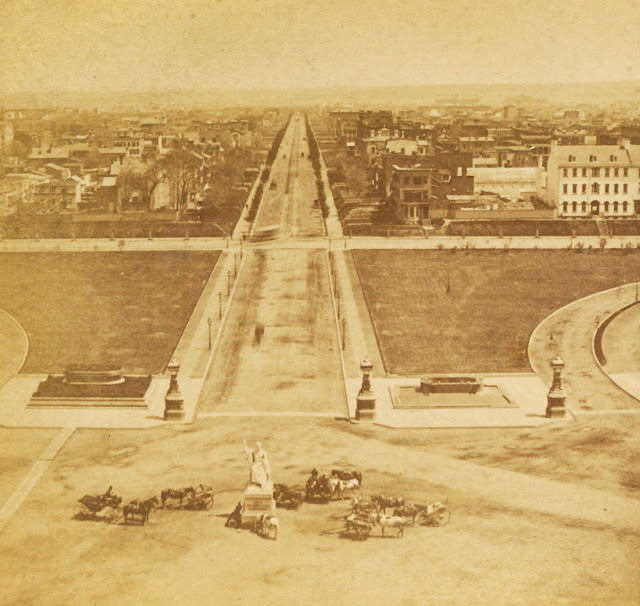
Capitol grounds, ca. 1875. Note the fountain still under construction.
The firm of Janes & Kirtland of New York was hired to cast the bronze fountains and the bronze caps on the lamp-piers in the spring of 1875 and those features were completed later that year. Both Frederick Law Olmsted and Thomas Wisedell were already familiar with Janes & Kirtland since they had also cast the iron and bronze features designed in both Central Park and Prospect Park. That firm had also created all of the cast iron parts used to erect the dome on the U. S. Capitol. Though much of the construction for the fountains had occurred in 1875, delays from the granite supplier had left the northern fountain unfinished putting Edward Clark in the position of redirecting the funds that had been earmarked for that fountain towards other projects. In April, 1876, Congress appropriated an extra $20,000 in order to expedite the completion of east plaza in anticipation of increased tourism in Washington, D.C. that would coincide with the Centennial Exposition in Philadelphia which was set to open on May 10, 1876.
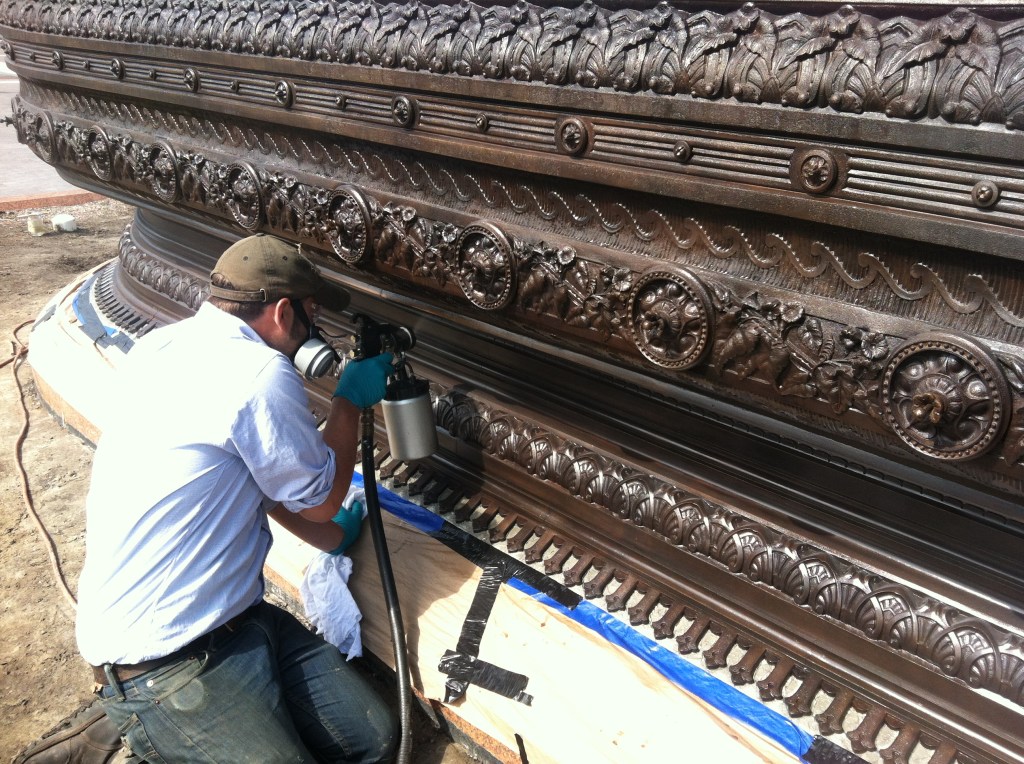
In 2020, Evergreene Architecural Arts had finished a complete restoration of the fountain and lamp-piers as well as other architectural features on the East Plaza designed by Thomas Wisedell which will be the topic of the following post.
Acknowledgement:
- Photos and a description of the fountains’ restoration can be found at https://evergreene.com/projects/bronze-olmsted-fountains-conservation/
Further Reading:
- Documentary History of the Construction and Development of the United Stated Capitol Building and Grounds (Washington, D.C.: The Government Printing Office, 1904).
- The Papers of Frederick Law Olmsted. Volume VII: Parks, Politics and Patronage 1874-1882 (Baltimore, MD: Johns Hopkins University Press, 2007).
- Brown, Glenn, History of the United States Capitol vols. I and II (Washington, D.C.: U.S. Government Printing Office, 1900, 1903).
- Dresser, Christopher, Studies in Design (published n parts between 1874 and 1876).
- Jones, Owen, The Grammar of Ornament (London: Day & Son, 1856).
- Keim, DeBenneville Randolph, Keim’s Illustrated Handbook. Washington and Its Environs: A Descriptive and Historical Hand-Book to the Capitol of the United States of America. 6th ed. (Washington, D.C.: DeB. Randolph Keim, Publisher, 1875).
- Weeks, Christopher, AIA Guide to the Architecture of Washington, D.C., 3rd ed. (Baltimore and London: Johns Hopkins University Press, 1994).
 The Architecture of Thomas Wisedell