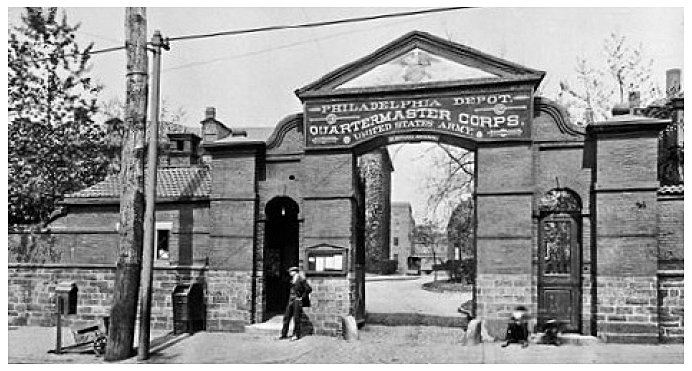
In May of 1875, Quartermaster-General Montgomery Meigs (1816-1892) asked Frederick Law Olmsted to consult on improving the grounds and buildings as well as the wall sand gates at the Schuylkill Arsenal located below South Street on Grey’s Ferry Road in Philadelphia. Olmsted and Meigs had previously worked together planning and constructing the Quartermaster’s depot at Jeffersonville, Indiana (1873-1874) as well as planning the terrace at the U.S. Capitol (1874-92).
The Schuylkill Arsenal was founded in 1799 and constructed between 1800 and 1806 and is most famously remembered for outfitting the Lewis and Clark expedition with supplies. By the late 1820’s, its function had shifted from storing arms and provisions to functioning as the largest facility in the United States for manufacturing military uniforms. During the Civil War, the facility employed about 10,000 seamstresses, with most of the labor consisting of civilian women. By the mid-1870’s, Meigs had recognized that most of the facility was aging rapidly with many of the building ill-suited for their purposes.
For the grounds, Olmsted relied on on the civil engineering skills of George Kent Radford and the landscape designs of Jacob Weidenmann while Thomas Wisedell was tasked with measuring and inspecting all of the architectural features. Rather than Montgomery Meigs, however,the entire project was overseen by Capt. John F. Rogers, the officer in charge of the arsenal.
To get the project underway and to get initial appropriations from Congress, Capt. Rogers had asked Thomas Wisedell to submit various plans for new gates at the arsenal’s north (main) entrance. The brick piers and arched pedestrian were already existing and appear to have been designed by Montgomery Meigs, perhaps in the 1860’s. Though it is unknown what those gates looked like, it is known that Capt. Rogers received multiple plans from Wisedell on June 28th, 1875. “Gate No. 3” was selected and it was described as having initials “Q.M.D.” on the left gate and “U.S.A.” on the right. Thomas Wisedell was soon asked to design new gates for the south entrance as well, though neither descriptions nor photos of those gates have surfaced.
Between June and October of 1875, Wisedell completed plans for renovating the two captains’ houses, as well as the gate lodge. Though the full extent of Wisedell’s designs are unknown, a description of Wisedell’s plans for the smaller house (known at that time as Capt. Hull’s residence) exists in the Library of Congress archives. For that project, Wisedell was asked to add a front verandah and create an entrance vestibule which would also have a combined coat and wash room. Most of the work on that house was done on the first floor with the addition of a new china closet and pantry which was accessible to the entrance hall, kitchen stairs and dining room. Off the dining room was to be an additional water closet accessible from both inside and out.
The gate lodge was to be outfitted with a new fireplace and new roof capped with Spanish tiles. The most conspicuous aspect of Wisedell’s plans included adding a roughly five-foot high brick wall on top of the existing stone wall which had been constructed between 1800 and 1806 (much of which still remains).

Besides the architectural plans, Wisedell was also tasked with rendering Olmsted’s landscape plans for the arsenal’s grounds — a plan which has unfortunately been lost. That plan was presented on July 6th, 1875 along with Olmsted’s proposed budget of $25,000 for the entire project. As for Thomas Wisedell’s share of that budget, $4,000 for for remodeling the larger residence for Capt. Rogers; $2,000 for Capt. Hull’s residence, and $2,000 for renovating the gate house and heightening the perimeter wall.
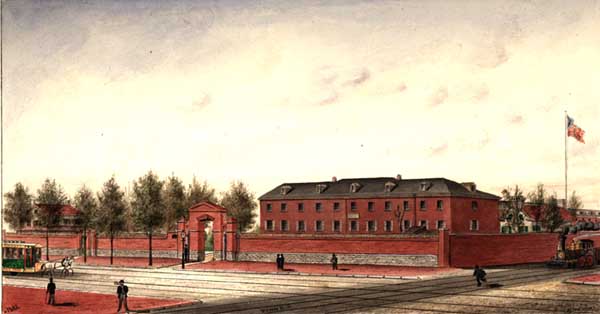
Collection of the Library Company of Philadelphia.
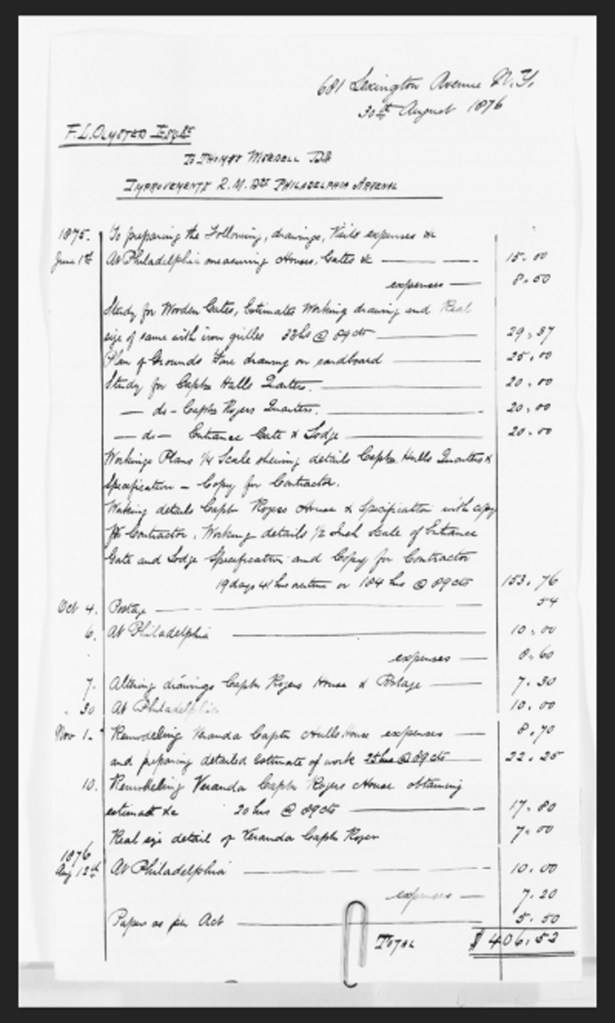
Thomas Wisedell made multiple trips to the arsenal throughout 1875 and 1876 to inspect the work as it was being carried forward and to present specific detailed drawings. His final visit was August 12th, 1876 as a final inspection after the entire project had been completed. Following that visit, Olmsted submitted his final bill detailing Thomas Wisedell’s work at he arsenal totaling $406.52.
The arsenal stayed in use until 1957 and in December 1960, the site was sold to the Pennsylvania Electric Company (PECO). The buildings were demolished the following year. What was left intact, however, was the most of the original stone wall from 1800-1806 while one small remnant of Thomas Wisedell’s brick wall can still be found at the northeast corner of the site.

Further Reading:
- Annual Report of the Quartermaster-General of the Secretary of War for the Fiscal Year Ending June 30, 1876 (Washington, D.C.: Government Printing Office, 1876).
- The Papers of Frederick Law Olmsted. Volume VII: Parks, Politics and Patronage 1874-1882 (Baltimore, MD: Johns Hopkins University Press, 2007).
- https://crowd.loc.gov/campaigns/olmsted/subject-file/mss351210244/?
- http://www.fortwiki.com/Schuylkill_Arsenal
 The Architecture of Thomas Wisedell