
In the fall of 1875, Dennis Bowen of the Buffalo Parks Commission asked Frederick Law Olmsted to plan the grounds surrounding the new City and County Hall which was to be completed in the spring of 1876. The building had been designed in 1871 by the Rochester, N.Y. architect Andrew Jackson Warner who was also supervising the construction of H.H. Richardson’s New York State Hospital then being constructed in the northern part of the city. Olmsted (with Calvert Vaux) had been active in Buffalo since 1868 with the creating of the system of parks as well as landscaping the grounds of the hospital. During that same period, Thomas Wisedell as making periodic trips to Buffalo to supervise the construction of the Parade House as well as the Spire House and other structures at Delaware Park (see Part 2e).
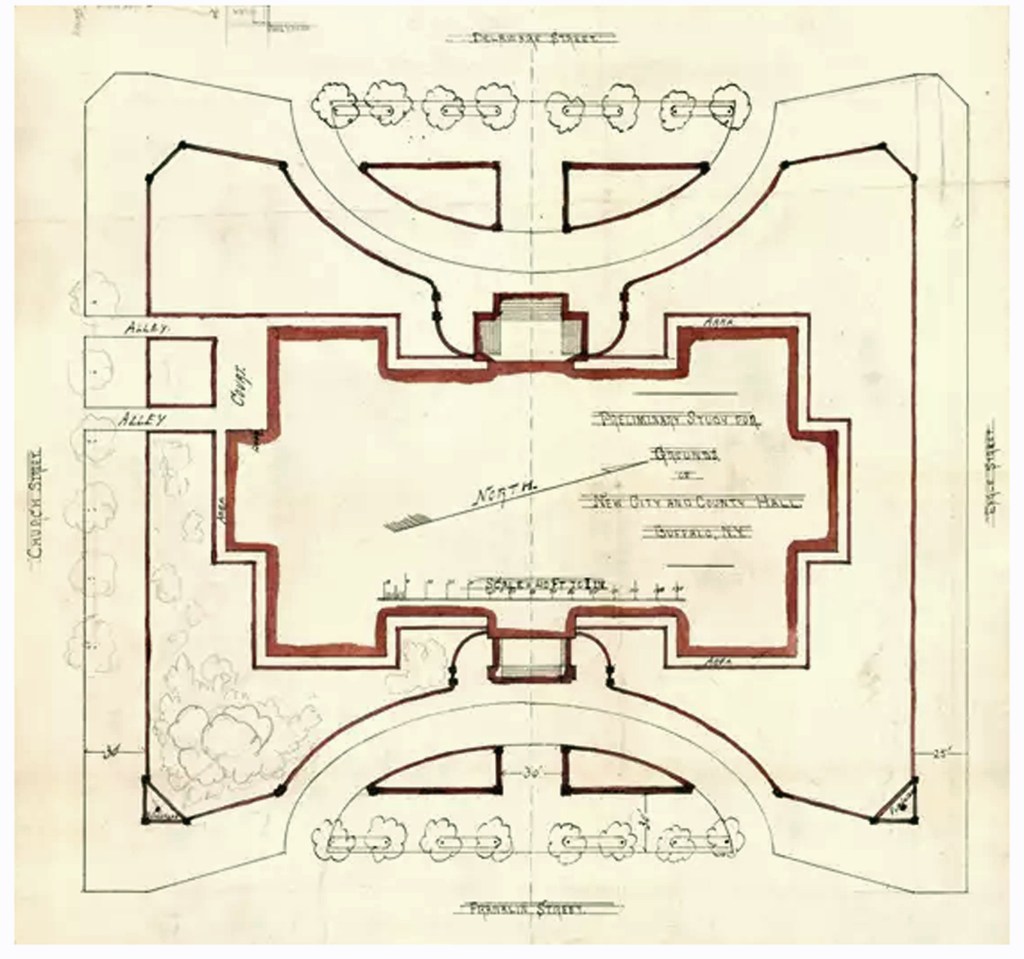
Throughout the fall of 1875, Olmsted was in New York City and Washington, D.C. while corresponding with Dennis Bowen and requesting information regarding the City and County Building’s design. When Olmsted presented his initial plan in January 1876, he envisioned the grounds with symmetrical carriage drives on the east and west sides of the building. Olmsted also tapered the streets inward, creating more space for carriages. At the corners along Franklin street, were triangular flower beds which also had corner piers and stone flagstaffs.
The City and County Building formally opened on March 13, 1876 with Olmsted in attendance. It was perhaps during that trip when he was able to fully inspect and measure the site. Between mid-March and early April, Olmsted had created a scheme for organizing and laying out the grounds while Thomas Wisedell had designed the the walls, piers and lamps. Olmsted and Wisedell’s plans were sent from New York City, arriving in Buffalo around April 18th. Included with the plans and specifications for the stonework and bronze lamps was a rendering of the building showing Olmsted’s vision for the plantings around the building along with Wisedell’s designs for the walls, piers and lamps and flagstaffs.

Within days of receiving the plans from Olmsted’s office in New York City, the rendering was turned into an engraving and published as a fold-out illustration in Francis F. Fargo’s Memorial of the City and County Hall Opening Ceremonies, Buffalo, N.Y., a book chronicling the building’s construction and its opening ceremonies. Though the author of that rendering is unknown, there are definite resemblances to earlier drawings by Thomas Wisedell.
The rendering clearly shows that Olmsted was subordinating the grounds to the building, using smaller trees and shrubs. For the perimeter wall, Thomas Wisedell repeated octagonal patterns in the stone piers, flagstaffs and even the bronze lamps had octagonal lanterns. John Druar (1837-1905), who was the contractor that erected the City and County Building, estimated the cost of the stonework at $11,000 with an additional $3,000 for the bronze lampposts, railing and gates. The following month, the plans were formally approved.
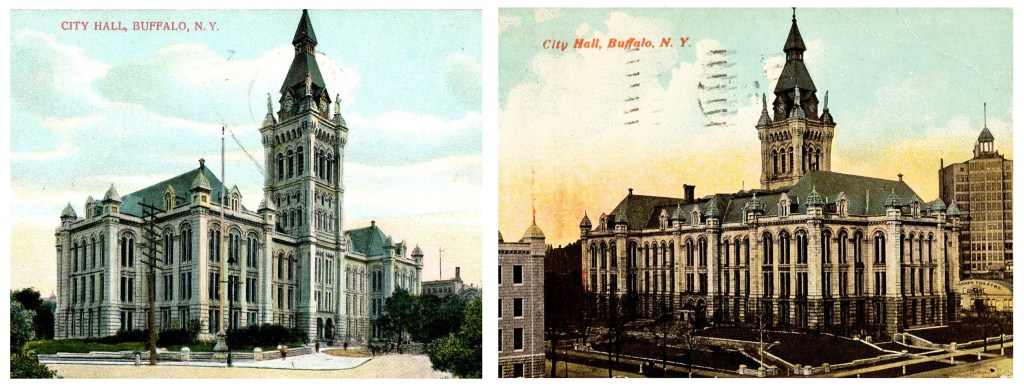
Over the summer and into the fall, Olmsted continued to revise his plans, leaving the east side of the building as he had originally intended, while reworking carriage entrance on the west side into a strait, broad terrace approached by diagonal entrances. The revised plans were completed in October 1876 and clearly show that Olmsted was integrating some of the lessons gleaned from the design of the terrace around the U.S. Capitol Building which had been planned in the summer of 1874 (see Part 4b) as well as the earlier Martyrs’ Memorial at Washington Park in Brooklyn (see Part 2d).

As for Thomas Wisedell, he increased the height of the flagstaffs to seventy feet while with the intention of having about 2/3 of their shaft being painted bright red. He also simplified the stonework, opting for square piers with chamfered caps along the walls and for the bases of the flagstaffs as well as the entrance piers for the western terrace. For the triangular beds surrounding the flagstaffs at the corners of Franklin Street, Wisedell used hexagonal piers which were better integrated into the triangular sites. Wisedell also redesigned he bronze lamps for which Olmsted had obtained an estimate of $18.00 per lamp from Janes & Kirtland (who had also created the bronzework for Central Park, Prospect Park and the grounds around the U.S. Capitol). Unfortunately, none of the lamps were erected and no images of their final design have been found. With Olmsted and Wisedell simplifying the designs for the stonework, the walls and piers had a much better relationship to the City and County Building giving the impression that the grounds and the building were designed by one architect. To support that impression, the building as well the grounds were constructed of the the same granite from the quarries at Clark Island, Maine.
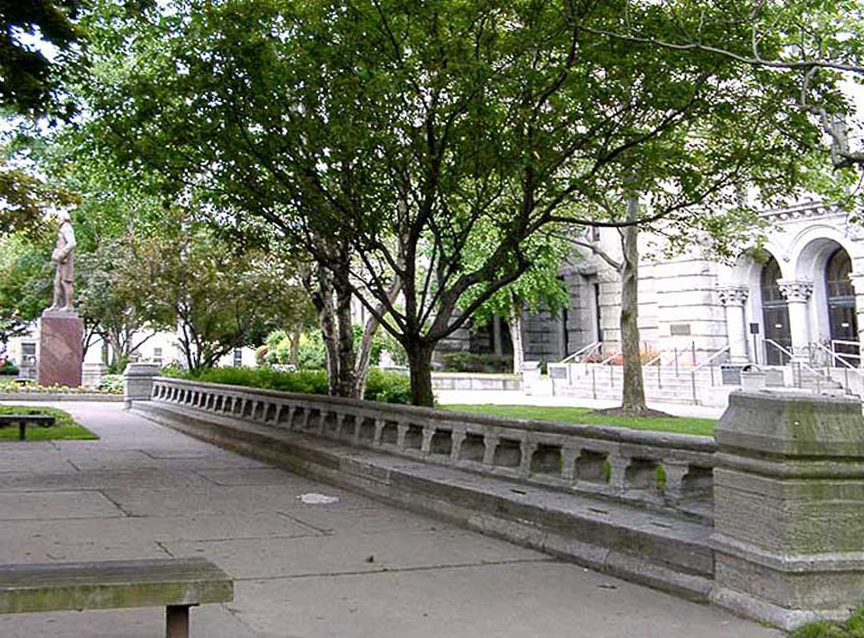
Another feature that echoed Olmsted’s plans for the Capitol ground in Washington was the long rows of stone benches on the building’s east side. In the original plan, these had been designed with solid backs and flatter slab coping. When this feature was redesigned, Wisedell opted for a row of T-shaped blocks. This created a more interesting effect of light and shadows whole greatly reducing the amount of stone needed for their construction. Whether it was intentional or coincidental is unknown, but the shape created in the negative spaces echoed a common pattern found in the the secular buildings of Robert Jewell Withers in the late 1850’s and early 1860’s.
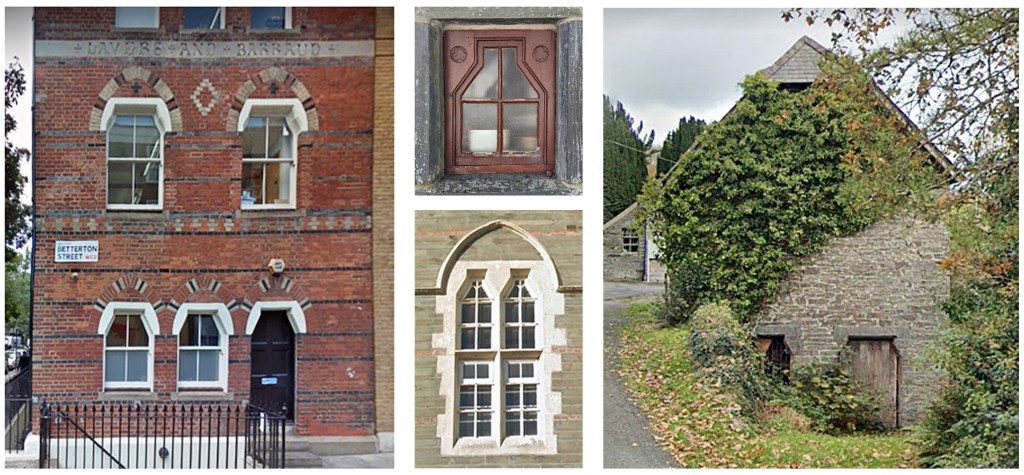
Top middle: Window, Girls’ School, Llandygwydd, Wales (1857-1858). Photo courtesy of Bethena.
Bottom Middle: Windows, Guildhall, Cardigan, Wales (1856-1860.
Construction of the grounds around the City and County Building was completed when the piers and flagstaffs were erected in late August of 1877. Unfortunately, the terrace on the building’s west side was destroyed in the early 1960’s for the addition of a modern office building designed by Milstein, Witteck & Davis which opened in 1964.
Further Reading:
- Annual Reports of the Buffalo Park Commissioners. 1869-1878 (Buffalo, N.Y.).
- Fargo, Francis F., editor and publisher, Memorial of the City and County Hall Opening Ceremonies, Buffalo, N.Y. (Buffalo: The Courier Company, Printers: 1876).
- Kowsky, Francis, R, editor, The Best Planned City: The Olmsted Legacy in Buffalo (Buffalo: The Burchfield Art Center, 1992).
- Kowsky Francis R., The Best Planned City in the World: Olmsted, Vaux, and the Buffalo Park System (Amherst and Boston: University of Massachusetts Press, 2013).
- The Papers of Frederick Law Olmsted. Volume VII: Parks, Politics and Patronage 1874-1882 (Baltimore, MD: Johns Hopkins University Press, 2007).
 The Architecture of Thomas Wisedell