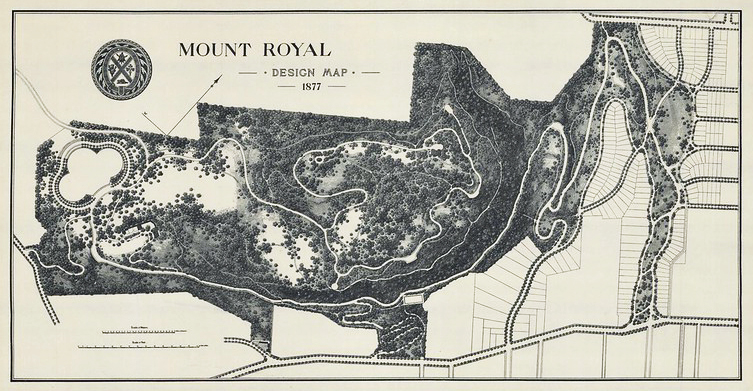
In October 1874, Frederick Law Olmsted was asked by the Montreal Park Commissioners to come to their city and visit their proposed site for a new park on Mount Royal. The following month, he made two trips to the site and presented his preliminare ideas. This project would take years to complete, with Olmsted’s vision only being partially realized. Rather than recapping the entire convoluted history, follow the link below to get an online pdf that sums up this project:
Click to access mount_royal_in_the_works_of_frederick_law_olmsted.pdf
Olmsted’s vision for Monunt Royal was to gradually ascend the mountain with a series of winding roads that graually moved visitors through eight different sections of the park, gradually ascending to the park’s highest point with no more than a 6% incline, making the park fully accessible to wheelchairs. The different sections, named principally for the topographical features — Cote-Placide, Piedmont, Underfell, Cragsfoot, Brackenfell, Glades, Crags and Upperfell — would have plants and varieties appropriate for various ecosystems reflecting the changes in elevation. Because of the sinuous, and continuous incline which would be about four miles long with an ascent of almost 600 feet, Olmsted had planned for three restaurants to be placed with the park – a small inn not far from the park entrance in the Underfell; the park’s only year-round restaurant was to be in a slightly sheltered park of the Brackenfall; and a multi-storied restaurant and observation called “The Crown of the Mountain” was to be constructed at the highest point in the park offering 360 degree views from the of Mount Royal.
Like other Olmsted projects form this period, Thomas Wisedell was charged with designing the park’s architectural features. Unfortunately, only parts of Olmsted’s overall vision was realized. As for Thomas Wisedell’s involvement, the only feature that is known to have been by him was the so-called “Crown of the Mountain” which was designed in 1876. Its style was described as manner reminiscent of the older French farmhouses from Quebec with a shaded ombra (perhaps similar to the Parade House in Buffalo) and was to be finished in rustic shingles with a copper roof. The restaurant was to seat about 300 people and was to be multiple stories with the top floor surving as an observation. Unfortunately, this was never constructed and Wisedell’s plans have never been found.
However, as historian Charles E. Beveridge has pointed out, a smaller structure was later designed in 1889 by Rutan, Shepley and Coolidge of Boston for Highland Park in Rochester, NY which was designed by Olmsted in 1888. Though this was much smaller and did not contain a restaurant, it apparently does give a sense of what Olmsted was trying to acheive at Mount Royal.
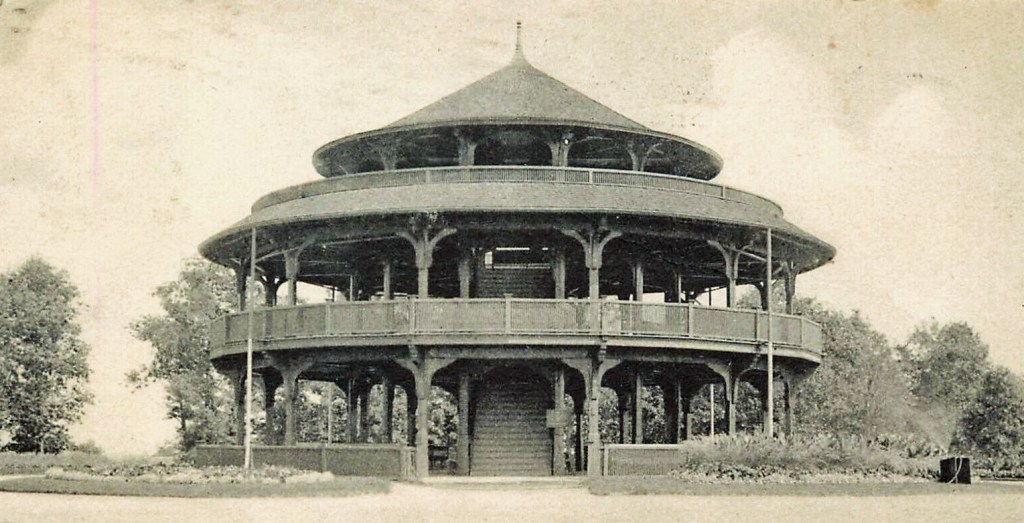
Just as a side note, this pavilions was demolished in 1963. However, it is currently being re-erected and is set to be completed in 2024.
Further Reading:
- https://www.mcgill.ca/urbanplanning/files/urbanplanning/mount_royal_in_the_works_of_frederick_law_olmsted.pdf
- https://crowd.loc.gov/campaigns/olmsted/subject-file/mss351210250/mss351210250-1/
- Beveridge, Charles E., Meier, Lauren and Mills, Irene, editors, Frederick Law Olmsted: Plans and Views of Public Parks (Baltimore: Johns Hopkins University Press, 2015)
- The Papers of Frederick Law Olmsted. Volume VII: Parks, Politics and Patronage 1874-1882 (Baltimore, MD: Johns Hopkins University Press, 2007).
 The Architecture of Thomas Wisedell