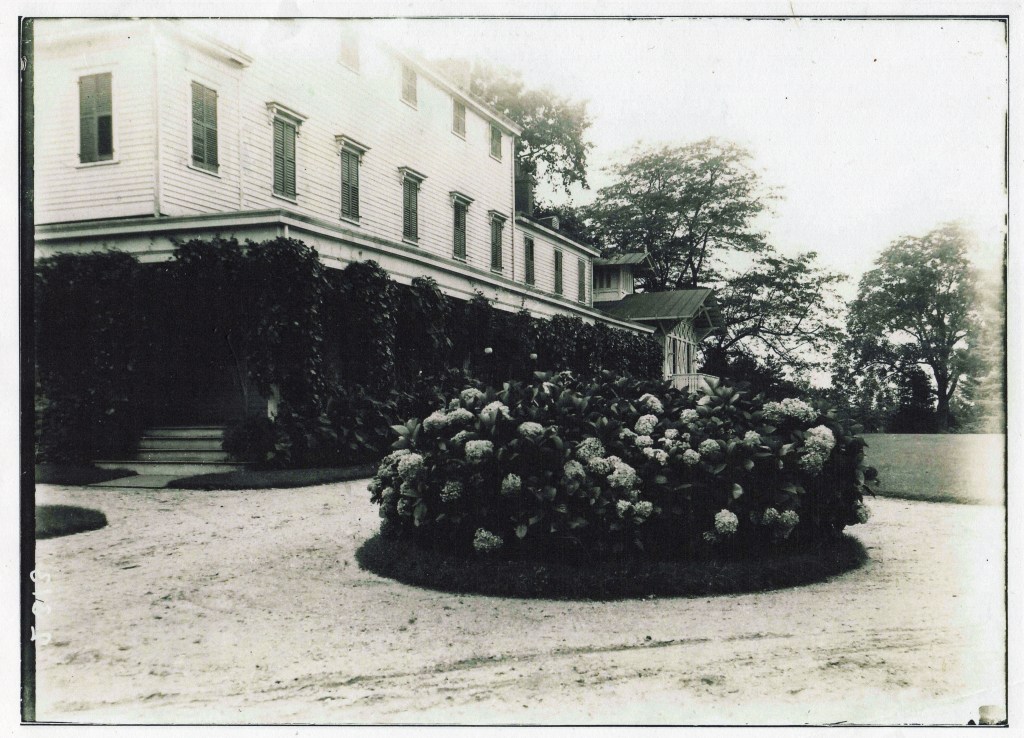
In the fall of 1874, as Wisedell was working on the William Bryant House in nearby Roslyn, New York as well as projects with Frederick Law Olmsted and Calvert Vaux in Washington and Buffalo, he began designing alterations and additions to the Charles Dana House on Dosoris Island (near Glen Cove), Long Island. Charles Anderson Dana (1819-1897) had been the influential and controversial editor of the New York Tribune from 1847 until 1862. In 1857, Dana published A Household Book of Poetry, one of the earliest compilations of its type in the English Language. During the Civil War, he had served as a correspondent, reporting from battles in Virginia and Tennessee. In 1863, Dane accepted the post of Assistant Secretary of War under Edwin Stanton. Following the war, Dana moved to Chicago where he founded the short-lived Chicago Republican newspaper. After the paper’s demise in 1867, Dana moved back to New York City and purchased the New York Sun, promptly remaking its image. He would serve as that paper’s managing editor until his death in 1897.
In 1873, after a few years of almost unprecedented success with the New York Sun, Dana decided to purchase the eastern part of “Dosoris,” a small island just north of Glen Cove off the northern coast of Long Island, New York. The property had previously belonged to James C. Fox and on its extensive grounds sat a large farm house, a barn and at least two out buildings. It was there that Dana envisioned a personal playground patterned after the ideas of Frederick Law Olmsted. Dana had been one of Olmsted most intimate friends since the 1850’s when both men wrote political commentary for Putnam’s Magazine. While at the New York Tribune, Dana had used his editorial position to press for Olmsted & Vaux’ Greensward plan which ultimately became Central Park.
Dana had long followed Olmsted’s career and wanted to bring his ideas to his property on Long Island. In 1874, Dana purchased the western part of Dosoris with the intention of creating an arboretum for his growing collection of trees from around the world. Though Olmsted did not formally plan the grounds, the two men definitely discussed the appropriate layout for the property. Dana then personally directed most of the work of laying out the roads, paths and flower beds. Over the next few years, Dana continued to procure trees from all over Asia, Europe and North America. Among his most prized were Chinese oaks which were sprouted from acorns that a friend had gathered from the tomb of Confucius.
Undoubtedly, it was through Olmsted’s recommendation that Dana hired Thomas Wisedell in 1874 to remodel the house and barn on the eastern part of the island and to design a poultry house large enough for over one thousand rare and exotic chickens. For the barn, Wisedell’s designs called for covering the upper stories in shingles, though the builder did recommend a less expensive cladding. Also, the interior was redesigned and remodeled into an apartment for Dana’s coachman.
The remodeling of the house was apparently a far more complex affair, though the extent of the project is not fully known. Wisedell added a third story as well as a wing projecting from the east side of the house. On the interior of the existing house, the former music room was remodeled into a butler’s pantry and cloak room, a water closet was installed near the front piazza, the second floor was completely remodeled and bedrooms were placed in the newly designed third story.
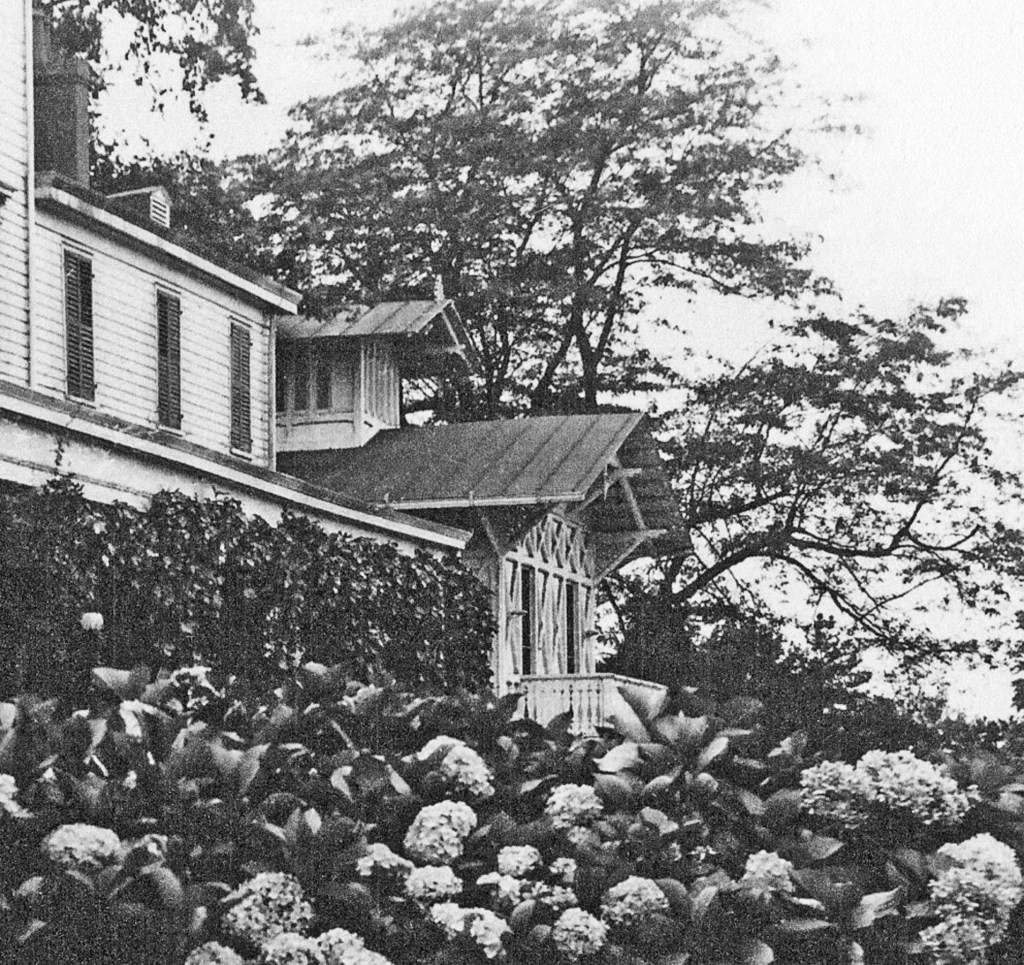
To the east of the house, Wisedell designed a one story, stick style addition. Though it is not known what this addition was used for, its design and proximity to the kitchen suggests that it was built to house Dana’s prized poultry. This was a rather simple design, perhaps one large room with a central belvedere which also served as to let natural light into the center of the room through the ceiling. The roof over the main structure as well as the belvedere had gable which projected almost four feet, supported by thin, knee brackets. At each end were two doors leading to wooden balconies. The exterior was clad with X-bracing over flush siding with X – bracing around the entire structure. This clearly related to earlier park structures at the Parade Grounds in Brooklyn and Buffalo by Calvert and was a still style more common to European park structures rather than American suburban estates.
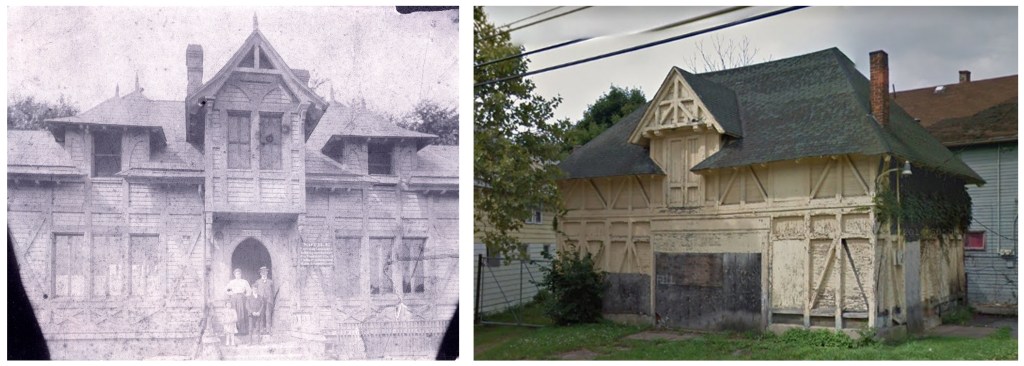
Right: Barn, Parade Grounds, Buffalo, NY, 1874.
While the interior was being remodeled in the late fall and winter of 1874 and 1875, Charles Dana stayed with his wife and children in Manhattan at the Hoffman House hotel where Wisedell met with the family as the project developed and it is the correspondence between the two men that gives most of the information about this project. After the remodeling was completed in the spring of 1875, Dana moved into the house though he continued to rent an apartment in Manhattan during the winter months. After Dana’s death in 1897, the family made the estate on Long Island their full-time residence.
Dana’s heir soon sold off the western part of the island to the financier and philanthropist, William L. Harkness. In 1913, Harkness hired architect James Gamble Rogers (1867-1947) to design a large, classically inspired brick addition which would become the main house while the existing farmhouse was altered to become the servants’ wing. In 1913, the eastern part of Dosoris was sold to Junius P. Morgan, the son of J. P. Morgan. That year, architect Roger H. Bullard began construction on “Salutations,” a massive, stone mansion designed in the neo-Geogian style. The 18th century farmhouse lived in by Charles Dana along with its out building which had all be remodeled by Thomas Wisedell were completely demolished.
Acknowledgements:
This project would have been lost to history had it not been for a small trove of letters written in 1874 and 1875 from Charles Dana to Thomas Wisedell. These were part of a larger collection of items belonging to Francis Kimball with whom Wisedell formed a partnership in the summer of 1879 under the name Kimball & Wisedell. The letters, among various other items, were generously given to me in 2004 by the heir to this collection, Ellen P. Miller.
As for the photo showing the poultry house, that was sent to me from the Society for the Preservation of Long Island Antiquities (now Preservation Long Island).
Further Reading:
- Harrison, Joan, Glen Cove Revisited (Charleston, Chicago, Portsmouth, San Francisco: Acadia Publishing, 2010).
- MacKaye, Robert B.; Baker, Anthony K. and Traynor, Carol A., editors, Long Island Country Houses and Their Architects (New York: W.W. Norton & Co., 1997).
 The Architecture of Thomas Wisedell