In February 1872, the Trustees of Trinity College voted to sell their property to the City of Hartford as the site which the State of Connecticut would erect their new state capitol building. Following the sale Abner Jackson, the president of Trinity College, had contacted Frederick Law Olmsted as a consultant in finding a suitable location for Trinity College to build their new campus as well as Bishop Arthur Cleveland Coxe asking for advise on finding an appropriate architect.
Coxe had been the rector of St. John’s Episcopal Church in Hartford from 1842 until 1854. During that period, he was an ardent following of the Tractarian Movement and the re-establishment of high church practices. In 1849, Coxe and Jackson were instrumental in convincing the British/American architect Gervase Wheeler to move to Hartford with the hopes of designing a new chapel for Trinity College, thus strengthening the ties between Hartford, Trinity College and England.
In 1851, Coxe went on an extended tour ecclesiastical and educational institutions throughout England (later published as a book in 1856) during which he befriended the eminent historian and publisher John Henry Parker at Oxford. While in England, Parker had published a sermon which Coxe had delivered on June 15, 1851 at the Church of St. Lawrence in Bradfield during ordination of Francis Paget as the 33rd Bishop of Oxford.
When President Jackson contacted Bishop Coxe in May 1872, Coxe had recommended that Jackson should tour educational institutions in Britain and wrote a letter of introduction to John Henry Parker. Jackson sailed to England in mid-July for an extended study of educational institutions in England, Scotland and Wales. Later that month, he met with Parker at Oxford and to two men discussed the needs of Trinity College as well as the current state of British architecture. Parker apparently spoke of various architects but saved his highest praise for William Burges, calling him “the most genius of any architect in England.” And with that, Parker wrote a card of introduction….
Jackson presented himself at Burges’ Buckingham Street office in London on August 1, 1872. During that initial meeting, Burges agreed to spend a day touring the various colleges at Oxford and advised Jackson to visit Cambridge as well. Burges also agreed to make a rough sketch of a campus at no charge which Jackson could take with him. After the two men returned from Oxford, Burges requested that Jackson return to London on September 2 when the they could spend two days going over the proposed college buildings. Over the next month, Jackson traveled around England and Scotland visiting various institutions. When Jackson returned to London to discuss some of the places he had visited, the two men came up with a general idea for the new campus.
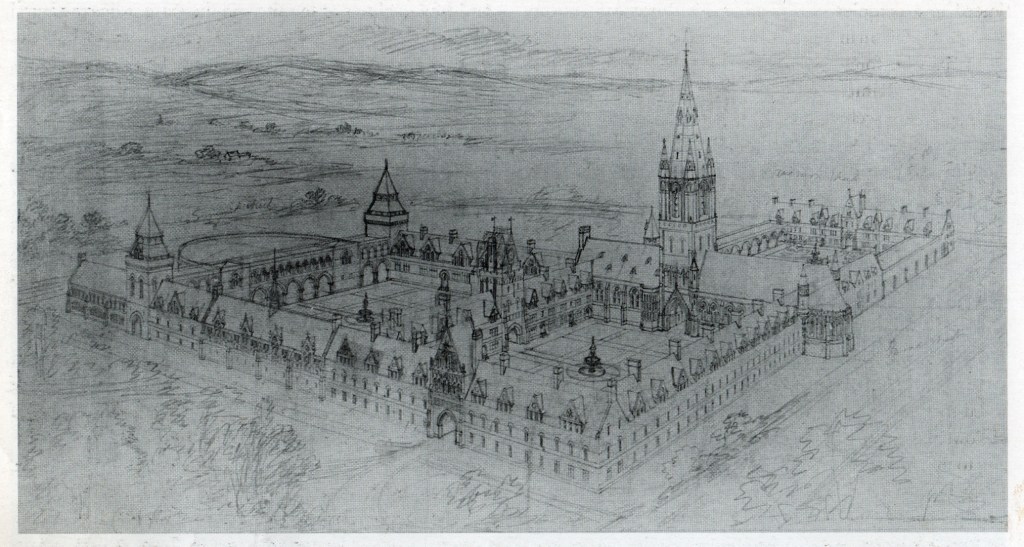
Drawing by Axel Hermann Haig, Collection of the Watkinson Library, Trinity College.
When this initial L-shaped, 3-quad plan had been designed, Trinity College had not yet decided on a new site for their future campus though the arrangement of building’s suggest ether the Willis Thrall site or Thomas Penfield site, both of which were large, flat tracts of land. Though this scheme does hint at a specific site, it was not probably not intended to be constructed but was meant to give the college trustees a sense of direction and possibility. While Jackson was in England, the college trustees secured the rights to purchase the Thrall property near the western edge of the city.
Jackson returned to Hartford and presented Burges’ ideas to the trustees in October 1872 and later that month, the trustees rejected the Thrall property in favor of the Penfield property (currently the site of the Burns Latino Studies Academy) which was much closer to the existing campus. However, the trustees continued to disagree about the future site of the campus, and it would not be until February 1873 when they formally agreed to purchase a tract of land on the southwest corner of the city known as “Rocky Ridge.” This site had been in discussion for the very beginning but its proximity to a quarry pit and large cemetery meant that it was never fully favored. The site was characterized by a long, flat and relatively high ridge with a large, sloping landscape. To Frederick Law Olmsted, it was clear that the L-shaped plan could not easily be constructed on this site. With this in mind, Jackson returned to London in July 1873 to again work in Burges in creating a more suitable plan.
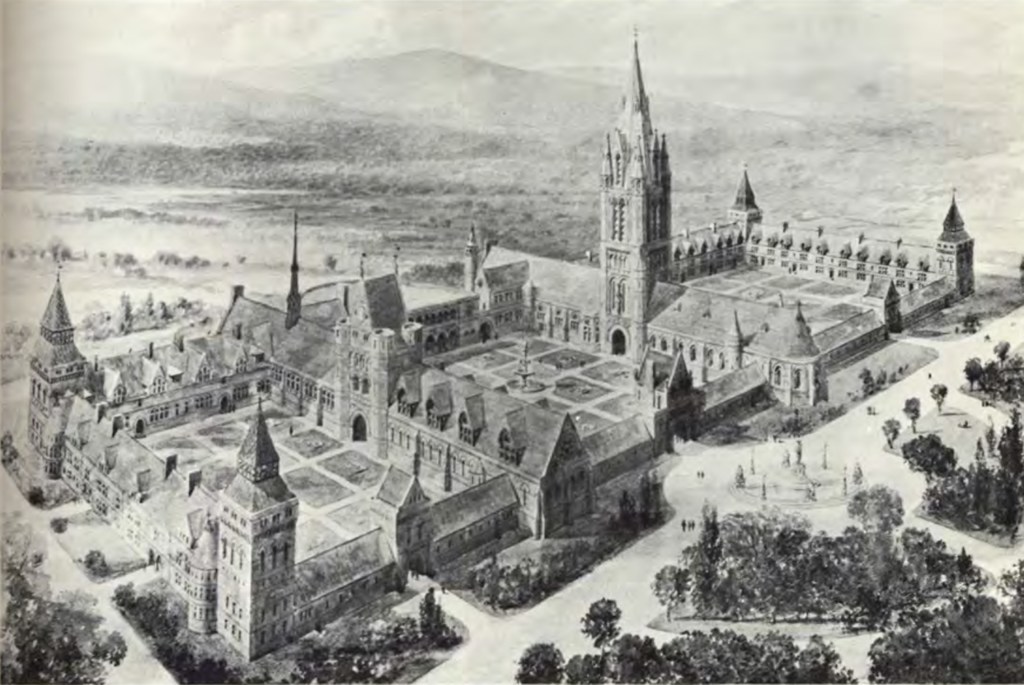
Collection of the Watkinson Library, Trinity College.
Now that Burges had an actually building site, his next scheme was to reorganize the L-shaped plan in to a linear one with the processors’ quad at on end and the students’ quad at the other with the chapel, auditorium and classrooms at the center. This new plan was then sent back to Hartford in August 1873 though Jackson stayed in London for another month, continuing to revise and expand the plans with Burges.
The benefit to the L-plan was that it allowed the campus to easily expand while still allowing easy access by the students and faculty. With the new linear plan, expansion would not have been as convenient. Burges and president Jackson then expanded the plan by inserting a fourth quad which added classrooms and more student housing.

President Jackson returned to Hartford in September with the final 4-quad plan which he presented to the trustees on October 31st. It was at that meeting when Francis Kimball was formally hired as Trinity’s supervising architect and began making preparations to travel to London to work with William Burges in creating the necessary construction renderings.
When Francis Kimball and his wife Jane left for London in December 1873, they were accompanied by Rev. Francis Goodwin, the son of Maj. James Goodwin who was in the process of constructing his large estate on Woodland Ave. Maj. Goodwin was perhaps Hartford’s most important architectural patron and was responsible for Kimball’s appointment to Trinity College.
Since 1871, the Goodwins had been working with Frederick Clarke Withers in designing what would become known as “Goodwin Castle,” and since Francis Goodwin was already an amateur architect he was credited with many of the ideas that went into his father’s home. The two couples arrived in London shortly before Christmas 1873 and Kimball was soon at work with William Burges while the Goodwins met with Edwin Godwin, one of the England’s most noted architects and designers from whom they commissioned an octagonal table, and a fireplace surround and mantle. Period photos of the house show bamboo wallpaper also designed by Godwin, though that was already available in the United States and would not have been commissioned.
While the Goodwins stayed in London for about two weeks, Francis and Jane Kimball stayed for almost nine months. During that period, he would meet notable figures of British architecture such as George Gilbert Scott, Jr., Albert Waterhouse and John Loughborough Pearson. Also among those he encountered was Robert Jewell Withers for whom Thomas Wisedell had apprenticed in the 1860’s.
By late September 1874, Burges and Kimball had completed about 170 drawings, and the following month, the Kimballs returned to Hartford. While Kimball was away in London, President Jackson had died and Thomas Pynchon had been appointed the new president of Trinity College. Pynchon had great enthusiasm for the building of Trinity’s new campus but he was also keenly aware of the financial obstacles of such a massive undertaking.

As the college was gaining a greater understanding of how to implement Burges’ scheme, Pynchon and Kimball began to rearrange the 4-quad plan the combining the two middle quads into one large, rectangular quadrangle. Though Burges was kept abreast of these changes, his correspondences have unfortunately been lost. What does survive, however is a set of drawings by Francis Kimball which represent designs either rejected by Burges or with alternate schemes which will discussed in following posts.
To be continued…
Further Reading:
- Armstrong, Christopher Andrew, “Qui Transtulit Sustinet: William Burges, Francis Kimball and the Architecture of Hartford’s Trinity College,” Journal of the Society of Architectural Historians vol. 59, no. 2 (June 2000): pp. 194-215.
- Brocklesby, John, “Trinity College, Hartford,” Scribner’s Monthly vol. XL, no. 5 (Mar. 1876).
- Coxe, ,Arthur Cleveland, The Priesthood and the People: A Sermon, Preached at Bradfield, on Trinity Sunday, June 15, 1851, on Occasion of the Bishop of Oxford’s Ordination (Oxford: Parker, 1851).
- Coxe, Arthur Cleveland, Impressions of England; Or, Sketches of English Scenery and Society, (New York: Dana& Co., 1856).
- Crook, J. Mordaunt, William Burges and the High Victorian Dream (Chicago and London: University of Chicago Press, 1981).
- Pullan, William Popplewell, The Architectural Designs of William Burges, A.R.A. (London, 1883).
- Pullan, William Popplewell, The Architectural Designs of William Burges, A.R.A: Details of Stonework (London: B.T. Batsford, 1887).
- Weaver, Glenn, The History of Trinity College vol. 1 (Hartford: Trinity College Press, 1967).
 The Architecture of Thomas Wisedell