
Economics was clearly the driving force behind the decision to combine the middle quadrangles. This probably stemmed from the decision to initially fit all of the college functions into one long range of buildings until funds were available to erect other buildings. The western side of the central quad was then designed to house the entire college. Since that single range of buildings measured 632, this was quickly given the title, “The Long Walk.” Frederick Law Olmsted and George Kent Radford had visited the site of the new campus in May 1875 to begin staking out the grounds. Coincidentally, all this was happening at the same time that both Olmsted and Radford were working with Thomas Wisedell in Washington, D.C. and in Buffalo, NY.
The new 3-quadrangle plan was publicly unveiled at Trinity’s commencement ceremonies on July 1, 1875. For the siting of the buildings, Kimball had been working closely with Olmsted assistant, George Kent Radford, an English civil engineer who was in charge of implementing Olmsted’s landscaping plan for the college. In September, Kimball moved out of his office downtown and into a small, wooden building erected at the Trinity College construction site which served as his office not only to supervise the entire construction process, but to also conduct tours and keep the press briefed with the progress of the campus.

The Long Walk consisted of three buildings eventually known as Seabury Hall, Jarvis Hall and Northam Towers. Since Seabury and Jarvis would be constructed first, Kimball immediately focused on their design. Jarvis Hall would prove to be the simplest and most repetitive in its plan thus Kimball would have its overall design basically completed in 1875 with minor changes which were implemented during construction.

The basic designs for the “Long Walk” were created from the eastern wings of the two central quads in the 1873 four-quad plan by William Burges. In that plan, Burges had two ranges of classroom blocks with a central gateway tower as well as two ranges of dormitories also with an identical central gateway tower. Separating those two ranges was to be the campus chapel.
When President Pynchon and Francis Kimball created the new three-quad plan in 1875, they kept the lower horizontal ranges of classrooms and dormitories, removed the chapel and inserted a gateway tower in its place. Where the original gateway towers had been, new five-story towers (later reduced to four) were designed to house junior professors with their windows patterned after the dormitories rather than the classroom blocks.
At Trinity College’s Watkinson Library are a set of watercolor renderings which show the early stages of designing the Long Walk. Though these are undated, most would have been completed in 1875 and do not represent the final designs used for construction. However, Kimball did send some of the plans to London in February 1876, and it is in the actual buildings where we can glean some of the changes that would have been recommended by William Burges.
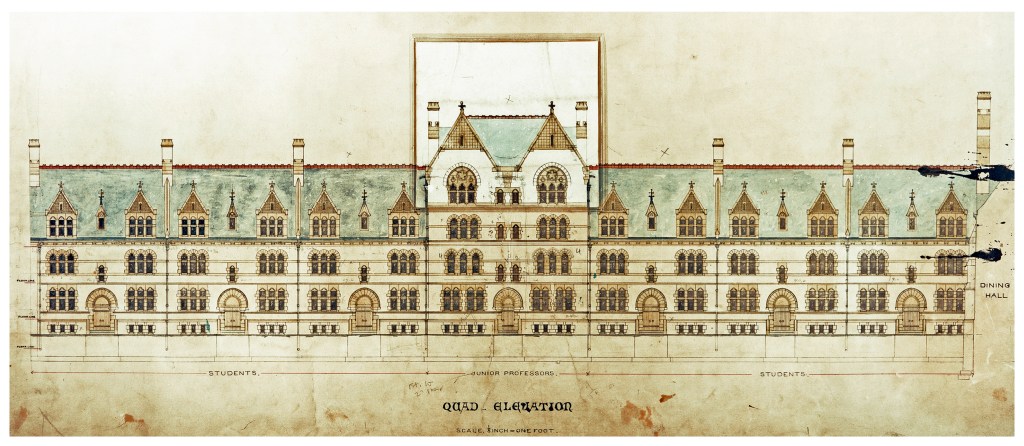
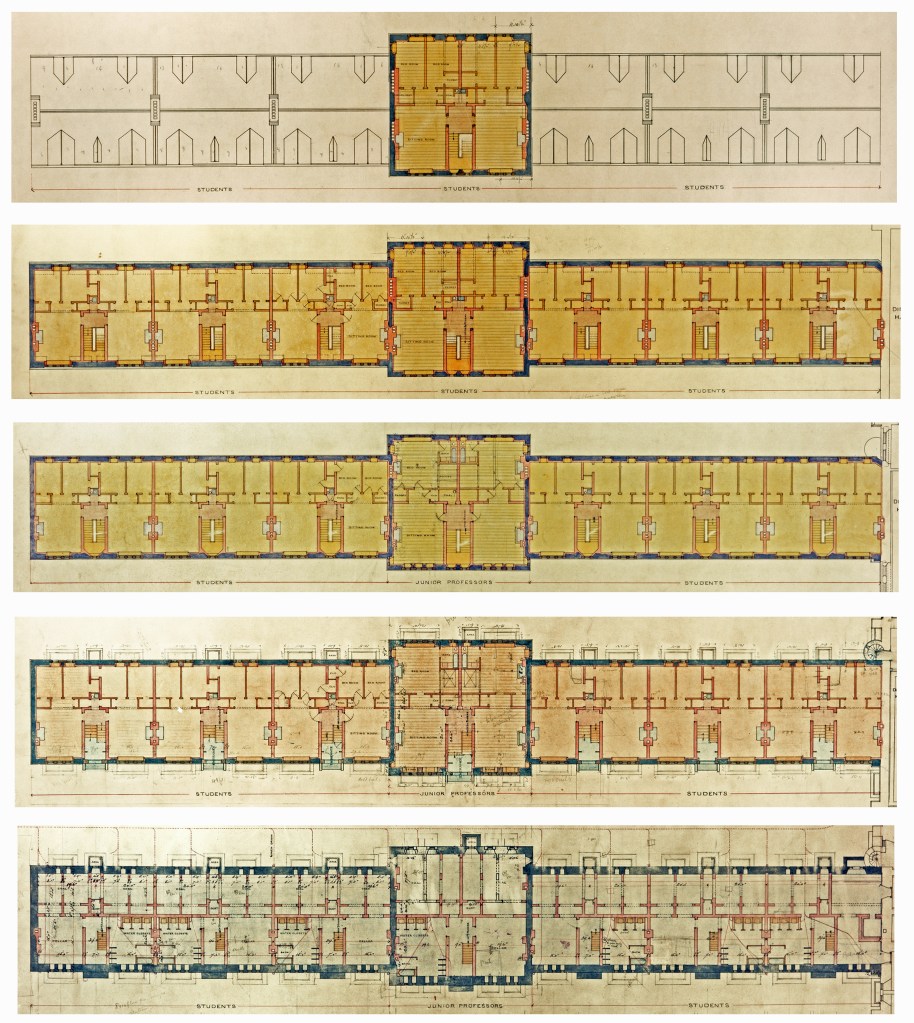
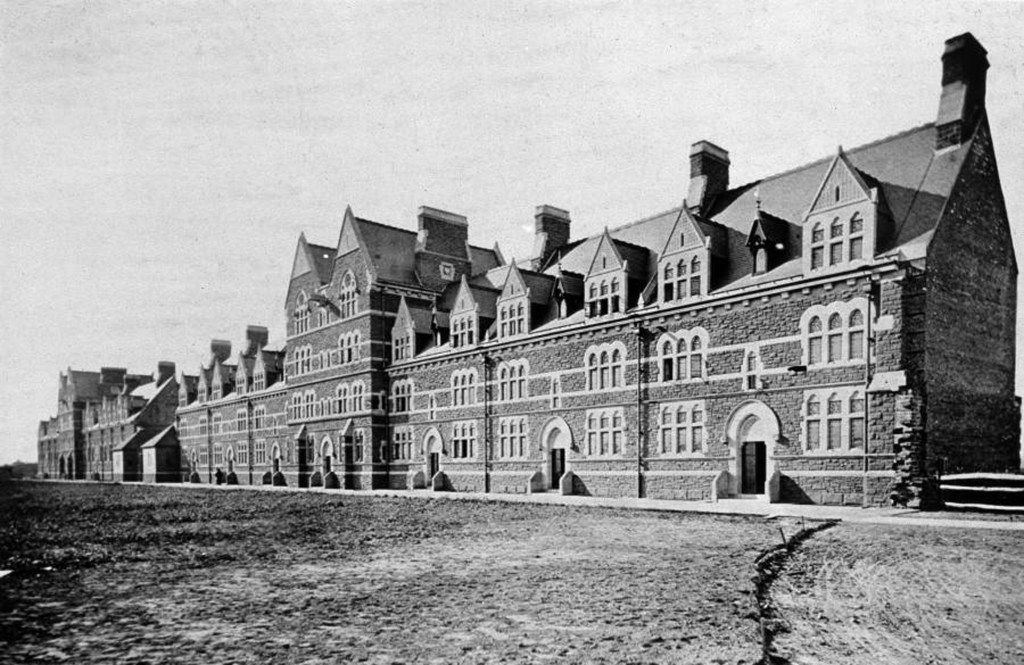
For Jarvis Hall, Kimball took the western wing of the Hall Quad from Burges’ four-quad plan, basically leaving the original design intact except for the junior professors’ block which was increased from three to four stories. The plan for Jarvis Hall called for two lower ranges of three story blocks which repeated the same plan six times. On the interior, the students’ apartments had two bedrooms, each measuring 8′ by 10′ which opened onto a 15′ by 16′ 6″sitting room. In the basement were the showers, toilets and coal bins. The four-story tower at the center of Jarvis Hall was planned for junior professors on the first two floors and students on the top two floors. These apartments were slightly larger and had a 17′ by 20′ sitting room, off of which was a single bedroom which measured 15′ by 16′ with a bathroom set off to one corner. Jarvis Hall officially opened in with the beginning of the fall semester in September 1878.

Further Reading:
- Armstrong, Christopher Andrew, “Qui Transtulit Sustinet: William Burges, Francis Kimball and the Architecture of Hartford’s Trinity College,” Journal of the Society of Architectural Historians vol. 59, no. 2 (June 2000): pp. 194-215.
- Brocklesby, John, “Trinity College, Hartford,” Scribner’s Monthly vol. XL, no. 5 (Mar. 1876).
- Pullan, William Popplewell, The Architectural Designs of William Burges, A.R.A. (London, 1883).
- Pullan, William Popplewell, The Architectural Designs of William Burges, A.R.A: Details of Stonework (London: B.T. Batsford, 1887).
- Trinity College, Hartford, Connecticut: The College Pictured, [n.p., n.pub., 1900].
- Weaver, Glenn, The History of Trinity College vol. 1 (Hartford: Trinity College Press, 1967).
- “F. H. Kimball Report to the Building Committee, Feb’y 20th, 1878. Laid before the Trustees at their meeting held March 2, 1878,”
 The Architecture of Thomas Wisedell