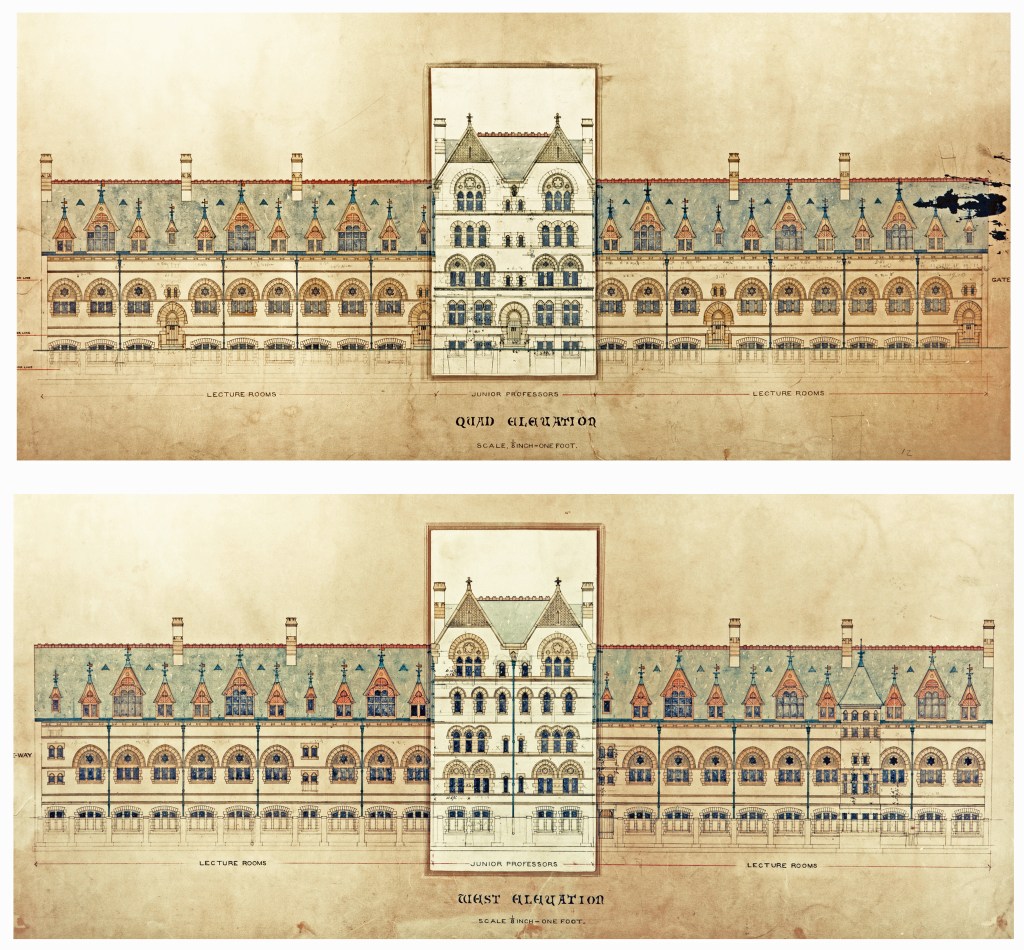
The initial designs for Seabury Hall were mostly created in 1875 and echoed the massing of Jarvis Hall with its central four-story block flanked by lower ranges. Unlike Jarvis, however, the lower sections were two stories rather than three, though with the same height on the exterior. Since Seabury was temporarily dedicated to functions such as the library, museum, dining hall and the chapel, these were designed with larger spaces and greater ceiling heights. All of those functions were intended to be temporary as each would eventually be removed to new buildings and Seabury would become dedicated to offices and classrooms.
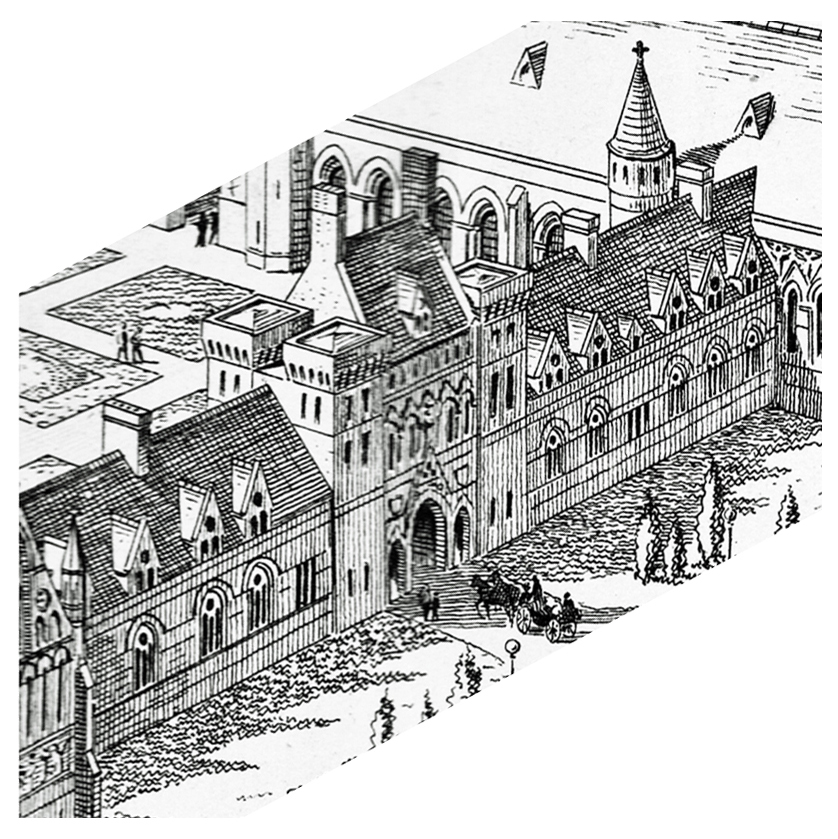
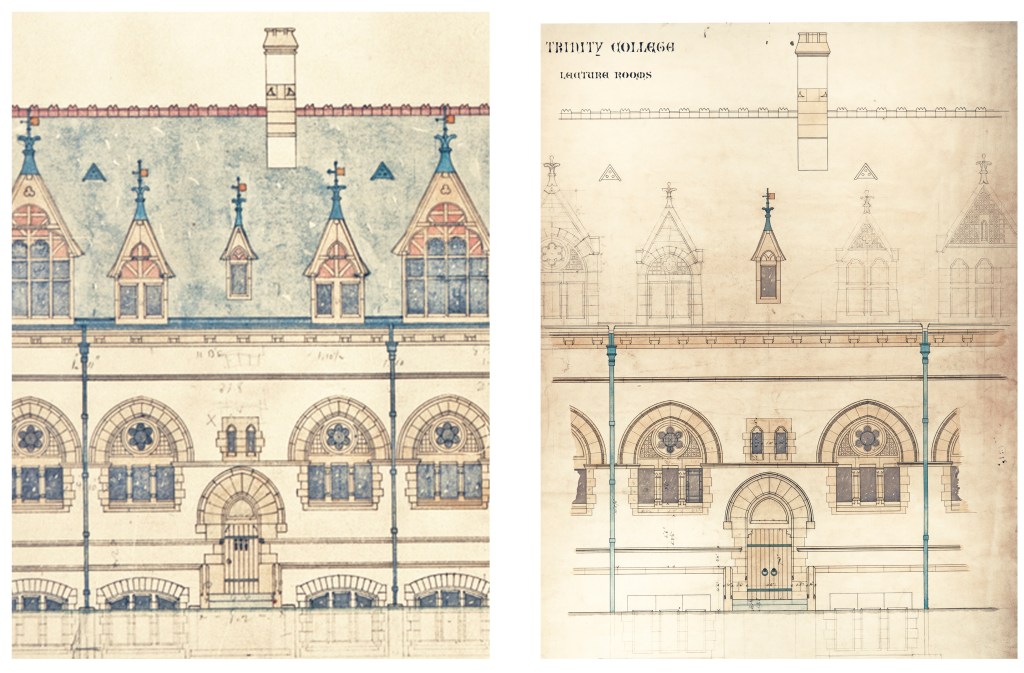
For the design of Seabury Hall, Kimball took the eastern wing of the Chapel Quad from Burges’ 4-quad plan, removed the gateway tower, and inserted a four-story block also used to house junior professors, though with a slightly modified window treatment. The facade was designed with repeated gothic window along the first floor with wooden dormers on the roof.
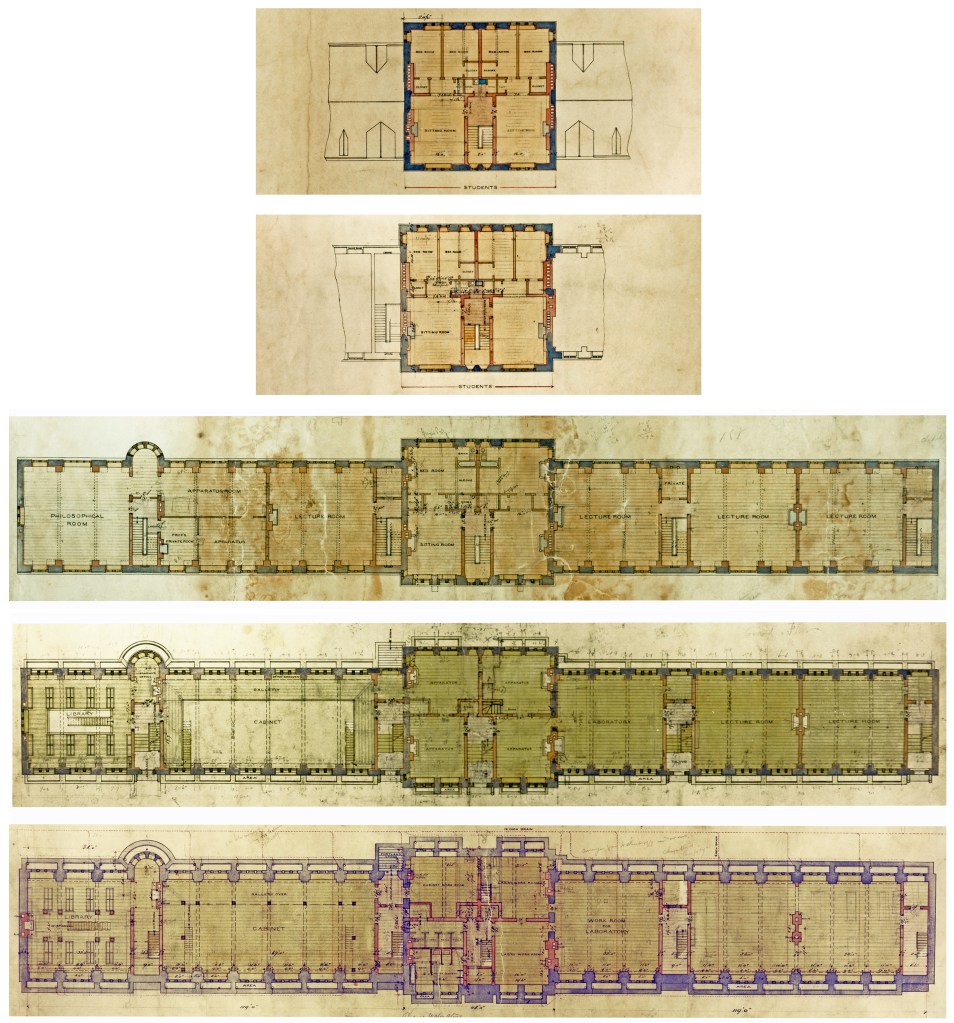
at the bottom to the top floor of the Junior Professors’ block.
The initial plans for Seabury show the library in the basement and first floor with the reading room (marked philosophical room on the plan) housed on the top floor. Beside the library, and separated by the stair hall was the Natural History Museum, known at the time as the Cabinet. The main part of the Museum was housed in the basement while the first floor was designed as a gallery with smaller displays. On the top floor were classrooms devoted to the study of the natural sciences.
Next to the museum was the four-story block principally designed as housing the junior professors, though the basement and first floor were designed with restrooms and smaller classrooms also designed for scientific study. Next to the junior professors block was another shorter range which principally housed lecture rooms.
In February 1876, Kimball sent the plans and elevations to William Burges in London. Though very few changes would be made to the designs of Jarvis Hall, Seabury would have some of its plan reworked and the wooden dormers would be completely redesigned in stone.
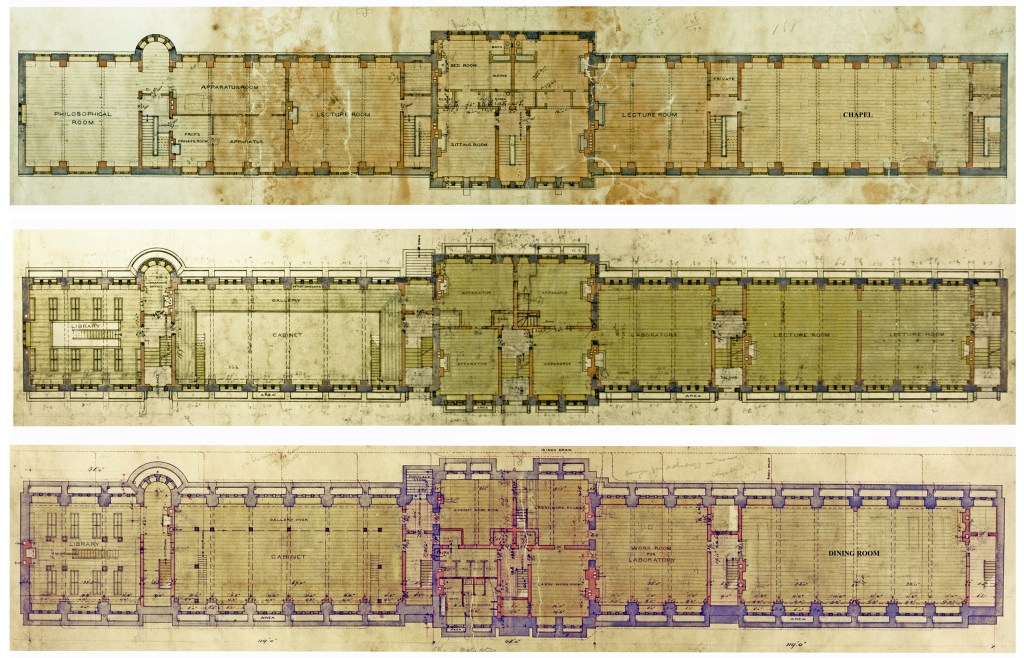
The principle changes to the plan that happened in 1876 were with the inclusion of the dining hall in the basement and chapel on the top floor. Since those spaces needed to be much larger, it required moving the chimney stack originally located in center of those spaces to the ends of the dining room. As for the chapel, there would be no fireplace and the space was fully heated by steam radiators lining the exterior walls. Later that year, Francis Kimball traveled to New York to oversee tests for steam fittings. These tests actually garnered attention in the architectural press since at the time, this was one of the largest projects in the United States to utilize radiant heat.
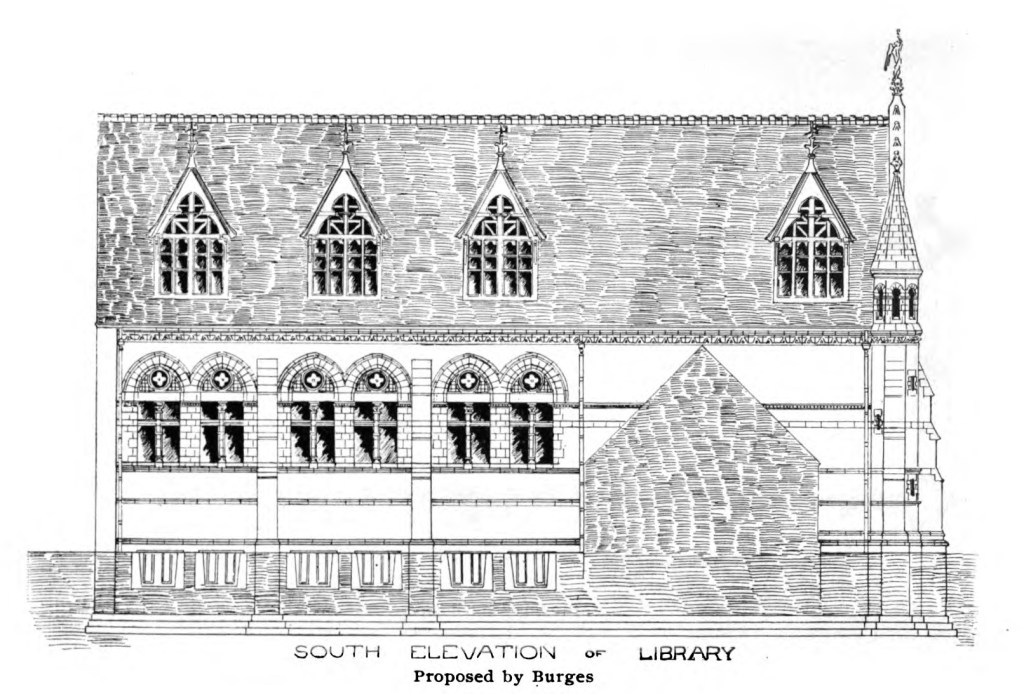

The design for the wooden dormers seems to have come from Burges’ proposed library which was designed in 1874 while Kimball was in London. Though wooden dormers were rarely used by Burges, these had a striking similarity to those found at the hospice in Beaune, France which was constructed around ca 1443-1450, a building whose restoration had just happened in the early 1870’s and had been in numerous publications throughout the 19th century. However, after Kimball had sent the plans for Seabury Hall to William Burges in February 1876, the dormers were redesigned in stone in a style much closer to those seen on the 1873 four-quad plan. The most logical reason why the dormers would have been redesigned would have stemmed from the fact that the wooden dormers had been intended for the library rather than for classrooms. Although Seabury Hall was designed to house the library, that was considered to be a temporary arrangement until a permanent library could be constructed and the spaces in Seabury Hall would become classrooms. A future post will show how Kimball reused the wooden dormers when he incorporated them into the Hartford Orphan Asylum, a project which he designed and constructed while working for Trinity College.
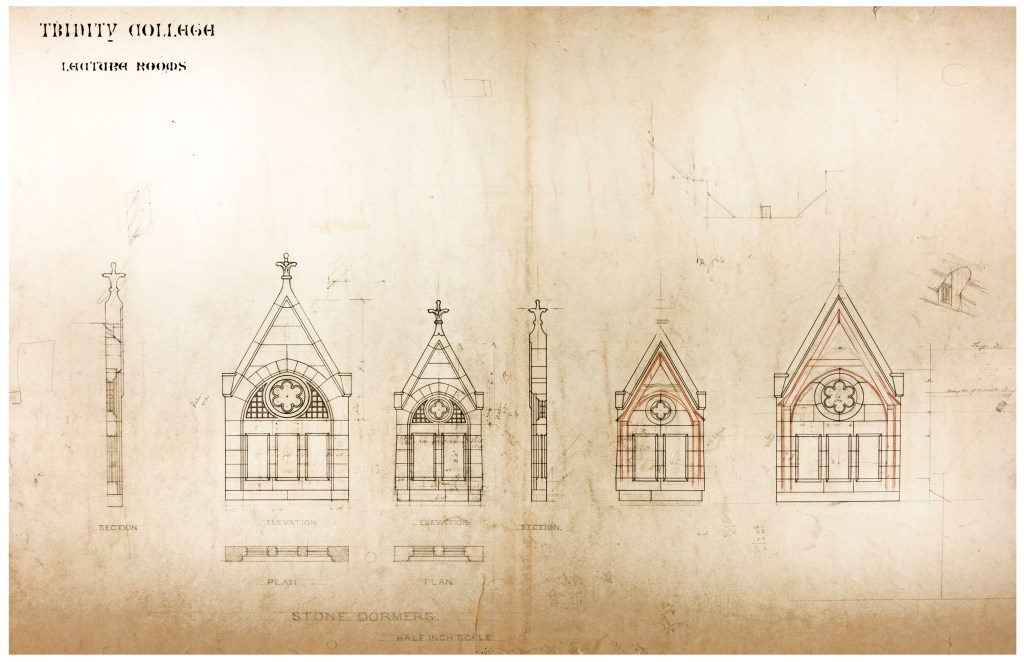
When Kimball redesigned the larger wooden dormers with stone he still incorporated the smallest wooden dormers which were placed over the stair-halls. Initially, Kimball had created two different styes shown in the illustration below, though it would be the designs with the plate tracery which matched the gothic windows on the first floor that were ultimately constructed.

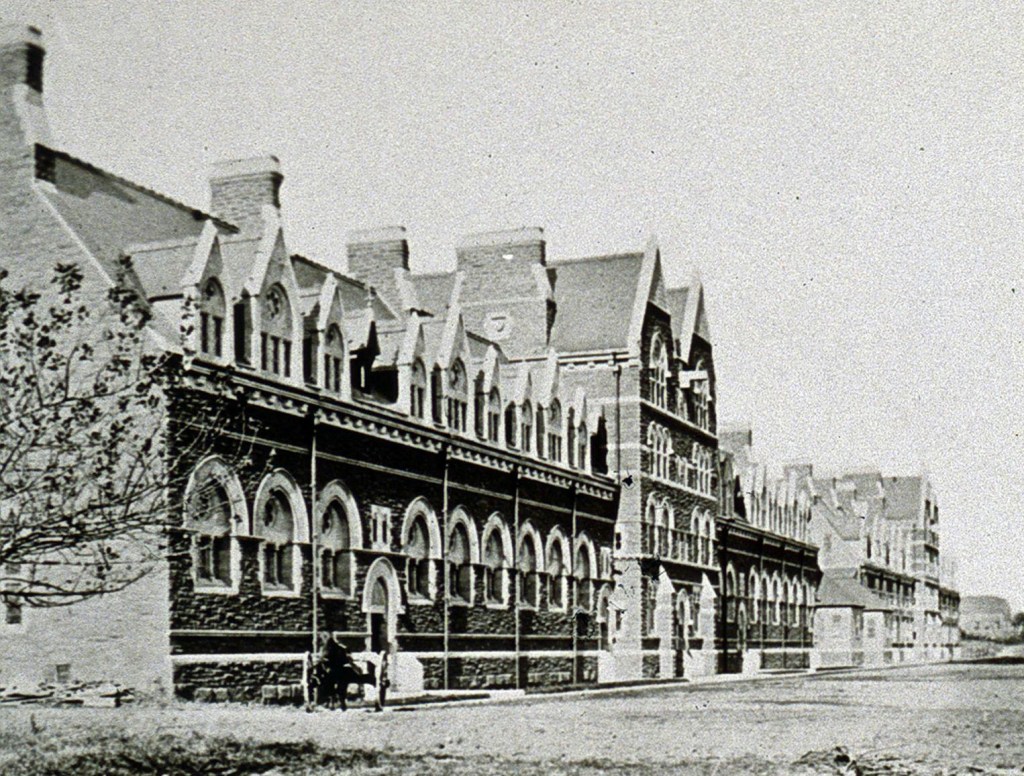
As construction of Jarvis and Seabury was nearing completion, Kimball presented his final report to the building committee on March 2, 1878. In that report, he spelled out the individual costs which at that time totaled almost $346,000.00 with an estimate of just over $52,000.00 to complete the two buildings. A couple months later, Kimball wrote a letter to President Thomas Pynchon saying that the total estimated cost would be $400,000 plus an extra $35,000 to complete the kitchen and dining hall. In that report, Kimball did state that he made a couple fundamental changes to the design and construction of the two buildings. First of all, he justified the use of a more expensive stone rather than brick stating, “for collegiate or in fact for any public building, the use of brick is out of the question. It lacks dignity and repose, the walls trim white, and rapidly change for the worse.” Because of the more expensive material, Kimball did state that he reduced the thickness of the walls from Burges’ original design as a way of cutting material costs. Another fundamental change which probably increased the construction costs was that he had made the decision to raise the buildings slightly, allowing for greater exposure of the basement windows. Also, the foundations for the gateway between the buildings were constructed up to the water table and the kitchen for the dining hall was placed in the basement. It the completion of the gateway tower that will be the subject of the next posting…..
Further Reading:
- Armstrong, Christopher Andrew, “Qui Transtulit Sustinet: William Burges, Francis Kimball and the Architecture of Hartford’s Trinity College,” Journal of the Society of Architectural Historians vol. 59, no. 2 (June 2000): pp. 194-215.
- Brocklesby, John, “Trinity College, Hartford,” Scribner’s Monthly vol. XL, no. 5 (Mar. 1876).
- Pullan, William Popplewell, The Architectural Designs of William Burges, A.R.A. (London, 1883).
- Pullan, William Popplewell, The Architectural Designs of William Burges, A.R.A: Details of Stonework (London: B.T. Batsford, 1887).
- Trinity College, Hartford, Connecticut: The College Pictured, [n.p., n.pub., 1900].
- Weaver, Glenn, The History of Trinity College vol. 1 (Hartford: Trinity College Press, 1967).
- “F. H. Kimball Report to the Building Committee, Feb’y 20th, 1878. Laid before the Trustees at their meeting held March 2, 1878,”
 The Architecture of Thomas Wisedell