Jarvis and Seabury Halls opened in September 1878, though the chapel and museum were not completed until January. What was still missing, however, was the gateway connecting the two buildings. William Burges died on April 20, 1881; coincidentally, that was the same day that one of Trinity’s oldest trustees, Col. Charles H. Northam (1797-1881) announced his intention to donate $40,000 to construct the monumental gateway. This proposal was accepted on April 23 and construction commenced on July 1 on what would become Trinity’s most prominent landmark. Before the gateway could be completed, Northam unfortunately fell ill and died on November 12. During construction, the building was informally known as Northam Towers and on July 28, 1882, the trustees formally adopted the name as a fitting tribute.
In the college newspaper, The Trinity Tablet, the architects for Northam were listed as “Kimball and Wisedell of New York.” Technically this was correct since they had created all the contracts. This, however, has unfortunately led to the misunderstanding that it was Kimball rather than Burges who was responsible for the overall design of Northam. In the summer of 1879, Kimball had formed a partnership with Thomas Wisedell of New York, though he continued to live in Hartford until 1880 and rented an apartment in New York City. It is doubtful that Wisedell had a hand in designing Northam as he was quite occupied with numerous commissions that the firm was designing at that time. Also, when Northam announced his gift, he stated that he would donate the funds “if the trustees will construct the gateway between the present colleges [Jarvis and Seabury Halls], according to the plans submitted by Mr. Kimball,” implying that a design was already in place.
William Burges, architect, 1872
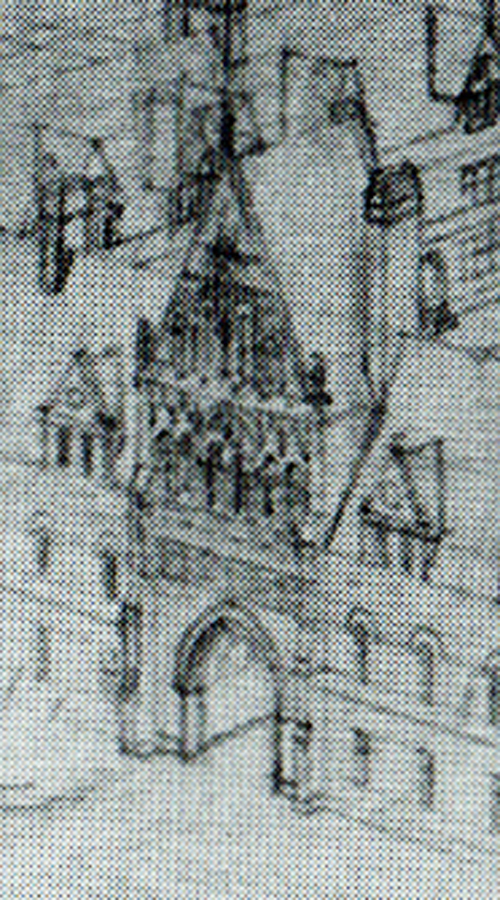
The idea of a gateway tower had been integral to Burges’ plans for Trinity College since their inception with the L-shaped in 1872. At that time, the towers created a north/south axis through the professors’ and students’ quads. These were four-story towers designed in a 13th century, French gothic style, a theme that Burges would maintain as the project progressed.
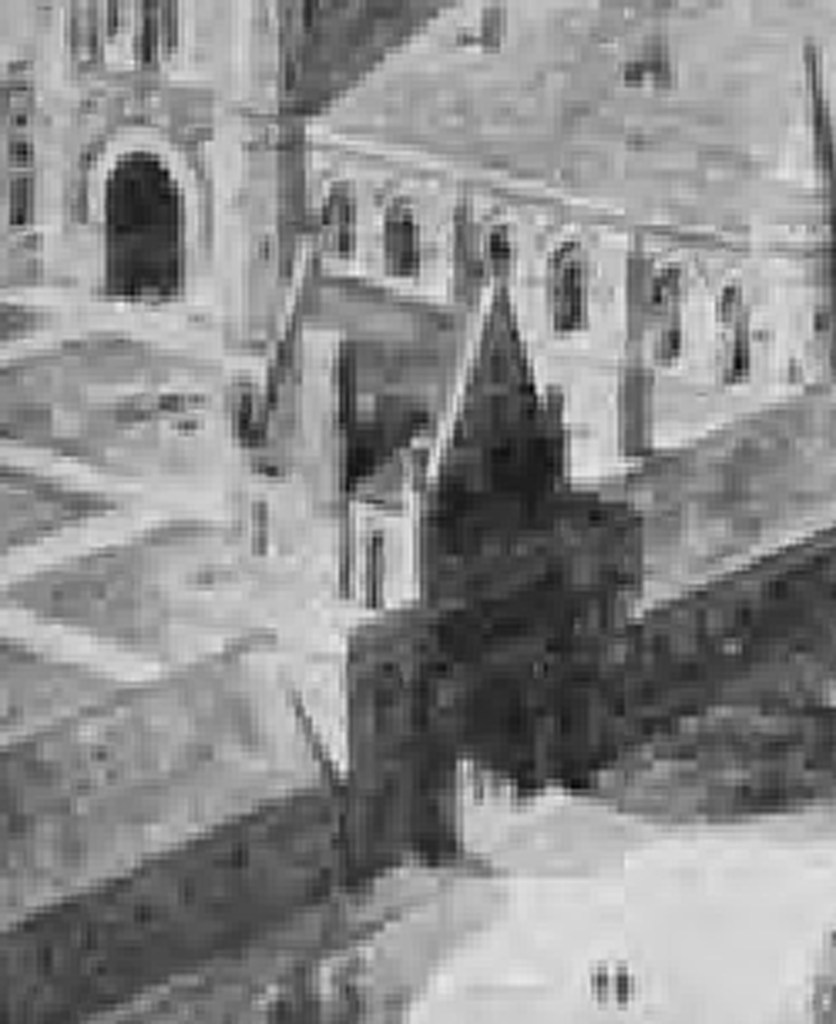
When president Jackson returned to London in the summer of 1873 and the three-quad plan was reworked form an L-shaped plan into a linear pattern, Burges altered the gateways to include smaller two-story towers at each corner. Later that summer, as Jackson and Burges added a fourth quad to the plan, the gateway towers were redesigned by changing the direction of the roof gable and increasing the corner towers to three stories. Also, the actual gateway through the tower was widened and redesigned with a large central arch for carriages flanked by smaller arches for pedestrians.

From December 1874 through October 1874, Francis Kimball worked alongside William Burges in London creating working drawings for a variety of buildings at Trinity College which were unfortunately left unbuilt. Among those drawings, however, were plans for a three-story gateway with smaller corner towers capped with conical roofs. This drawing exhibits some of the basic ideas that were hallmarks of Burges’ design philosophy including a reliance on 13th century French gothic precedence with over-scaled details and masses crowding in on each other.
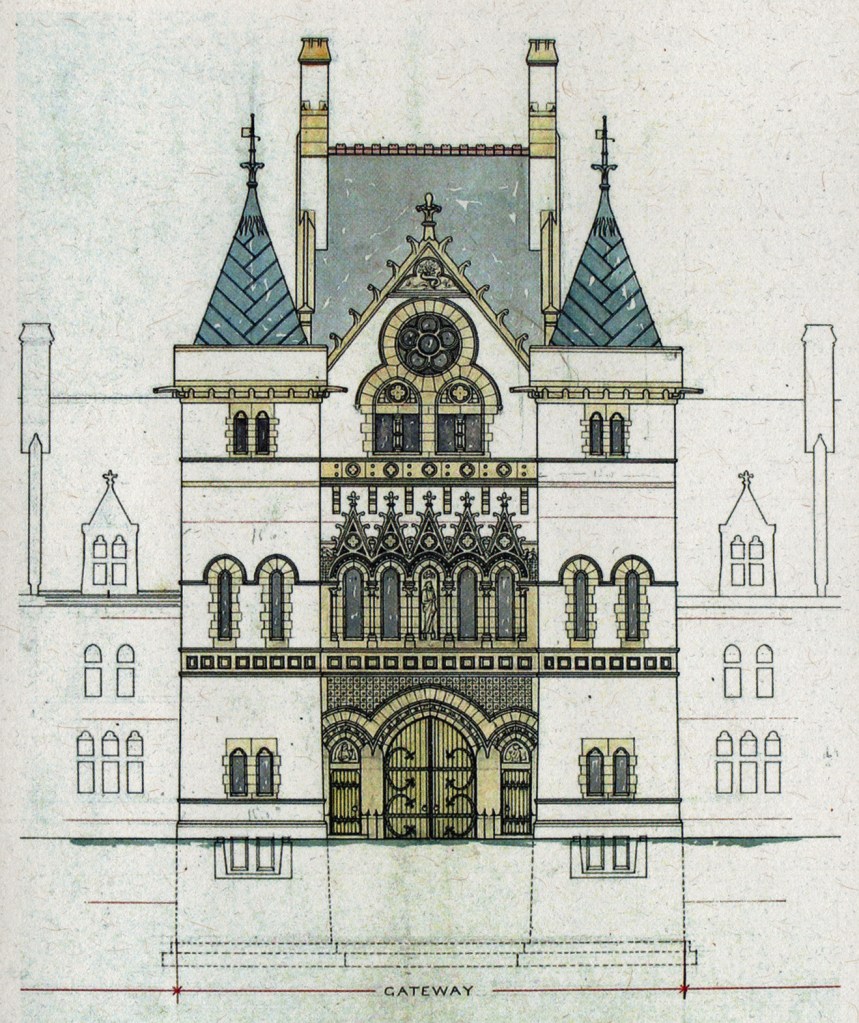
The basic form and massing for Northam Towers was established in 1875 when Kimball and Pynchon created the final three-quad plan with larger gateway towers centered on the east and west wings of the central, large rectangular qua. By the fall of 1878, the foundations were constructed up to the water table and the basement was fully enclosed, housing the heating apparatus for the campus as well as the kitchen for the dining hall.
As noted earlier, Kimball had sent plans to Burges in February 1876. Included in those plans must have been the new three-quad plan with this design for Northam. Later that year, Kimball produced design below which had broader and bolder proportions matching the size of the building that was eventually constructed.
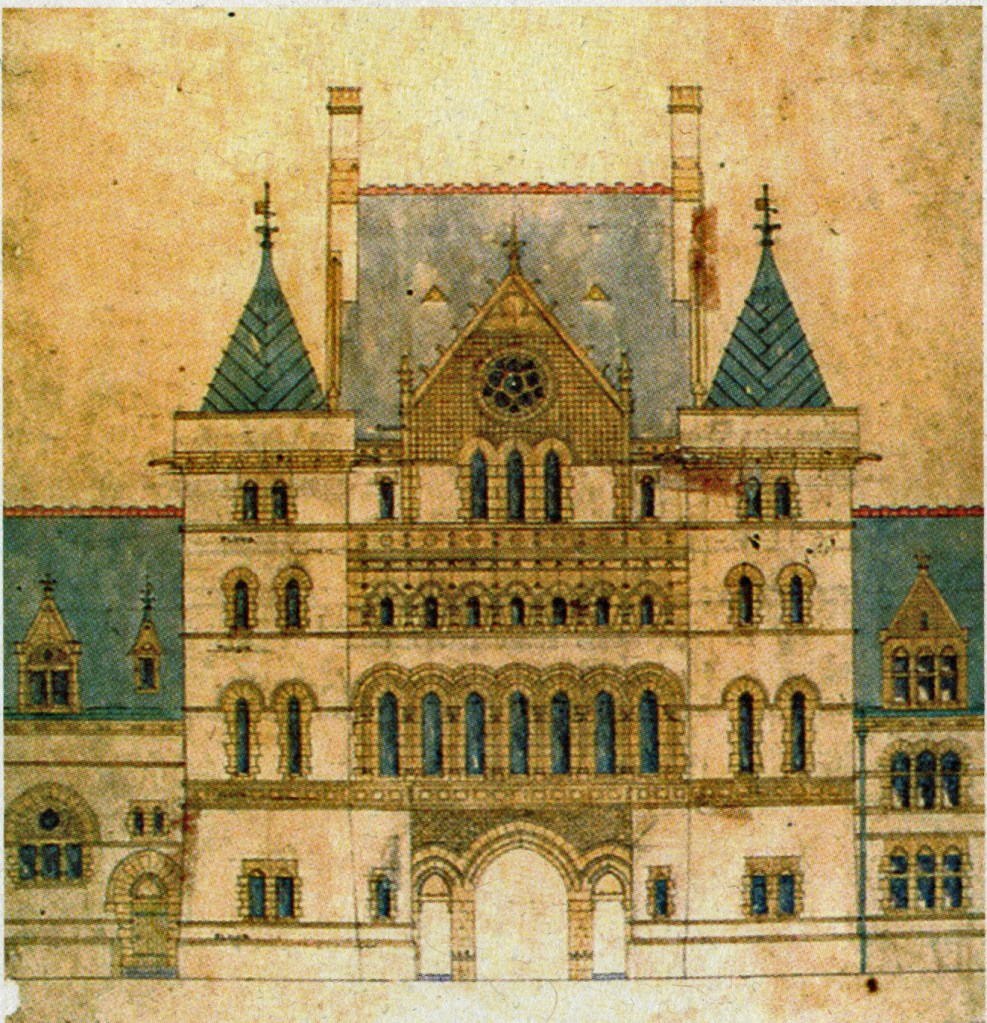
For this design, the building’s width was broadened and reincorporated the central gable as well as the carriage and pedestrian entrances from Burges’ 1874 design. Since this rendering was produced after Kimball sent plans to London in February 1876, it most likely was created with input from William Burges.
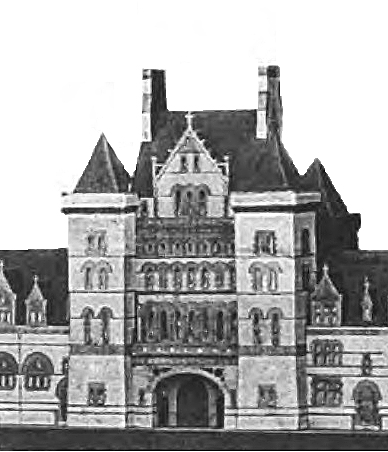
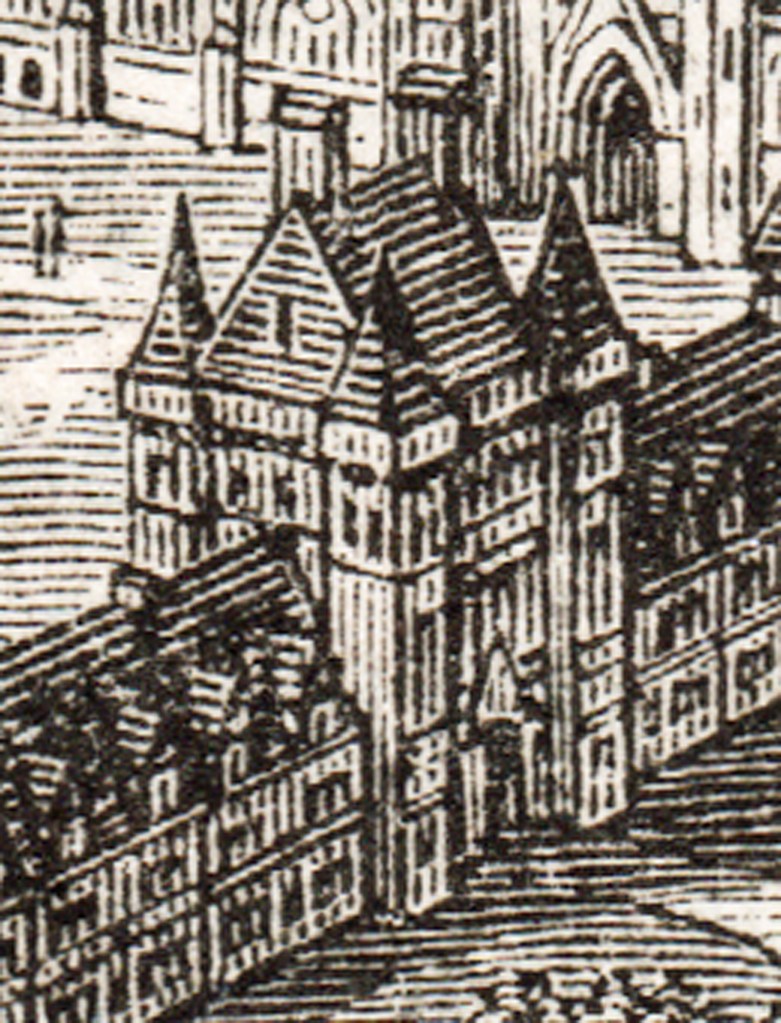
Late in 1874, Kimball had a model built that reflected the overall design for the long walk and as the project evolved, Kimball continuously updated the model. The model was photographed in late 1876 or early 1877, and not only showed the final design for Jarvis and Seabury Halls, but also showed that Northam’s design had evolved. The front gable and the arcade of smaller windows had been raised and another arcade was inserted at the third story. At the ground level, the pedestrian and carriage entrance was recessed and a broad, gothic arch was added, showing that the area between the towers was given more depth, requiring the need for the second arch. These details are minor enough and borrow from Burges’ design elsewhere that it is Burges, not Kimball (as had long been presumed) who must be given credit for the overall design of Northam Towers.

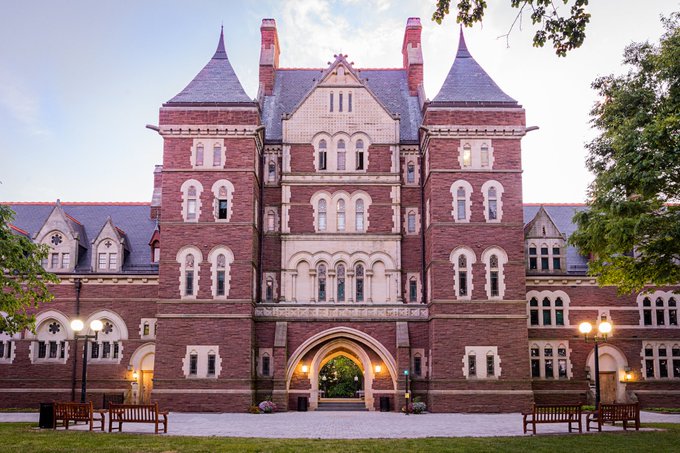
Though Northam’s design was pretty much completed before Burges’ death in 1881, though the building did have other refinements principally to the middle of the building. The proportions were slimmed by turning the upper floors into a broad bay, reducing the arcade from seven arches to five with three arches on the third floor. The arcade of smaller arches was eliminated and the gable was realigned with the fourth floor. For the entrance, the broad, gothic arch on the exterior was simplified and the recessed pedestrian and carriage was simplified into a single arch. What probably prompted the redesign of the entrance was that carriages would not be permitted and stairs were added making it accessible only to pedestrians.
With the opening of Northam Towers in 1883, the “Long Walk” was given its complete form. Throughout its construction, numerous architects visited the site studying the drawing and taking photos. Most notably, Henry Hobson Richardson visited the site in 1878 after the completion of Jarvis and Seabury Halls, transforming his own designs and influencing his designs for his numerous libraries as well his plans for Sever Hall at Harvard University.
Between 2007 and 2022, the entire Long Walk was cleaned and restored giving a modern day glimpse into the effect that William Burges vision had when the buildings were completed almost 140 years earlier.
Further Reading:
- Armstrong, Christopher Andrew, “Qui Transtulit Sustinet: William Burges, Francis Kimball and the Architecture of Hartford’s Trinity College,” Journal of the Society of Architectural Historians vol. 59, no. 2 (June 2000): pp. 194-215.
- Brocklesby, John, “Trinity College, Hartford,” Scribner’s Monthly vol. XL, no. 5 (Mar. 1876).
- Brocklesby, William C., “Trinity College,” in The College Book, edited by Charles F. Richardson and Henry A. Clark (Boston: Houghton, Osgood and Company, 1878): pp. 263-276.
- Pullan, William Popplewell, The Architectural Designs of William Burges, A.R.A. (London, 1883).
- Pullan, William Popplewell, The Architectural Designs of William Burges, A.R.A: Details of Stonework (London: B.T. Batsford, 1887).
- Weaver, Glenn, The History of Trinity College vol. 1 (Hartford: Trinity College Press, 1967).
- “F. H. Kimball Report to the Building Committee, Feb’y 20th, 1878. Laid before the Trustees at their meeting held March 2, 1878.”
 The Architecture of Thomas Wisedell