When Francis Kimball was hired by Trinity College, he must have taken the job not as a full-time position, but rather as an extension of his private architectural practice. After returning from London, not only was he responsible for the design and construction of Trinity College, but also had to complete the interior designs for the George P. Bissell Banking House which was begun before his trip abroad. More than likely, Kimball had actually worked on some the bank’s interior features while he was in London.
By the time Kimball returned to Hartford in October 1874, construction of the exterior of the Bissell & Robinson and Corning Buildings was almost finished (see Part 12). Before the end of the year, Kimball had designed the banking room for Geo. P. Bissell & Co. This was described as being “finished throughout in solid, richly polished oak,” with plate glass screens also framed in oak. The floors were completely covered with encaustic tiles of buff and blue colors. The furniture and mantels were also constructed of oak and cut and ground glass windows separated the offices from the banking hall. In the basement were the vaults sealed in five feet of concrete and constructed of brick and concrete with iron doors weighing almost two tons. Geo. P. Bissell & Co. opened in their new banking space in mid-August 1875. Unfortunately, no photos of this interior have been located.
In the spring of 1875, as Kimball was completing the designs of Seabury and Jarvis Halls, he was also working out plans for a residential design for Henry W. Scovill (1853-1919) of Waterbury, Conn. which by the newspaper accounts, seemed to have been influenced by Frederick Clarke Withers’ recently completed Goodwin house in Hartford. Also at that time, Kimball entered a competition to design a new synagogue for Beth-Israel, Connecticut’s oldest and largest Jewish congregation. Unfortunately, both designs remained unbuilt as Scovill opted to stay in his family’s 18th century Georgian home while the competition for Temple Beth-Israel was won by the partnership of George Keller and Emil Schwab of Hartford. This event marked the second time Keller and Kimball had competed against each other for a coveted commission. This time however, it was Keller who triumphed.
In either late 1875 or early 1876, Kimball gained a commission to design a new warehouse for Elisha T. Smith (1820-88) at 222-224 State Street in Hartford. Smith was one of Hartford’s wealthiest citizens having founded his own wholesale grocery firm in 1845. He was soon involved with shipping and later became associated with the Connecticut River Steamboat Company becoming its president and designed the steamer City of Hartford. Around 1860, he entered the sugar and molasses trade in New York City, though he also maintained his Hartford residence on Ann Street. In 1866, Smith left New York City and, returned to live in Hartford full time.
By the mid-1860’s, Smith had been acquiring property on State Street and eventually owned the three buildings at 222-232 State Street, maintaining his own business at 230-232 State Street. In 1868, he constructed a four-story warehouse at 226-228 State Street with Romanesque arches on the ground floor constructed of brick with brownstone trim. By 1875, Smith had become one of Hartford wealthiest citizens with the largest distillery in Connecticut.
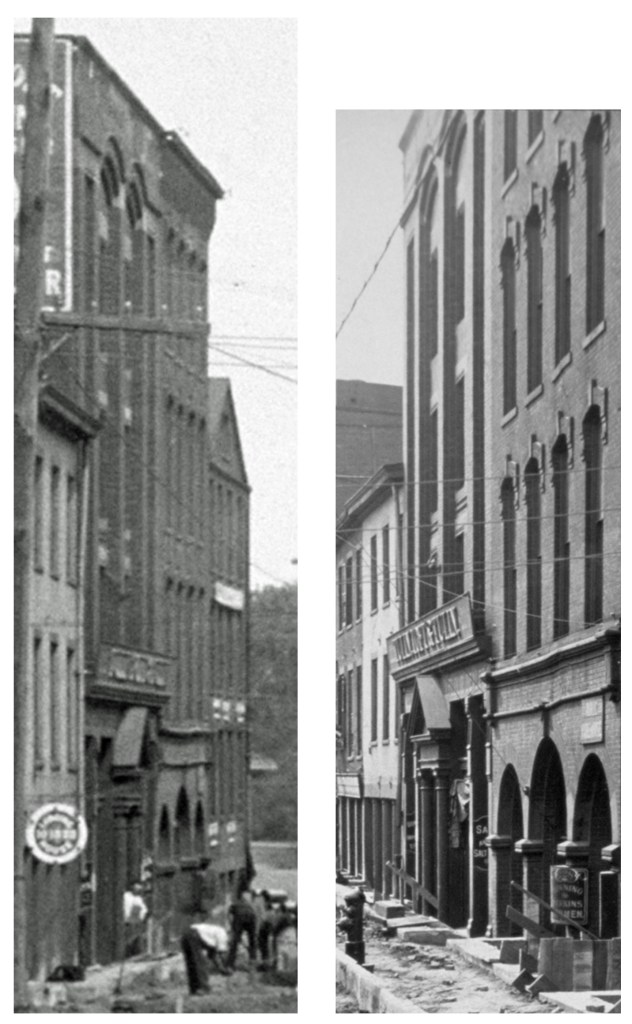
Right: Elisha T. Smith Building looking north on State Street, 1908.
The warehouse was four-stories with a glass and cast iron ground floor and tall, three-story arches on the upper floors. On the ground floor, Kimball designed a classically detailed storefront with modified Tuscan columns flanking an arched doorway, all capped by a triangular pediment. On either side of entrance were massive sash windows ornamented with square and rectangular, stained glass panels. On each side of the windows were doors leading to the upper floors designed with rectangular panels echoing most of the window treatments.
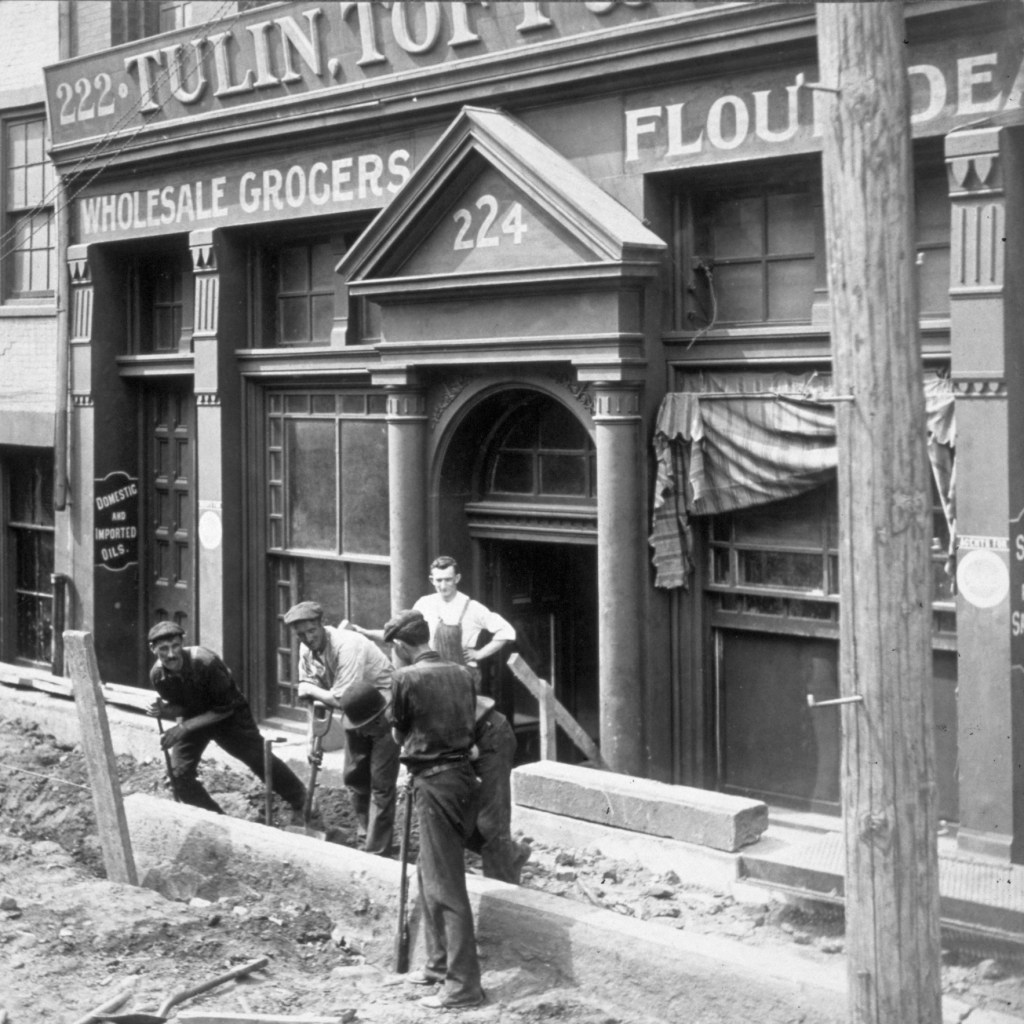
For the upper floors, Kimball designed a pair of arches with recessed spandrels allowing the arches to rise a complete three stories uninterrupted by horizontal elements. Flanking the arches were three story, rectangular panels, also with recessed spandrels, giving the building a strong sense of verticality.
The interior was planned with a central entrance hall which led to two flights of stairs leading to the upper floors. On each side of the hall were relatively small offices with rooms for housing merchandise in the rear. Compared to its relatively staid neighbors, the building definitely stood out with its brightly painted, cast iron and red brick with light-toned, Ohio stone accents on the upper floors. The building was completed by the end of 1876 at a cost of $5,000.00.
This was Kimball’s earliest known commercial design following the ten months he spent in London. What may have provided a reliable model for this building was William Burges’ remodeling of a warehouse on Upper Thames Street in London designed in 1865 for Joseph and John Skilbeck and constructed the following year.
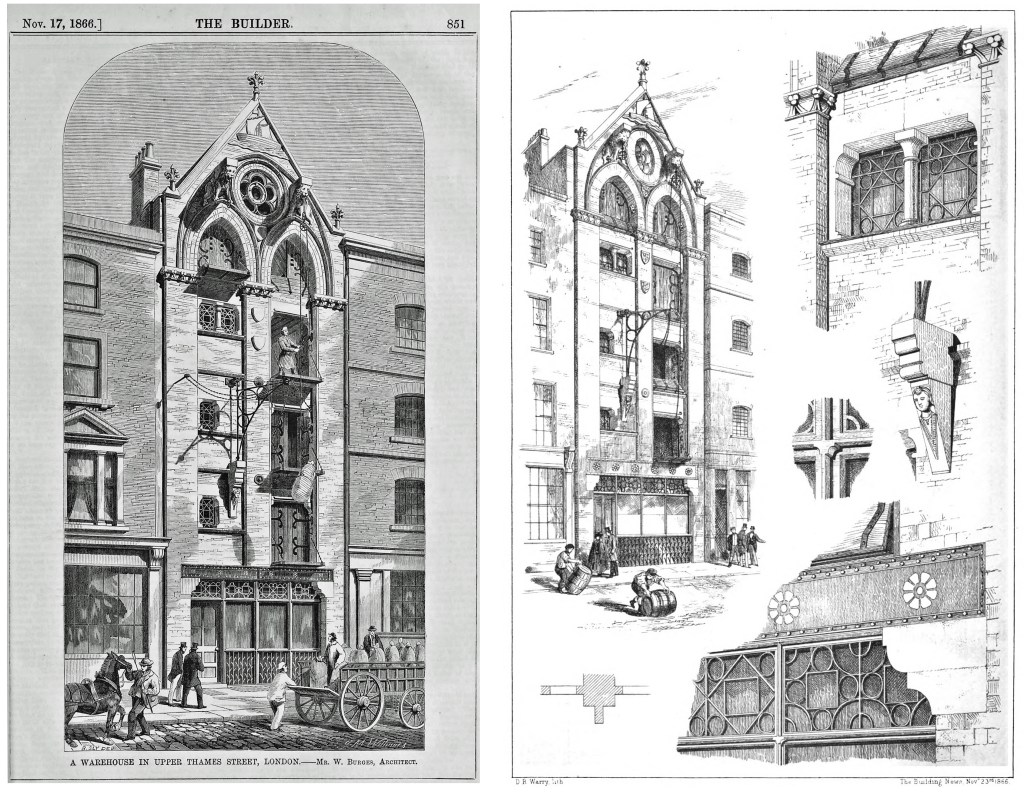
That building had a shopfront designed with wrought and cast iron with a pair of three-story, gothic arches on the upper floors. Within the arches, the windows and floor were slightly recessed allowing the arches to remain uninterrupted. This building had gained tremendous attention when it was constructed, sparking debate over the appropriateness of a gothic application not only to commercial structures, but also to warehouses which were seen as requiring the simplest treatment without sculpture or superfluous décor.
One critic of the warehouse by Burges pointed out that there was little relationship between the cast iron shopfront and the design of the upper floor. The same seemed to apply to the building on State Street, where the upper floors have more in common with the neighboring building’s series of ground floor arches. With this project, Kimball seemed to be grappling with how to integrate classical rationale of Bryant & Rogers with the more expressive and colorful designs of William Burges. In other words, Kimball was beginning to develop an architecture that was identifiable as his own, and with his next project, Kimball would begin getting a recognition that would continue for the next forty years….
Photos of the Elisha T. Smith warehouse are from https://collections.ctdigitalarchive.org
Further Reading:
- Crook, J. Mordaunt, William Burges and the High Victorian Dream (Chicago and London: University of Chicago Press, 1981).
- “A Warehouse in Upper Thames Street, London, Mr. W. Burges, Architect,” The Builder 24 (Nov. 17, 1866): pl.
- “New Warehouse, 46 Upper Thames St., Wm. Burges, Arch’t,” Building News 13 (Nov. 23, 1866): p. 783; pl.
- “New Building on State Street,” Hartford Courant (Dec. 9, 1876): p. 1.
 The Architecture of Thomas Wisedell