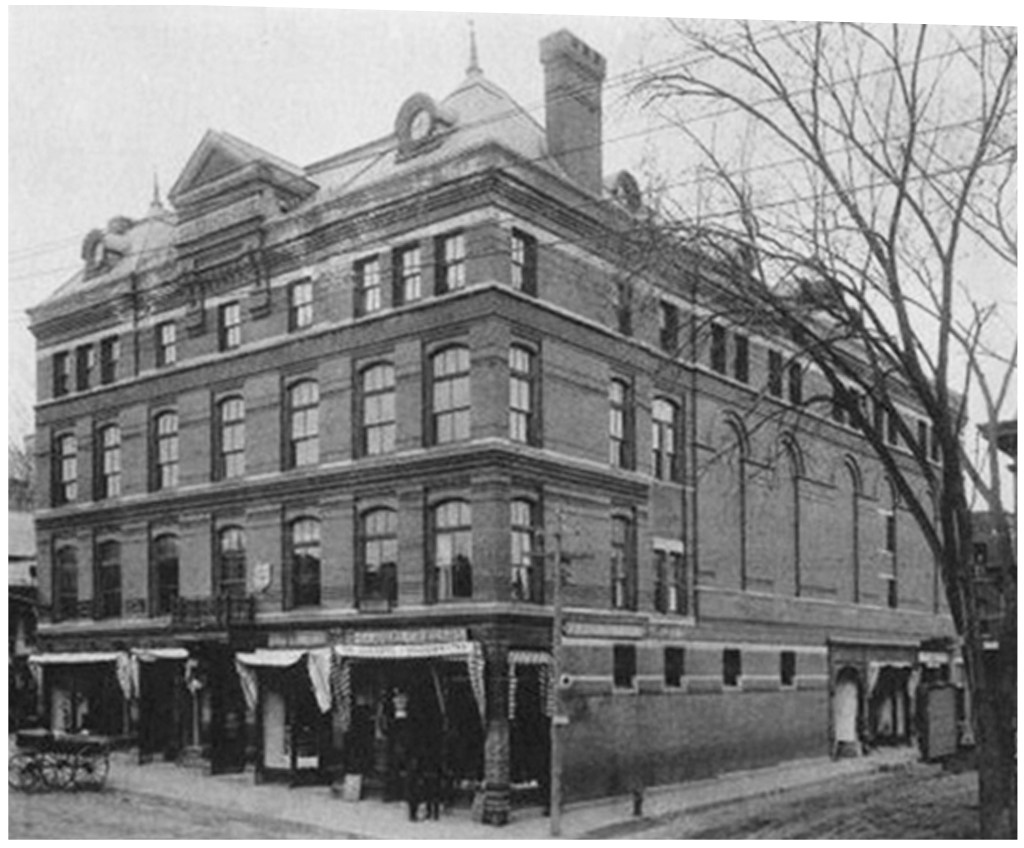
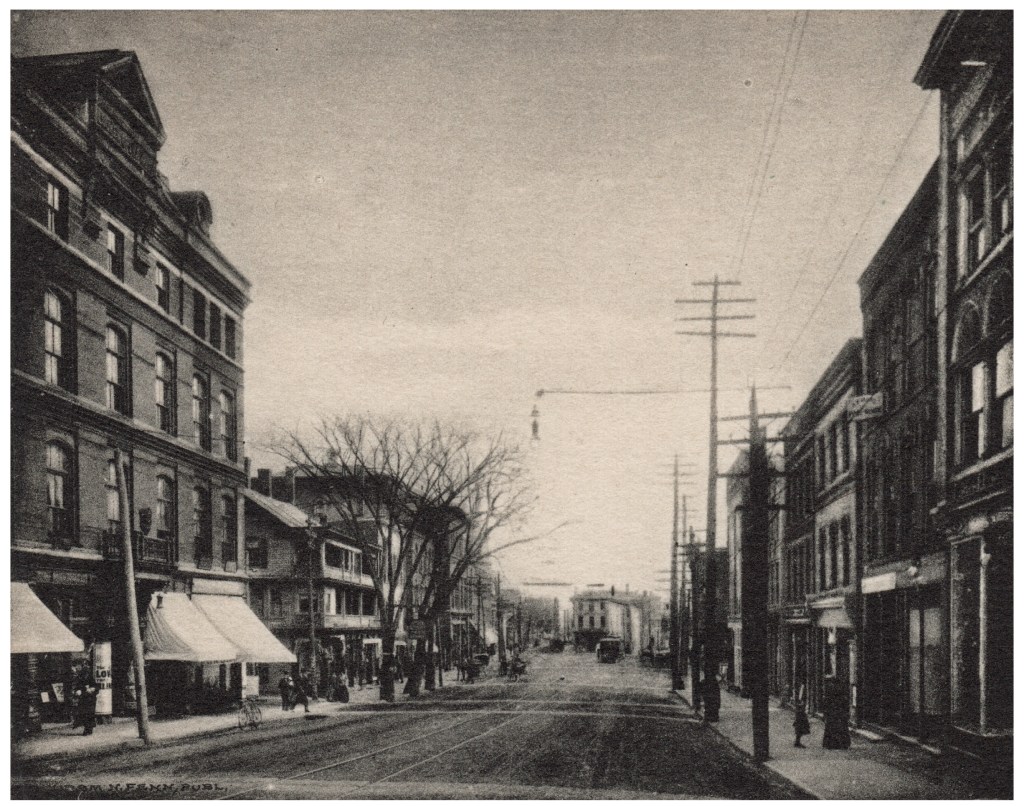
Shortly after Kimball was hired to design the Goodwin Building in Hartford in May of 1879, he was also asked to design a commercial block in Willimantic, Connecticut for Silas Loomer (1824-1899).
Loomer was originally from Columbia, Connecticut and in the 1840’s, he began teaching at Hop River. He soon set up a small business supplying lumber and coal to the Hartford, Providence & Fishkill Railroad and with the advent of the telegraph, Loomer also supplied the tall poles required to support the lines. In 1859, he was elected to the State Legislature.
After moving to Willimantic in 1861, Loomer established that city’s first lumber yard and coal dealership in 1862. He later served as the president of the Dime Savings Bank and also as a director for the First National Bank, the Willimantic Savings Institute and the Air Line Railroad which was the shortest and fastest route connecting Boston and New York City.
By 1878, Loomer had amassed a small fortune, sold his lumber and coal business and went into insurance and banking while also investing in real estate. On March 4, 1879, Loomer purchased property on the northwest corner of Main and North Streets and soon began removing the existing wooden structures and excavating for the foundations. By the end of April, Loomer had announced that he was about to erect a “proposed new block” fronting seventy-four feet along Main Street and extending one hundred twenty-five feet along North Street.
Though the announcement had been made, Loomer had still not hired an architect and was still unsure of what to erect on the site. Apparently, it was not until the site had been cleared and while foundations were being laid in July and August 1879 when Loomer had decided that an opera house would make a great investment not only for himself, but for the community. The Willimantic Enterprise newspaper had been pressing for the construction of an opera house, citing that Franklin Hall, which had been built in 1869, was too small for traveling shows and that Willimantic was being passed over by many of the best acts which toured New England.
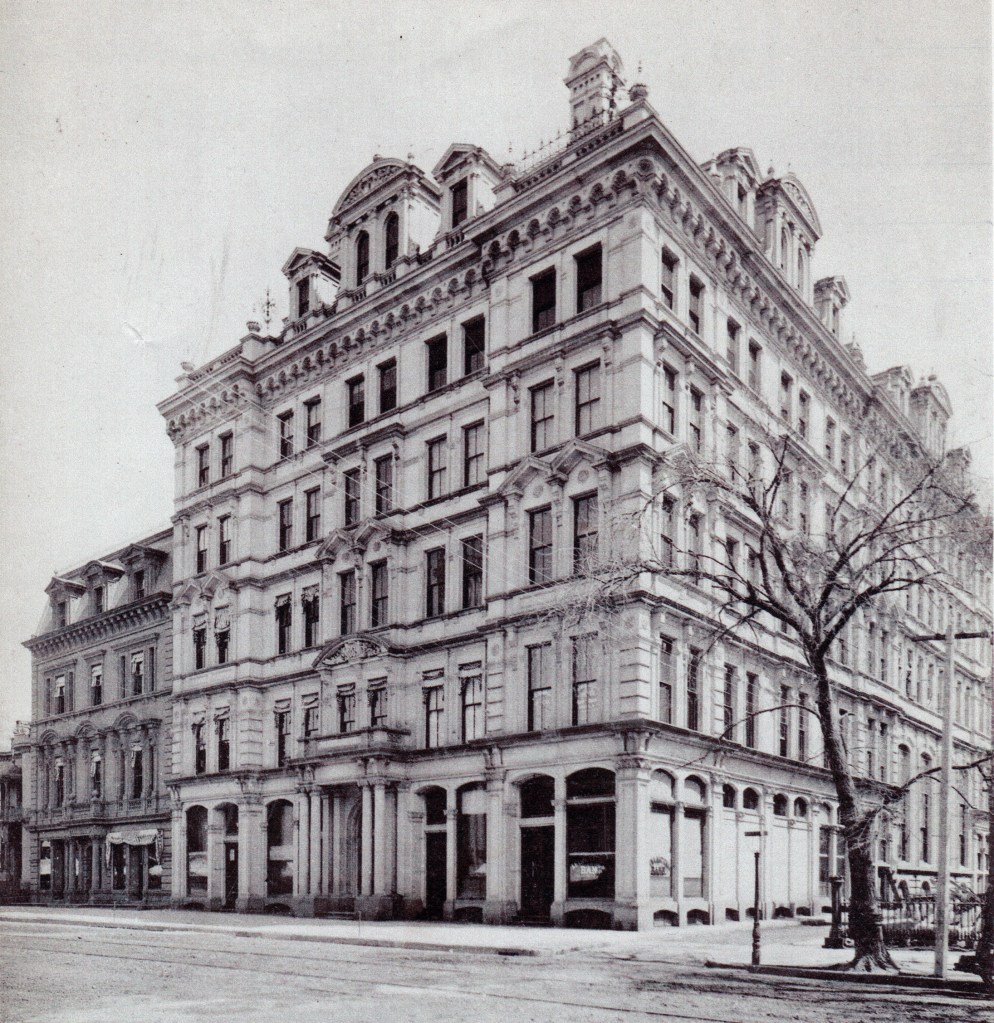
Since Loomer had interests in banking and insurance, he would have been quite familiar with Kimball’s work in Hartford, especially the buildings for Charter Oak and Connecticut Mutual Life Insurance companies. The overall design and massing of the opera house was quite similar to those earlier insurance buildings. Like those structures, this too utilized a symmetrical facade with horizontal stacking, slightly articulated end pavilions capped with pyramid roofs and a mansard roof over the remainder of the building. Also, the building’s functions were revealed by varying the style and arrangement of windows.
For the building in Willimantic the ground floor retail spaces had large, plate glass windows. Since the second and third floors both held office spaces, both floors were given identical, segmentally arched, sash windows. Above the windows on the third floor was a wide band of decorative brick coursing along the the Main Street and North Street facades. The top floor had a large ball room that was illuminated by rectangular, sash windows and ocular dormers in the mansard roof.
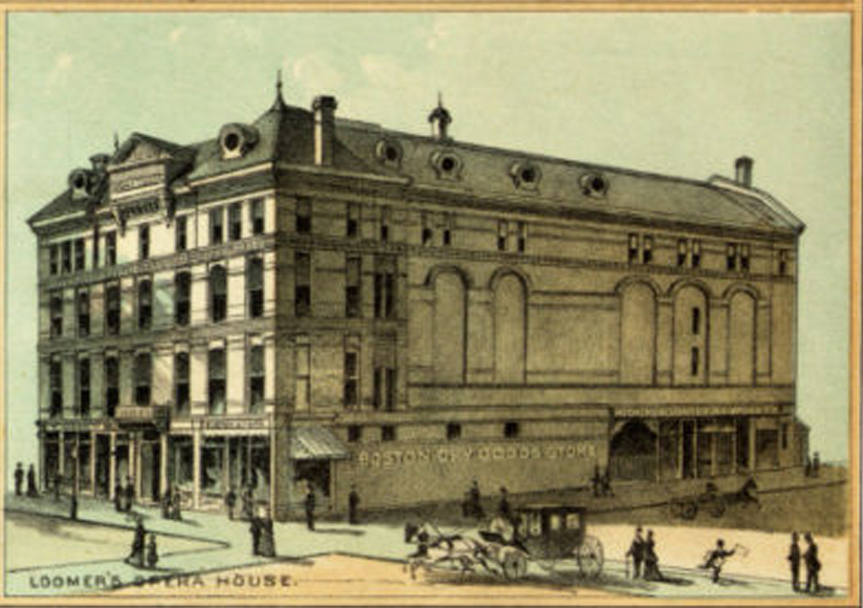
by the W.O. Laughna Art Publishing Company of New York City.
Along North Street, part of the wall was given square windows while the far end had two storefronts and a broad, carriage entrance for the theatre. The second and third floors had two a row of five, two story blind arches. Even the scale and placement of these arches recalled the two-story windows illuminating the large banking room on the Charter Oak Life Insurance building. The fourth story had rectangular sash windows as a continuation of those found on the Main Street facade.
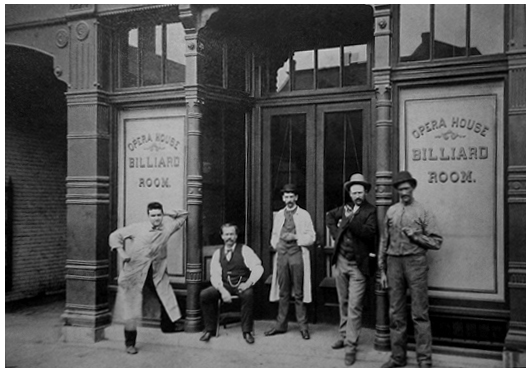
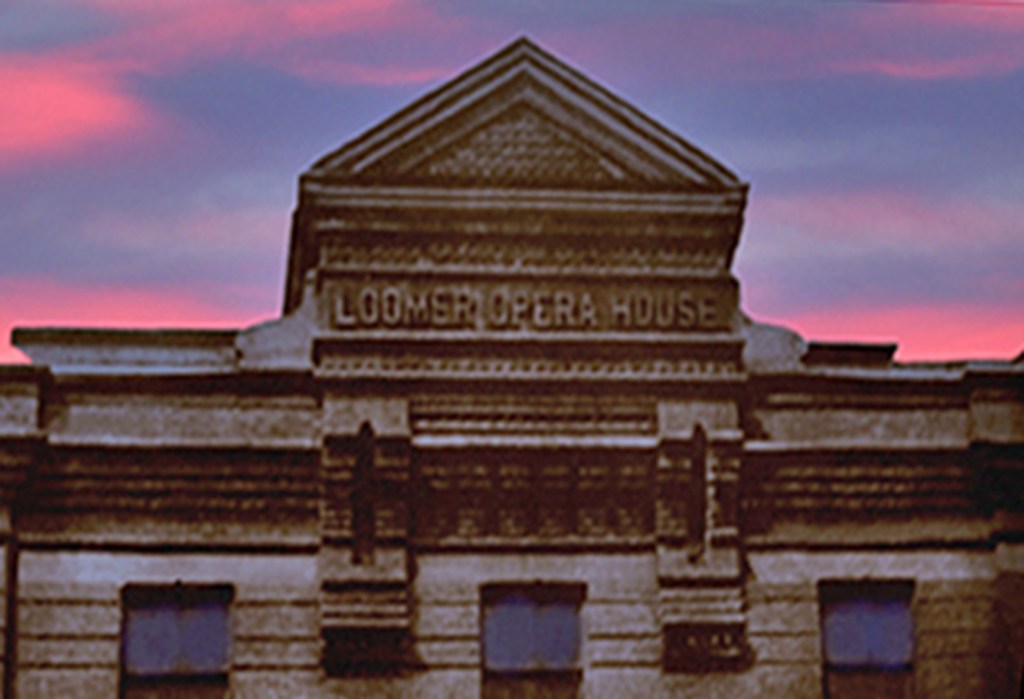
What separated this commercial building from those earlier insurance buildings, however, was the material and style. Rather than granite, the Opera House was constructed of red brick with light-toned Ohio sandstone bands and accents. A Queen Anne style gable was centrally placed on the building’s cornice. In relief on a stone band just above the cornice, were the words “Loomer Opera House.”
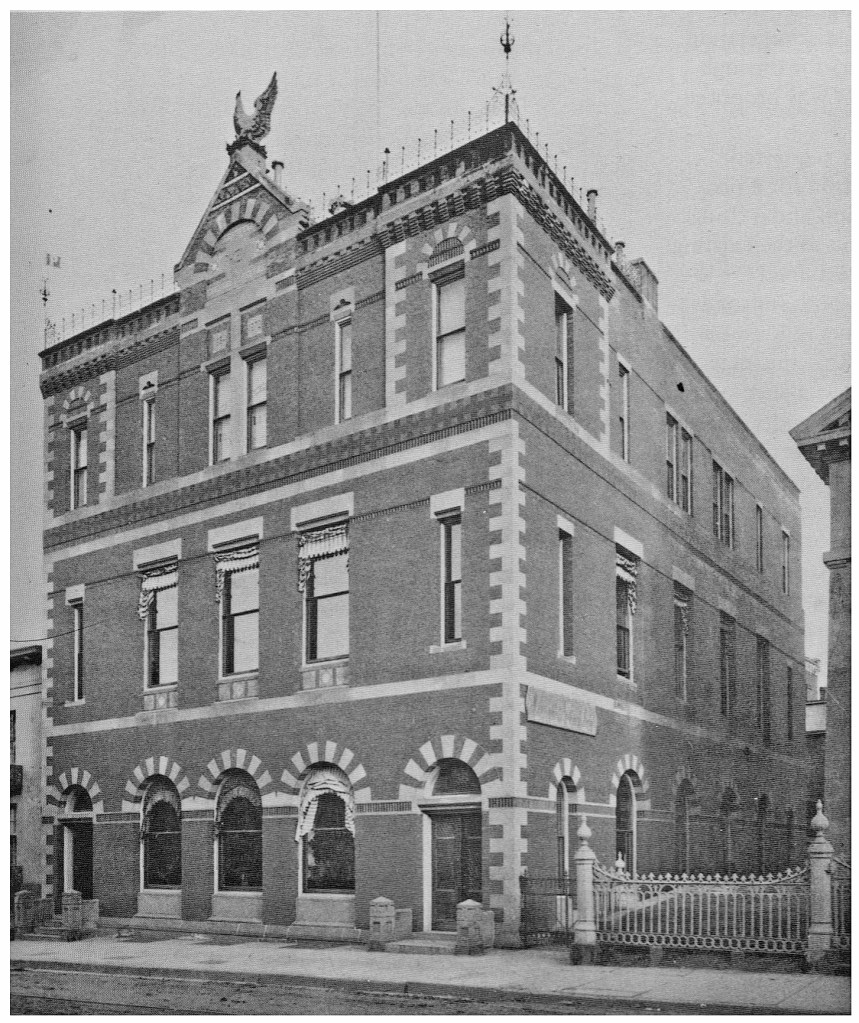
The model for this building may have been the Phoenix Fire Insurance Company building in Hartford which had been designed in 1872 by Charles Gambrill and H. H. Richardson and completed the following year. The building was designed as a Florentine palazzo with slightly articulated corner pavilions on the top floor. Later critics such as Henry-Russell Hitchcock basically dismissed this building as, “one building of the seventies which hardly deserves a place in Richardson’s canon.” However, at the time that it was constructed it was viewed as one of the best building in Hartford and was one of the first office buildings to experiment with polychromy and an attempt to move away from the ponderous granite, Second Empire buildings which had become the mainstay of Hartford’s insurance industry.
Kimball was quite familiar with the Phoenix Fire building since it sat on Pearl Street near the Connecticut Mutual Life Insurance Building and visible from his office in the State Savings Bank. Not only did Kimball have ample opportunity to witness the building’s construction, but had occasion to actually meet with Richardson when he was in Hartford in 1878 visiting Trinity College. Also, in a letter to the editor of American Architect and Building News, Kimball referred to the Phoenix Fire building as “less pretentious but fully… pleasing.”
The principle features that Kimball borrowed from Richardson’s Phoenix Fire building were the central gable, the end pavilions being designed only on the top floor, the corbeled brick cornice, the sandstone coursing at each floor, and the wide, brick band separating the top two floors. On the opera house, though, Kimball used small terra cotta tiles rather than brick to create the band. Perhaps as a response to the flatness of Richardson’s facade, Kimball used projecting piers, recessed windows and corbeling to give the facade depth and texture. Add to that the style of the gable, and once again Kimball incorporated emerging traces of the Queen Anne style.
Shortly before he was hired to design the Opera House, Kimball had formed a partnership with Thomas Wisedell of New York. The firm of Kimball & Wisedell was initially established with the commission to remodel the Madison Square Theatre in New York City (the subject of future postings). Though Thomas Wisedell’s name was never associated with the Opera House, the fact that the two men were actively designing a theatre in New York City surely implies that Thomas Widedell would have had some influence the building’s design, perhaps explaining why the central gable was done in a Queen Anne style.
The 1,100-seat opera house was 62′ by 70′ with a 40′ high ceiling and a massive stage measuring 60′ wide and 34′ deep, all lit by gasoliers. Though photos of the stage exist, no photos of the auditorium have been found and contemporary descriptions did not fully convey the colors and style used. What is known, however, is that there were two galleries with four proscenium boxes and that the auditorium seating was designed in the standard horseshoe arrangement and was fitted with mahogany folding chairs with cherry and mahogany throughout. The floor was angled with a three-foot pitch, increasing the sight-lines considerably from the rear. The ceiling was designed with a large, circular, glass dome encircled by numerous gas jets.
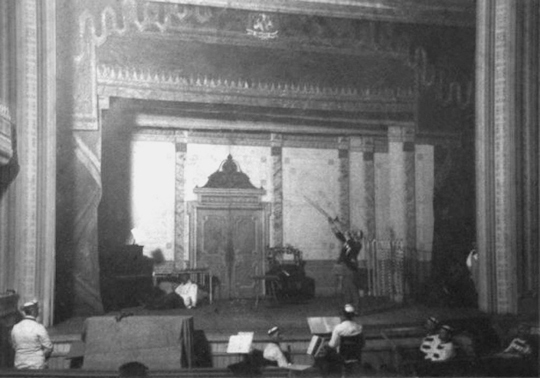
W. H. Griffin of Booth’s Theatre in New York City designed twelve separate scenes and Hughson Hawley, who worked with Kimball & Wisedell on the Madison Square Theatre, painted the act drop which was a historic scene of the ancient actor Roscuis (ca. 126-62 B.C.) and his entrance into Rome. For the paintings decorating the auditorium, Kimball brought in Vincent G. Stiepevitch, a recent Russian emigrant who had painted a large mural for the box office entrance to the Madison Square Theatre.
The first retail stores began occupying the building in April 1880 though the opera house was not completed until the fall. On November 9, the Loomer Opera House formally opened to Franz Suppe’s Fantitza and Eduard Holst’s The Bells of Normandy, both performed by the Boston English Opera Company.
By the end of the nineteenth century, the opera house mostly staged vaudeville performances and silent movies were screened by 1903. With the construction of the Gem (1912) and Capitol (1926) movie theaters, the opera house was seeming rather obsolete and quite expensive to operate.
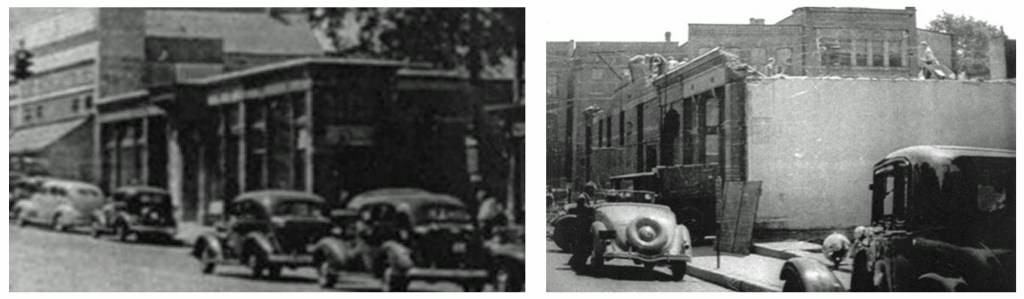
Right: Demolition of North Street facade, Loomer Opera House, 1939.
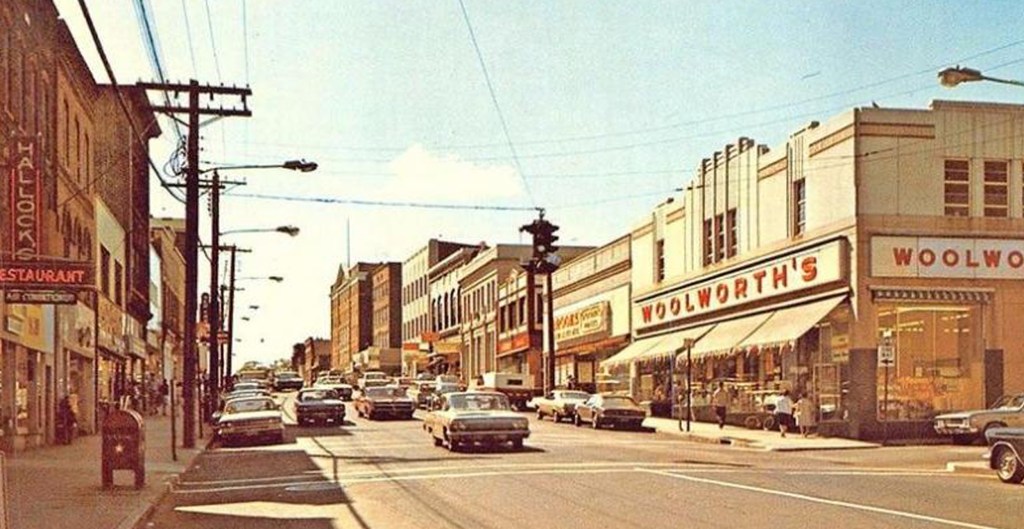
The Loomer Opera House closed in the mid-1930’s though the ground floor tenants remained until 1939. That year, the Loomer family sold the building to the engineering school at the Massachusetts Institute of Technology who slowly demolished the building so they could study its construction methods. Unfortunately, that study has not been found. The following year, a one story building was constructed for the F.W. Woolworth Company on the former site of the Loomer Opera House.
The photographs of the opera house came from the websites https://loomeroperahouse.wordpress.com/ and https://threadcity.us/
Further Reading:
- Bayles, Richard M., History of Windham County, Connecticut (New York: W. W. Preston & Co., 1889).
- Beardsley, Tom, “Opera House Brought Culture to Willimantic,” The Willimantic Chronicle (Feb. 1, 1997): p. 7.
- “Building in Hartford,” American Architect and Building News vol. 1 (Oct. 21, 1876): p. 339.
- Hitchcock, Henry-Russell, The Architecture of H. H. Richardson and His Times, rev. ed. (New York: The Shoe String Press, Inc., 1961).
- Lincoln, Allen B., editor, A Modern History of Windham County Connecticut vol. II (Chicago: The S. J. Clarke Publishing Company, 1920).
- “Loomer Opera House,” The Willimantic Chronicle (Nov. 10, 1880).
- Oschner, Jeffrey Karl, H.H. Richardson Complete Works (Cambridge, MA and London, UK: The Mit Press, 1982).
- T. [sic] H. Kimball, “Building in Hartford,” American Architect and Building News vol. 1 (Nov. 4, 1876): p. 359.
- Willimantic Chronicle (April 28, 1880).
- Willimantic Chronicle (Nov. 3, 1880).
 The Architecture of Thomas Wisedell