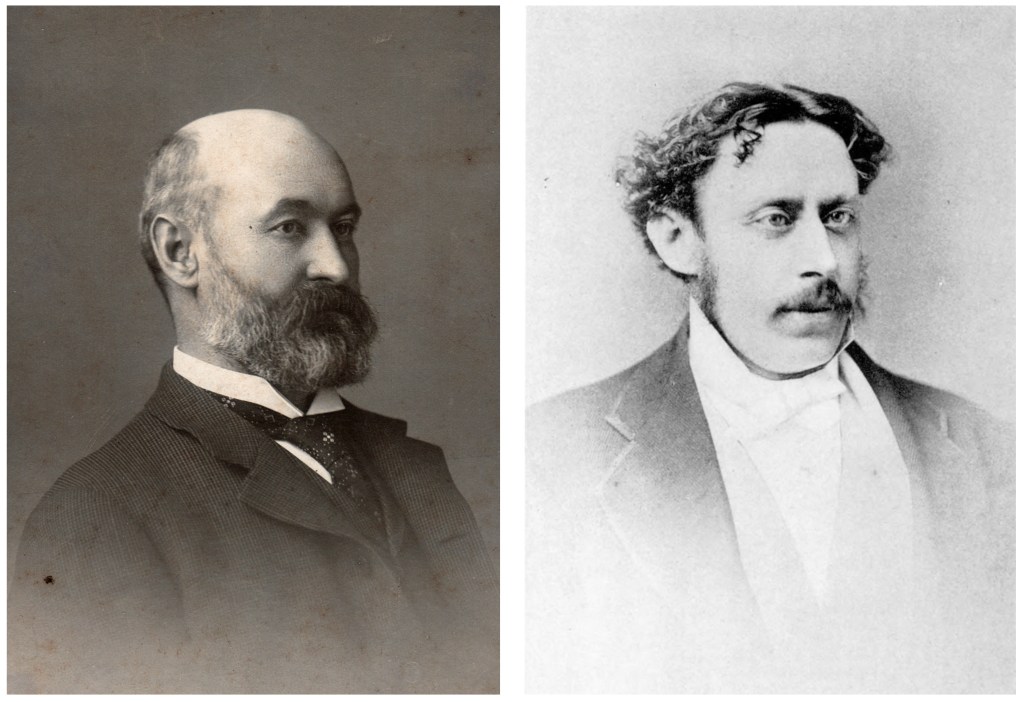
Right: Thomas Wisedell, ca. 1875. Photo collection of the Library of Congress.
By the summer of 1879, Thomas Wisedell had established a reputation as a superb designer of architectural details. His training under Robert Jewell Withers in London gave him a foundation in the Gothic Revival while exposing him to the most important British architects of the day as well the writings of Owen Jones, A.W.N. Pugin, John Ruskin and E. E. Viollet-le-Duc.
After moving to New York in 1868, he furthered his training by designing ornamental details for park structures working for Olmsted & Vaux while also working as a draftsman in the office of Calvert Vaux and Frederick Clarke Withers — experiences which advanced his knowledge of architectural ornament well beyond the Gothic Revival and into Indo-Islamic, North African, Moorish, Japanese and Renaissance to name but a few.
When Frederick Law Olmsted established his own firm in 1874, Wisedell became his principle designer with projects in Washington, D.C., Buffalo, Philadelphia, Baltimore and Montreal; a position which he held until 1879 (though he did continue to work with Olmsted until 1884). Though Olmsted was his primary employer, Wisedell continued to work for Vaux & Withers as well as the newly formed firm of Vaux & Radford while completing a few small commissions as an independent architect.
As for Francis Kimball, he had gained extensive training as a carpenter, a designer, an architect and a construction supervisor. His training under his brother-in-law in Haverhill, Bryant & Rogers in Boston and Hartford as well as his extended time in London working alongside William Burges had given him a solid grounding in contemporary French and British architecture. With that solid foundation he quickly established himself as one of Hartford’s leading architects.
How Francis Kimball and Thomas Wisedell came to know each other may never be known, however, the two men had numerous professional acquaintances. An abridged list included Frederick Law Olmsted, Calvert Vaux, George Kent Radford, Jacob Weidenmann, Robert Ellin and John Kitson to name but a few.
Though all of those were prominent in the early careers of both Thomas Wisedell and Francis Kimball, It was Frederick Clarke Withers who potentially played the role of introducing the two men. Withers had been active in Hartford since 1867 when he and Calvert Vaux were hired to design renovations and additions to the Insane Retreat on Hartford’s south side. Around 1872, James and Mary Goodwin had hired Withers to work with their son Francis in designing their new home on Woodland Street in Hartford.
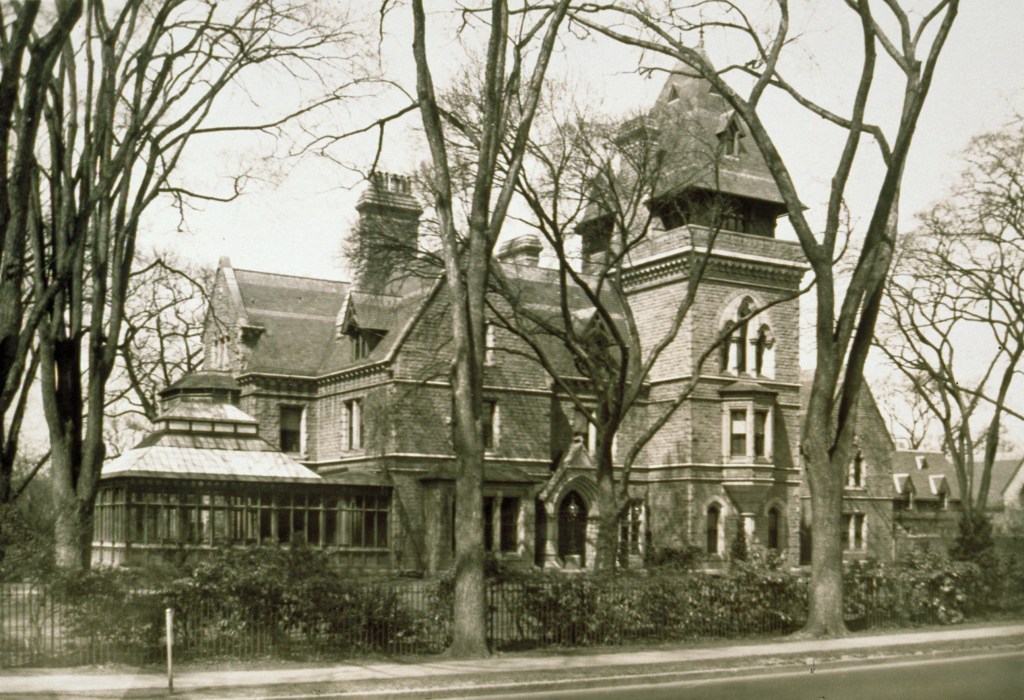
Following death of James in 1878, the Goodwin family hired Withers to do extensive additions and alterations to Christ Church, the Episcopalian Cathedral in Hartford. Among the changes to the cathedral was the addition of a new chapel and parish offices as well as remodeling the existing building by adding a new chancel with a memorial alter and reredos.
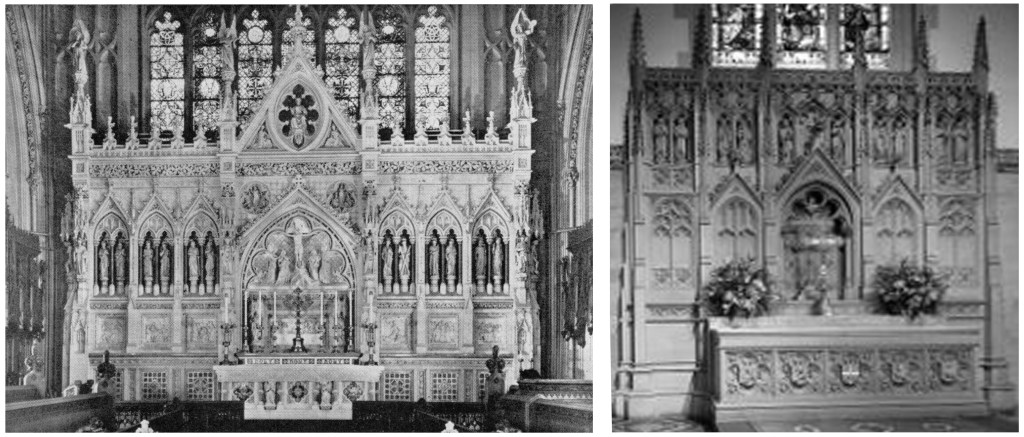
Right: Goodwin Memorial Alter and Reredos, Christ Church Cathedral, Hartford, Conn., 1879-80.
Thomas Wisedell had previously worked with Withers on the design for the Astor Memorial alter and reredos for Trinity Church in New York City in 1876. Though Trinity’s alter was substantially larger, there were numerous design parallels suggesting that Thomas Wisedell may have been involved with the design of the alter and reredos in Hartford as well. If that was indeed the case, Wisedell would have been spending time in Hartford in the summer and fall of 1879 when he formed his partnership with Francis Kimball.
The partnership of Kimball & Wisedell started with the commission to redesign the Madison Square Theatre in New York City (the subject of the next posting). This commission came to them through the brothers Rev. Dr. George S. Mallory (1838-1897) and Marshall H. Mallory (b. 1834), the owners and editors of The Churchman, a popular Episcopalian evangelical magazine based in Hartford with offices in New York City. It is also quite possible that Thomas Wisedell and Francis Kimball were brought together specifically for this commission. Besides owning The Churchman magazine, George Mallory had graduated from Trinity College in 1853 and in 1862, he returned to Hartford when he was appointed assistant professor of Latin and two years later he was elected Brownell professor of rhetoric and letters. In 1867, Mallory became the college treasurer and in 1872, he resigned his professorship and was elected to the board of trustees and was an active member of the building committee while the college was erecting its new campus.
In the summer of 1879, the manager of the Madison Square Theatre, Steele MacKaye, had convinced the Mallory brothers to purchase the theatre and help transform the building and help to produce plays that were more family oriented which also meant created an atmosphere that would cater to a female audience. It is quite plausible that Francis Kimball had been hired by the Mallory Brothers while Thomas Wisedell had been hired by Steele MacKaye and the two were thrown together for this commission.
Admittedly, the circumstances surrounding the formation of the the partnership between Thomas Wisedell and Francis Kimball is completely conjectural, the fame and notoriety their firm quickly achieved was undeniable as will be seen with the upcoming postings on the Madison Square Theatre……
 The Architecture of Thomas Wisedell