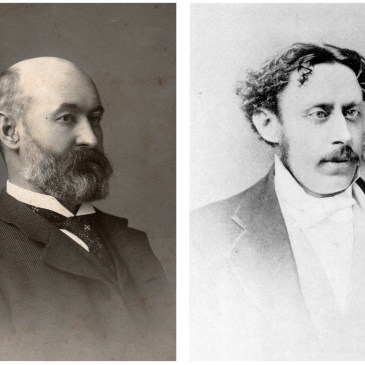
Part 19 — Kimball & Wisedell, Architects

By the summer of 1879, Thomas Wisedell had established a reputation as a superb designer of architectural details. His training under Robert Jewell Withers in London gave him a foundation in the Gothic Revival while exposing him to the most important British architects of the day as well the writings of Owen Jones, A.W.N. Pugin, … More Part 19 — Kimball & Wisedell, Architects
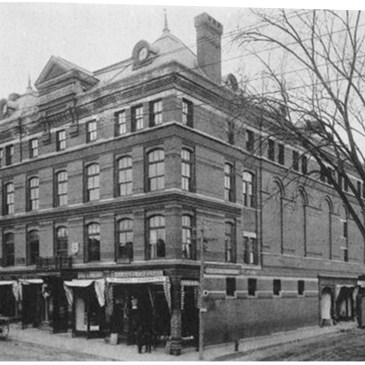
Part 18 – Francis Kimball, Architect — The Loomer Opera House, Willimantic, Conn.

Shortly after Kimball was hired to design the Goodwin Building in Hartford in May of 1879, he was also asked to design a commercial block in Willimantic, Connecticut for Silas Loomer (1824-1899).  Loomer was originally from Columbia, Connecticut and in the 1840’s, he began teaching at Hop River.  He soon set up a small business … More Part 18 – Francis Kimball, Architect — The Loomer Opera House, Willimantic, Conn.

Part 17 – Francis Kimball, Architect — The Goodwin Building, Hartford, Conn.

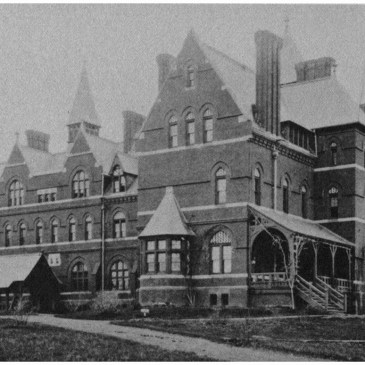
By 1879, Kimball’s practice was really taking shape.  Seabury and Jarvis Halls as well as the Hartford Orphan Asylum had all been completed, and other smaller commissions were underway.  In mid-January, Kimball had moved his office out of Seabury Hall and into the second floor of the State Savings Bank building at 39 Pearl Street, … More Part 17 – Francis Kimball, Architect — The Goodwin Building, Hartford, Conn.

Part 16 – Francis Kimball, Architect — South School and The Connecticut Theological Institute.

As construction was moving forward on Seabury and Jarvis Halls at Trinity College, Francis Kimball would find himself entangled in two projects which highlighted problems faced by architects as the profession struggled to gain legitimacy– one would play out in the local press while the other was elevated into the national debate over the relationship … More Part 16 – Francis Kimball, Architect — South School and The Connecticut Theological Institute.

Part 15 – Francis Kimball, Architect — The Hartford Orphan Asylum.

In February 1876, Francis Kimball was asked to submit plans to design new facilities for the Hartford Orphan Asylum.  For this commission, Kimball would  once again compete against his friend and rival George Keller.  The Hartford Orphan Asylum was established in 183l and formally incorporated two years later.  Its mission was to care for orphaned … More Part 15 – Francis Kimball, Architect — The Hartford Orphan Asylum.

Part 14 – Francis Kimball, Architect — Elisha T. Smith Warehouse, Hartford, Conn.

When Francis Kimball was hired by Trinity College, he must have taken the job not as a full-time position, but rather as an extension of his private architectural practice.  After returning from London, not only was he responsible for the design and construction of Trinity College, but also had to complete the interior designs for … More Part 14 – Francis Kimball, Architect — Elisha T. Smith Warehouse, Hartford, Conn.

Part 13c (still continued)– Francis Kimball and Trinity College. Northam Towers.

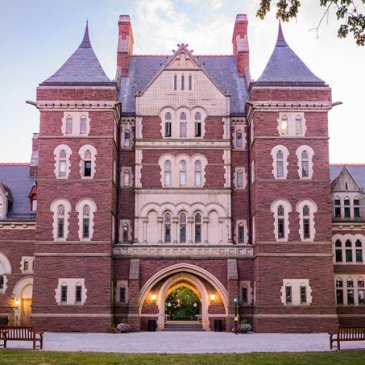
Jarvis and Seabury Halls opened in September 1878, though the chapel and museum were not completed until January.  What was still missing, however, was the gateway connecting the two buildings.  William Burges died on April 20, 1881; coincidentally, that was the same day that one of Trinity’s oldest trustees, Col. Charles H. Northam (1797-1881) announced … More Part 13c (still continued)– Francis Kimball and Trinity College. Northam Towers.

Part 13b (still continued)– Francis Kimball and Trinity College.  Seabury Hall.

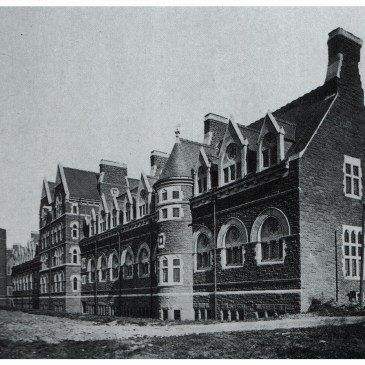
The initial designs for Seabury Hall were mostly created in 1875 and echoed the massing of Jarvis Hall with its central four-story block flanked by lower ranges. Unlike Jarvis, however, the lower sections were two stories rather than three, though with the same height on the exterior. Since Seabury was temporarily dedicated to functions such … More Part 13b (still continued)– Francis Kimball and Trinity College.  Seabury Hall.

Part 13a (still continued)– Francis Kimball and Trinity College.  Jarvis Hall.

Economics was clearly the driving force behind the decision to combine the middle quadrangles. This probably stemmed from the decision to initially fit all of the college functions into one long range of buildings until funds were available to erect other buildings. The western side of the central quad was then designed to house the … More Part 13a (still continued)– Francis Kimball and Trinity College.  Jarvis Hall.

Part 13 (continued – rewrite)– Francis Kimball and Trinity College.

In February 1872, the Trustees of Trinity College voted to sell their property to the City of Hartford as the site which the State of Connecticut would erect their new state capitol building. Following the sale Abner Jackson, the president of Trinity College, had contacted Frederick Law Olmsted as a consultant in finding a suitable … More Part 13 (continued – rewrite)– Francis Kimball and Trinity College.