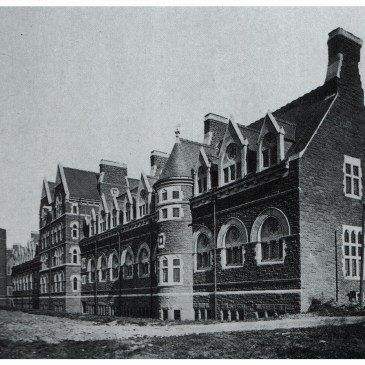
Part 16 – Francis Kimball, Architect — South School and The Connecticut Theological Institute.

As construction was moving forward on Seabury and Jarvis Halls at Trinity College, Francis Kimball would find himself entangled in two projects which highlighted problems faced by architects as the profession struggled to gain legitimacy– one would play out in the local press while the other was elevated into the national debate over the relationship … More Part 16 – Francis Kimball, Architect — South School and The Connecticut Theological Institute.
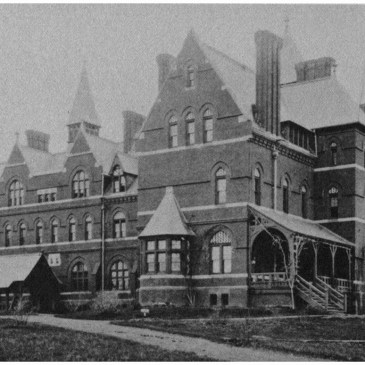
Part 15 – Francis Kimball, Architect — The Hartford Orphan Asylum.

In February 1876, Francis Kimball was asked to submit plans to design new facilities for the Hartford Orphan Asylum.  For this commission, Kimball would  once again compete against his friend and rival George Keller.  The Hartford Orphan Asylum was established in 183l and formally incorporated two years later.  Its mission was to care for orphaned … More Part 15 – Francis Kimball, Architect — The Hartford Orphan Asylum.

Part 13b (still continued)– Francis Kimball and Trinity College.  Seabury Hall.

The initial designs for Seabury Hall were mostly created in 1875 and echoed the massing of Jarvis Hall with its central four-story block flanked by lower ranges. Unlike Jarvis, however, the lower sections were two stories rather than three, though with the same height on the exterior. Since Seabury was temporarily dedicated to functions such … More Part 13b (still continued)– Francis Kimball and Trinity College.  Seabury Hall.

Part 2(a) – From London to New York: Calvert Vaux, Jacob Wrey Mould and Central Park

In the fall of 1868, Thomas Wisedell was presented with an opportunity to move from London to New York City to be part of a group of British designers, engineers and craftsmen who had previously immigrated to the United States and were not only creating the modern park movement but also transforming American design. The … More Part 2(a) – From London to New York: Calvert Vaux, Jacob Wrey Mould and Central Park

Part 1(b) – Projects by Robert Jewell Withers 1863-1868

Churches and Chapels 1863-1865 – Restoration and addition to St. Llwchaiarn’s Church, Llanllwchaiarn, Newtown, Montgomeryshire, Wales (Extant) 1863           — At the behest of the Earl of Pembroke, five different architects were asked to send drawings completed churches to the Archdiocese of Dublin, Ireland, in consideration for the building of St. Bartholomew’s Church.  The final decision … More Part 1(b) – Projects by Robert Jewell Withers 1863-1868

Part 1(a) – Apprenticeship with Robert Jewell Withers 1863-1868

One of the challenges that countless historians have faced is that of attribution. Since it was uncommon for draftsmen to sign the renderings or to be given credit, we very rarely know who actually created specific drawings or actually designed specific details. This is definitely the case when researching Robert Withers. Since we may never … More Part 1(a) – Apprenticeship with Robert Jewell Withers 1863-1868

The Architecture of Thomas Wisedell

This blog was created to highlight the career of of the British-born, American architect Thomas Wisedell (1846-1884). From late 1868 through 1879, he worked with Calvert Vaux and Frederick Law Olmsted, designing architectural features for many of their early projects. With the 200th anniversary of the birth of Frederick Law Olmsted (April 26, 1822 – … More The Architecture of Thomas Wisedell