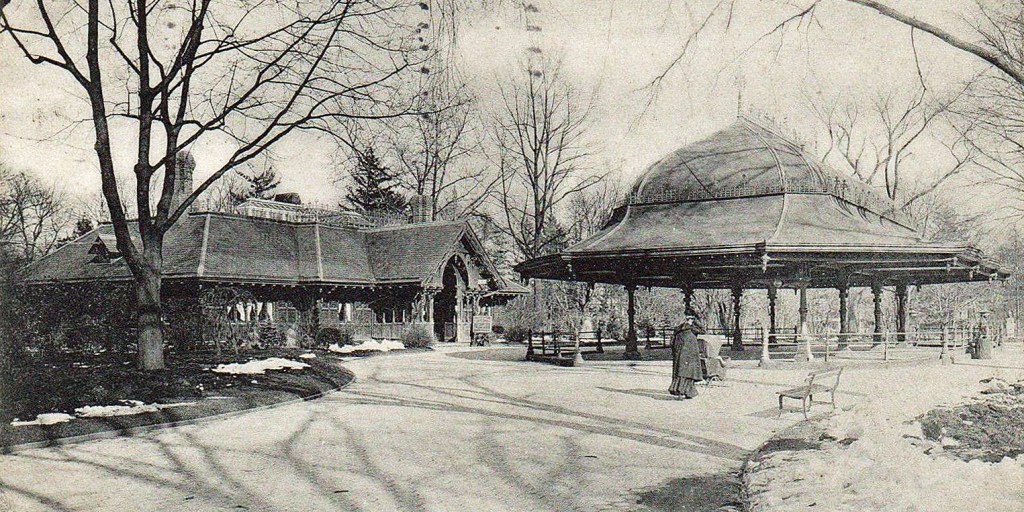
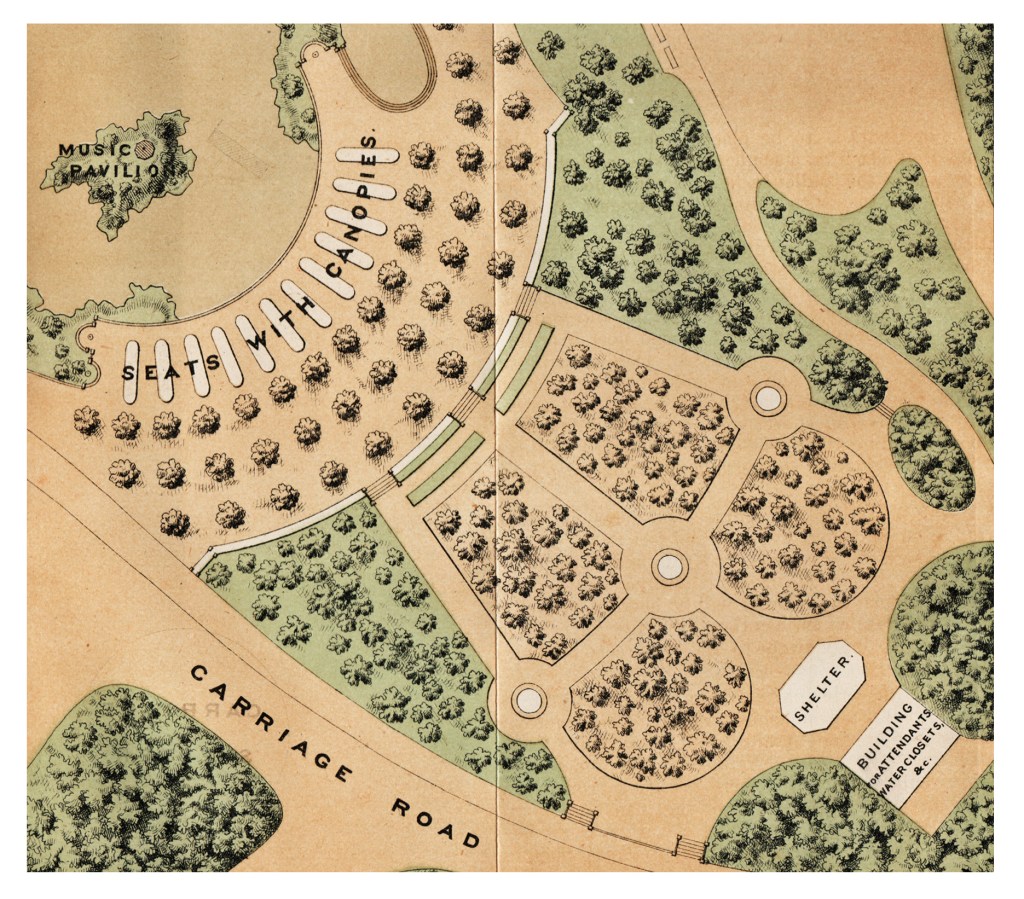
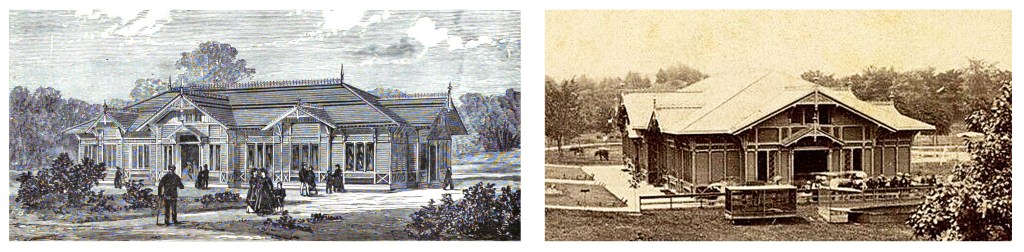
When Frederick Law Olmsted and Calvert Vaux were laying out the Concert Grove in 1869-70, they intended for an open-air shelter with outdoor seating in front of a “Building for Attendants, Water Closets, etc.” which was to have restrooms, coat rooms and a coffee shop. The size and scope of this building was soon expanded as it became obvious that the refectory across the bay from the Concert Grove would not be constructed.
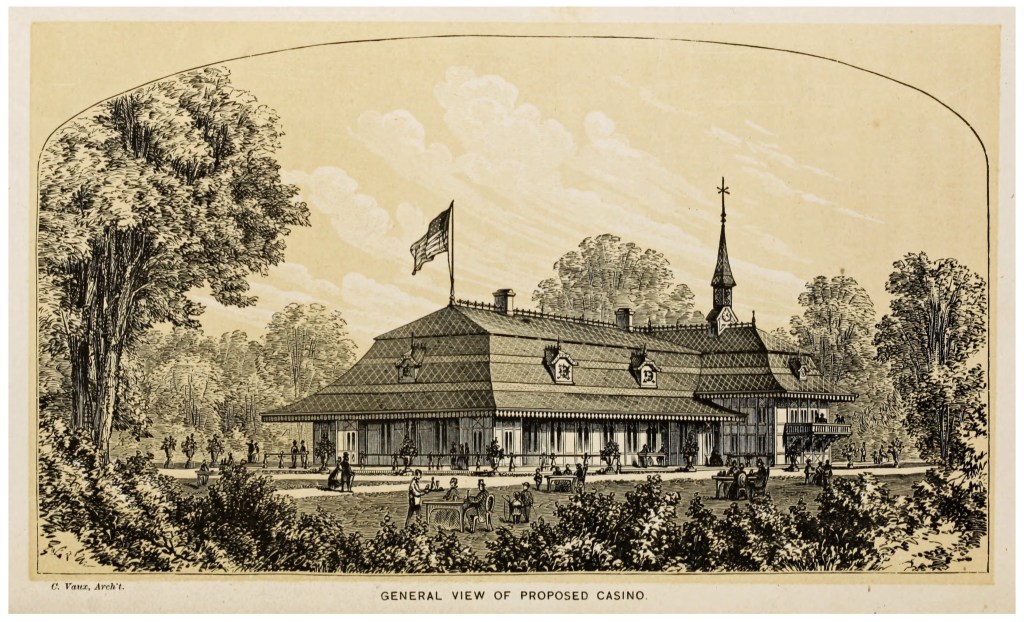
For the house and shelter, Vaux resurrected the original, unbuilt design for the “Casino” (Ladies Pavilion) in Central Park from 1862, which had been redesigned in 1863 in favor of a smaller building constructed of stone. Vaux basically separated the body of the building from the roof to create two independent but related structures. Though some of the ideas expressed in the design for the Casino can by found in Vaux’ Villas and Cottages, as well as earlier earlier French publications by Victor Petit, it was not until after his trip to Europe in 1868 that Vaux began to fully explore this style.
Upon his return from Europe, Vaux designed the shelter house for the Parade Grounds adjacent to Prospect Park. This building relied on French precedence while incorporating English Gothic and Swiss Chalet styles, synthesized into something new and unique which historian Vincent Scully has termed “The Stick Style.” The Concert Grove House clearly displayed similar ideas of the exposed timber-frame grid but incorporated a far more elaborate decorative program.
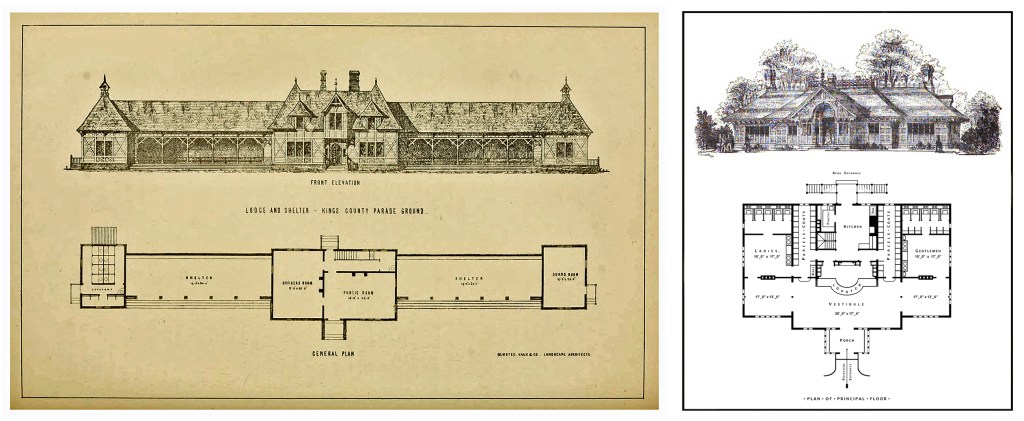
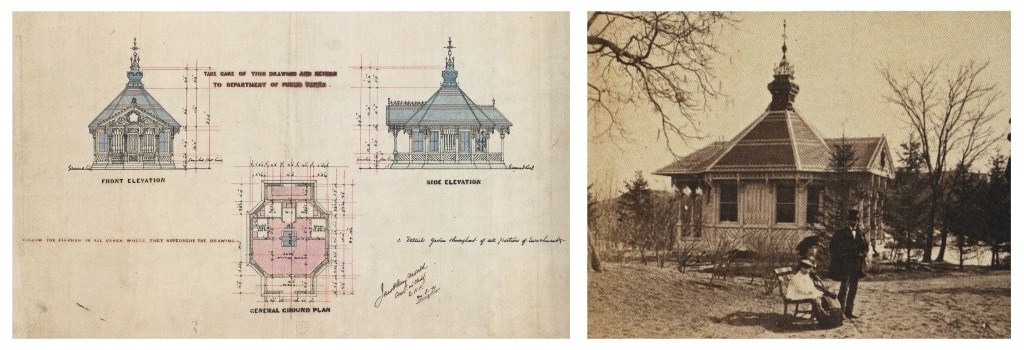
Right: Concert Grove House and Plan, 1870-1872 (Drawn by Thomas Wisedell).
A closer look at both the Parade Shelter and the Concert Grove House reveals one to have its foot in the past while the other was much more contemporary, reflecting current technology and a more cosmopolitan design. The Parade House relied on construction details such as exposed timber framing and cross bracing in a manner reflecting European designs from the 1840’s and 50’s though currently in fashion in the United States. The Concert Grove House uses some of those same features, however, it also clearly displayed a far more elaborate decorative scheme not associated with Calvert Vaux but rather with Jacob Wrey Mould as well as the British designer, Christopher Dresser.
When Central Park’s Board of Commissioners was replaced in April 1870, Olmsted & Vaux position with that park was terminated (though Olmsted would return a couple year later). At that time, Jacob Wrey Mould was promoted to Architect-in-Chief while Julius Munckwitz, who had been an associate under Mould since 1862, was promoted to Supervising Architect. The first buildings designed by Mould with Munckwitz were the numerous building for “zoological purposes,” the largest of which was “The Menagerie.” This was designed as to avoid superfluous details as a clear departure from other wooden building of the same period in park like the “Ladies Cottage” which used decorative details with religious and domestic associations.
When Vaux and Wisedell were designing the Concert Grove House, they were clearly aware of Mould’s designs. However, a look at other earlier buildings by Mould also show his influence on the design for the Concert Grove House. In 1865, Mould had completed the Church of the Holy Trinity (Unitarian) at the corner of 42nd and Madison in New York City. Mould incorporated Christian and Islamic details and seemed to borrow from the proportional ingenuity indicative of his studies of the Alhambra Palace while working for Owen Jones. As for the roof itself, Mould increased its height and pitch while extending its eaves down to the top of the windows.
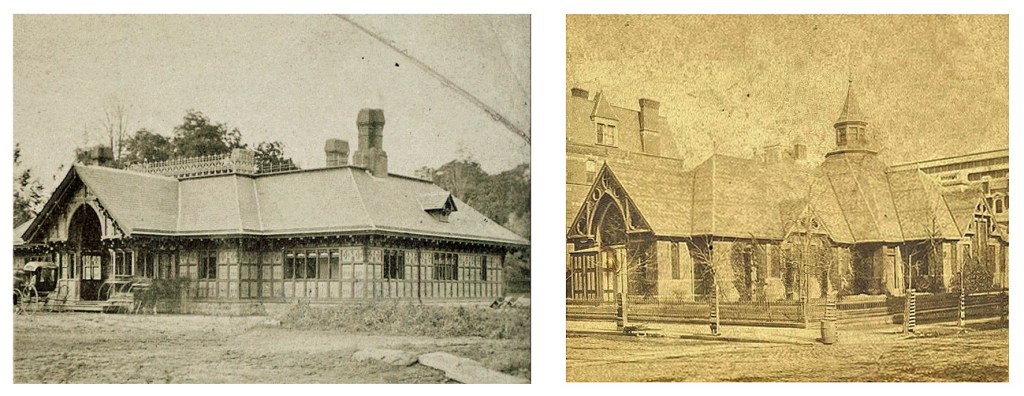
Right: Jacob Wrey Mould, Church of the Holy Trinity, ca. 1865.
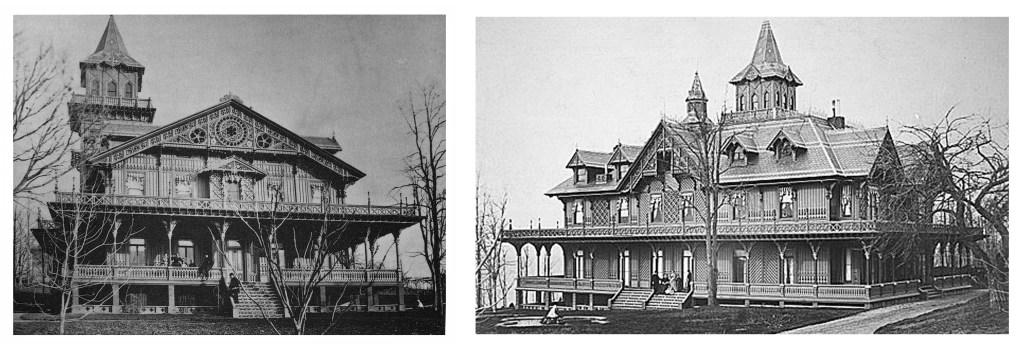
Another project by Mould which dated from 1863-1864 is the house for Kennard Thompson at Glen Cove, Long Island known as “Glen Chalet.” This was an absolute tour-de-force of construction and decoration. The house was painted in bright, primary colors and used a variety of scroll and fret work with other carpentry patterns to achieve effects of light, shadow, pattern and texture.
https://www.nycgovparks.org/about/history/bicycling
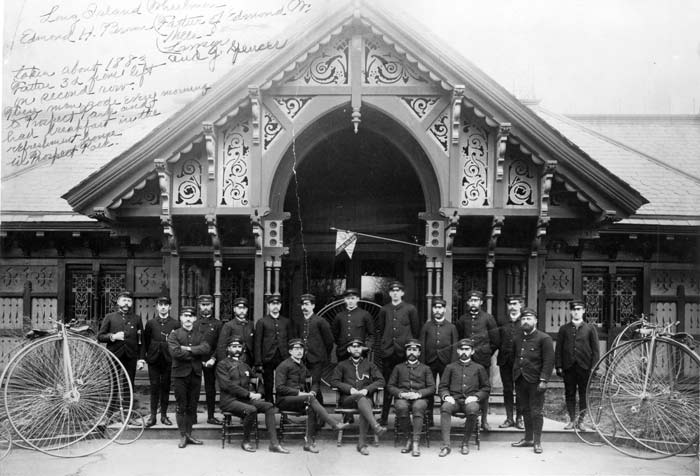
For the Concert Grove House, Thomas Wisedell also employed a variety of wood-working methods, but unlike Mould’s designs, he primarily relied on patterns cut by scroll saws into solid boards to create pattern and texture. This method of cutting had just become industrialized around 1864 with the invention of treadle-powered scroll saw, allowing for individual designs to be inexpensively repeated. By simply rotating or reversing a cut board, it actually reads as a separate design. For the wall surface, there were only two patterns which were used to fill in between the timber grid while the pediment used only five different designs which were then rotated and/or reversed to create variety.
As for the decorative program, this is where Thomas Wisedell’s talents were truly on display. Calvert Vaux’ sensibilities tended towards a simpler and less decorated wall surface. When detail was called for, he relied heavily on the architects he partnered with which included Alexander Jackson Davis, Frederick Clarke Withers, and Jacob Wrey Mould. With each architect there was usually a different stylistic outcome and all were instrumental in Vaux’ development as an architect. Thomas Wisedell’s decorative program for the Concert Grove House represented Vaux’ ability to to find talented designers who shared a common ideology.
Frederick Clarke Withers had been thoroughly trained as a British, Gothic Revival architect while Jacob Wrey Mould had been trained by Owen Jones and had an extremely broad approach to design, heavily relying on realistic portrayals of nature as well as Islamic motifs and geometric abstraction. What made the decorative features for the Concert Grove House so unique was that Thomas Wisedell didn’t use three-dimensional wood carving to echo the nearby stonework, but rather two-dimensional patterns cut into simplified botanical designs.
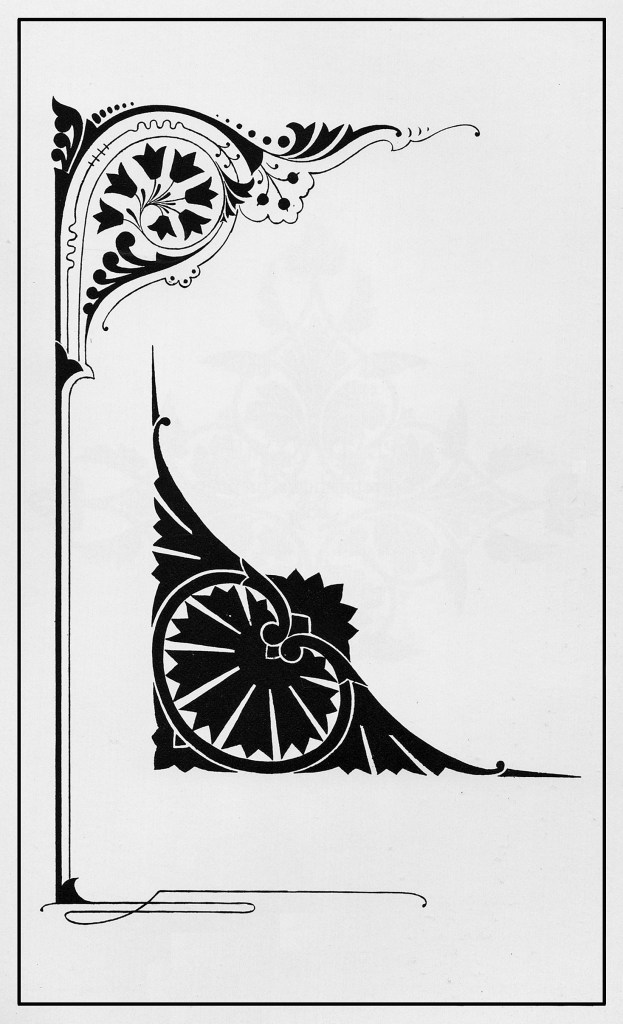
Wisedell was clearly displaying his understanding of the principles laid out by Christopher Dresser in his 1862 book The Art of Decorative Design. Dresser had been a pupil of Owen Jones in the early-mid 1850’s and contributed at least one study of leaves and flowers to The Grammar of Ornament. In his own lectures and writings, Dresser used Owen Jones’ methods for creating ornament but expanded the principles into an understanding of how design happens organically in nature and then abstracted those patterns two-dimensionally. This is quite an oversimplification, but does get the point across.
Plate XXVII from The Art of Decorative Design.
The Concert Grove House officially opened on the June 1, 1872. Unfortunately, no photos of the interior have been found and the only known description comes from an article in the Kings County Rural Gazette of June 29, 1872:
The Concert Grove House provides, “cloak rooms,” for shawls, overcoats, etc.; boys hold the horses; retiring rooms for ladies and gentlemen; needed refreshments, from a plain sandwich to the finest ice cream, at very reasonable prices; and even medicinal aid if necessary….. [The interior was] nicely ornamented [with an] elegant temperance bar with a silver-mounted marble soda fountain.
Though the Concert Grove House had been completed in 1872, an unusually rainy summer that year exposed construction flaws which would take over a year to remedy and the building reopened in either October or November of 1873. Besides the problems with the Concert Grove Hose, the rain also delayed the erection of the stonework and plantings which would not be completed until 1874. As for the open-air pavilion, its was designed following the completion of the Concert Grove House in 1872, though its construction was also stalled and would not be completed until 1874. With that said, the open-air pavilion with all of its Indo-Islamic complexities still has not been addressed and will have to wait until the next posting…..
Further Reading:
- Annual Reports of the Brooklyn Park Commissioners. 1861-1873 (Brooklyn, N.Y., 1873).
- Fourteenth Report to the Board of Commissioners of the Central Park for the Period January 1 to April 20, 1870 (New York, 1871).
- Annual Reports of the Board of Commissioners for the Department of Parks of the City of New York (New York, 1870-1872).
- Dresser, Christopher, The Art of Decorative Design (London: Day & Son, 1862).
- Flores, Carol A. Hrvol, Owen Jones: Design, Ornament, Architecture, and Theory in an Age in Transition (New York: Rizzoli International Publications, 2006)
- Kowsky, Francis R., Country, Park & City: The Architecture and Life of Calvert Vaux (New York and Oxford: Oxford University Press, 1998).
- The Papers of Frederick Law Olmsted. Volume IV: The Years of Olmsted, Vaux & Company 1865-1874 (Baltimore, MD: Johns Hopkins University Press, 1992).

