Due to the financial crisis of 1873, architects and builders were struggling to find work. Appropriations for work at both Central Park and Prospect Park were severely reduced. Thomas Wisedell had married the previous year and now had financial obligations to his new family; so it was with all of these factors in mind that Wisedell’s took his first steps towards establishing an independent practice.
From mid-April through early July 1873, Wisedell worked with William Farnsworth, a fellow draftsman in the office of Calvert Vaux, to create a design to be entered into the Centennial Exposition competition (see part 3a). Since that work had to be submitted in July, the only other work Wisedell would have been given that year was as a draftsman in the office of Vaux & Radford.
By the end of the year, Wisedell was given his first job as an independent architect and would soon be asked to remodel two houses on Long Island. All of this independent work would not have been possible without his connections to Calvert Vaux and Frederick Law Olmsted.
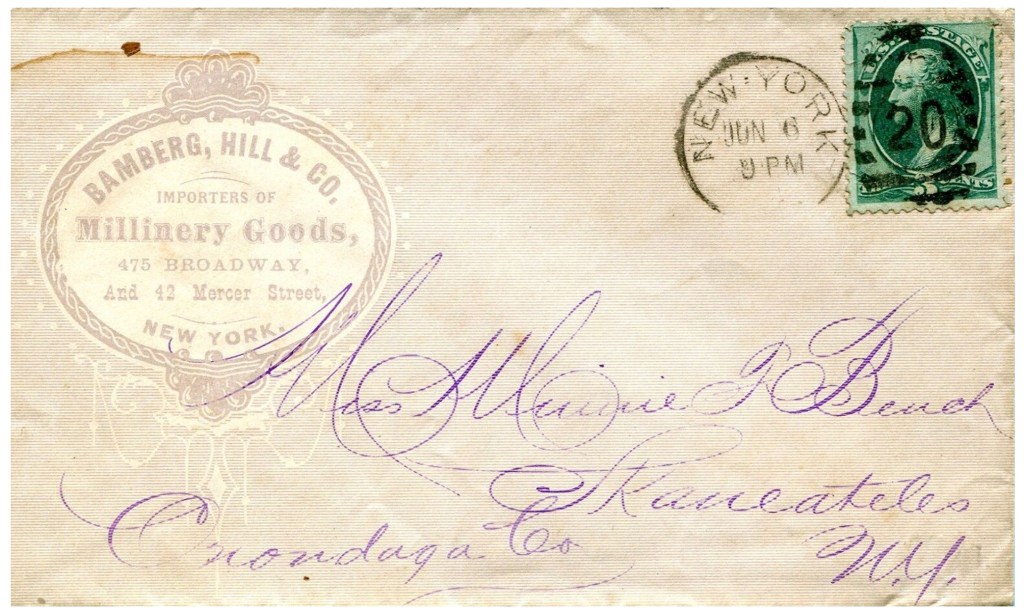
In late 1873, he was asked to design alterations to the building at 42 Mercer Street for the clothing and fancy goods importer Bamberg, Hill & Company. Jacob Bamberg had established his millinery business in Albany, NY in the early 1850’s and by 1860 he had a second store on Canal Street in New York City. Philip H. Hill was one of Bamberg’s earliest employees having worked in the Albany store since 1852. By the late 1850’s, Hill had also moved to New York City and around 1868, he was made a full partner and the company became known as Bamberg & Hill. With the addition of Henry Rosenheim in 1870, the firm became Bamberg, Hill & Co. and it was under this partnership when the company saw its greatest success, even opening a store in Paris.
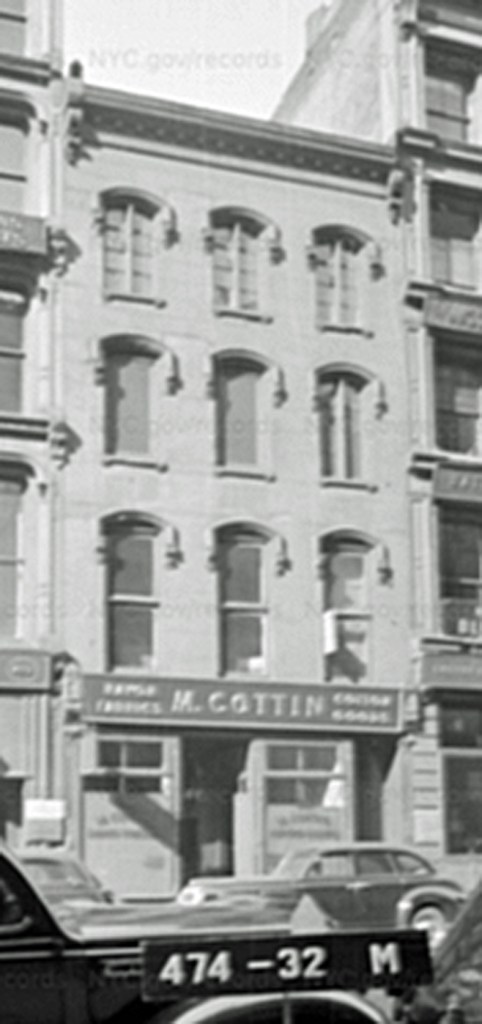
Photo ca. 1940, NYC Department of Buildings.
In 1871, the company moved from Canal Street to 475 Broadway (between Grand and Broome Sts.). Unfortunately, this building was demolished in 1894 and no images or full descriptions of this project have been located. What is known is that the building had been constructed around 1840 as a row of brownstone, Italianate commercial buildings. To get an idea of what that was, the building at 481 Broadway does still exist and gives an impression of the type of structure remodeled by Thomas Wisedell.
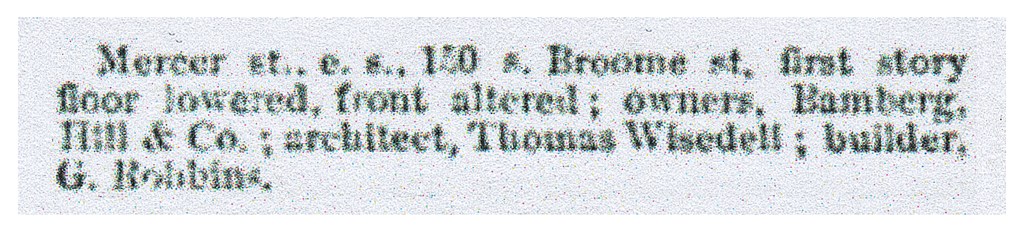
It was with this small commission that Wisedell’s name first appeared in the the New York City’s building records. His designs apparently were to the back of the building along Mercer Street and called for lowering the floor level and redesigning the cast iron and plate glass windows at the street level. What this implies is that the Mercer Street side was redesigned to accommodate delivery vehicles. The contractor for was George Robbins, a builder with nearby offices on Spring Street who was quite active in the area experienced with difficult renovations as well as moving buildings.
In 1874, Thomas Wisedell would gain two more commissions for remodeling the Long Island homes of William Cullen Bryant and Charles Anderson Dana (Parts 3b and 3c, respectively). However, Wisedell’s stint as an independent architect was very short-lived. In the spring of 1874, Frederick Law Olmsted was ask redesign the grounds around the United States Capitol Building in Washington, D.C. That would prove to be Thomas Wisedell’s most ambitious project, lasting until 1883. Olmsted would also plan improvements in Philadelphia, Baltimore and Montreal as well as the ongoing work in Buffalo with Calvert Vaux, would lead to some of the most important and inventive work in Wisedell’s early career (see sections 4 through 8).

