Part 1(c) – Chronology of Projects by Robert Jewell Withers

Feb 2, 1824 – Born at Shepton Mallet, Somerset, England. ca. 1828-1834 – Home-schooled 1834-1835 – Attended Mrs. Clark’s school, Newport, Isle of Wight 1836          – Attended Horsington School, Somerset, England. 1837-1839 – Returned to Newport, Isle of Wight to finish formal education 1839-1844 – Articled to Thomas Hellyer of Ryde, Isle of Wight. List of … More Part 1(c) – Chronology of Projects by Robert Jewell Withers
Part 2(e) continued — The Boathouse, Delaware Park, Buffalo, N.Y.

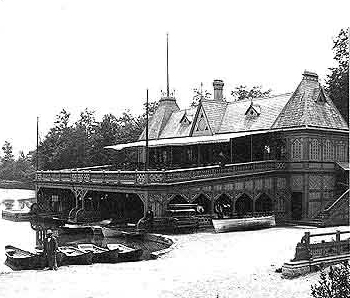
Within days of Edward Hager being awarded the contract to construct the sheltered seating at the boat landing as well as the original contract to erect the Spire-house, John R. Munroe (1828-1916) was awarded the contract to erect the Boathouse and refectory in Delaware Park. It was perhaps at that time when the park commissioners … More Part 2(e) continued — The Boathouse, Delaware Park, Buffalo, N.Y.

Part 2(e) continued — Sheltered Seats, Delaware Park, Buffalo, N.Y.

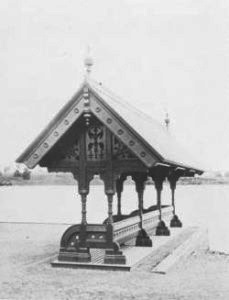
The overall design for the covered seats showed Vaux’ ideas while the detailing and ornamental work reflected the talents of Thomas Wisedell. The structure combined Indo-Islamic details with simple geometric patterns. The roof and eaves had been typical of Vaux’ domestic designs of the 1850’s with its basic, flat design punctured with simple, geometric shapes … More Part 2(e) continued — Sheltered Seats, Delaware Park, Buffalo, N.Y.

Part 2(e) continued — Spire House, Delaware Park, Buffalo, N.Y.

Delaware Park was the largest of three parks Olmsted & Vaux had designed for Buffalo.  Construction began in 1869-1870 and in June of 1874, Frederick Law Olmsted was back in Buffalo giving recommendations for the next phase of the park’s construction.  At the July 5th commissioners meeting, it was decided to procure plans and elevations … More Part 2(e) continued — Spire House, Delaware Park, Buffalo, N.Y.

Part 2(e) — The Refectory, Buffalo, N.Y.

While Olmsted and Vaux were creating Central Park and Prospect Park (as well as other smaller projects), they were also producing a park system for Buffalo, New York, where Thomas Wisedell would play an important role assisting Calvert Vaux in designing park structures.  This commission came to Olmsted & Vaux in 1868 and is viewed … More Part 2(e) — The Refectory, Buffalo, N.Y.

Part 2(d) – The Martyrs Memorial at Washington Park

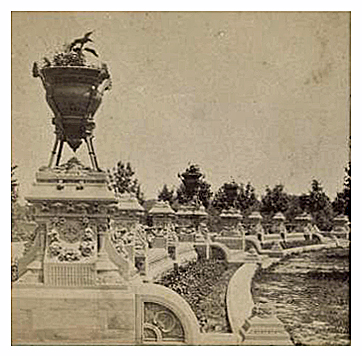
In April 1867 Olmsted & Vaux were tasked by the Brooklyn Park Commissioners to improve that city’s existing City Park, Washington Park, Carroll Park and City Hall Park (two triangular park as well as Tompkins Park were added in 1870). This idea of having all the Brooklyn’s parks redesigned at the same time was quite … More Part 2(d) – The Martyrs Memorial at Washington Park

Part 2(c) continued- The Concert Grove House and Pavilion

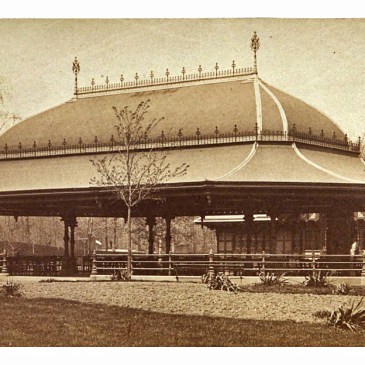
With the designs for the Concert Grove House completed in 1872, Calvert Vaux then turned his attention to designing the open-air pavilion. Vaux had long admired architecture and design stemming from southern Spain, North Africa and the eastern Mediterranean as well as Turkey and India. For the pavilion, he primarily combined the concept of a … More Part 2(c) continued- The Concert Grove House and Pavilion

Part 2(c) – The Concert Grove House and Pavilion

When Frederick Law Olmsted and Calvert Vaux were laying out the Concert Grove in 1869-70, they intended for an open-air shelter with outdoor seating in front of a “Building for Attendants, Water Closets, etc.” which was to have restrooms, coat rooms and a coffee shop. The size and scope of this building was soon expanded … More Part 2(c) – The Concert Grove House and Pavilion

Part 2(b) – Prospect Park and the Concert Grove

With Olmsted and Vaux’ dismissal as the architects of Central Park in the spring of 1870, Thomas Wisedell  also ended his tenure in that park and was given much greater design responsibilities in the creation of Brooklyn’s Prospect Park.  Prospect Park had originally been planned in 1861 by Egbert Viele, but due to the Civil … More Part 2(b) – Prospect Park and the Concert Grove

Part 2(a) – From London to New York: Calvert Vaux, Jacob Wrey Mould and Central Park

In the fall of 1868, Thomas Wisedell was presented with an opportunity to move from London to New York City to be part of a group of British designers, engineers and craftsmen who had previously immigrated to the United States and were not only creating the modern park movement but also transforming American design. The … More Part 2(a) – From London to New York: Calvert Vaux, Jacob Wrey Mould and Central Park