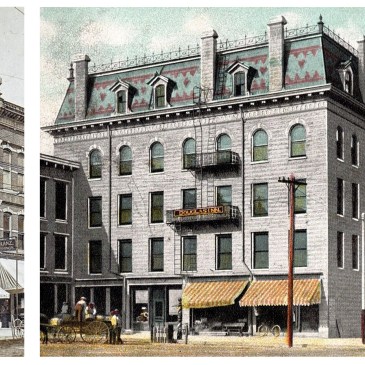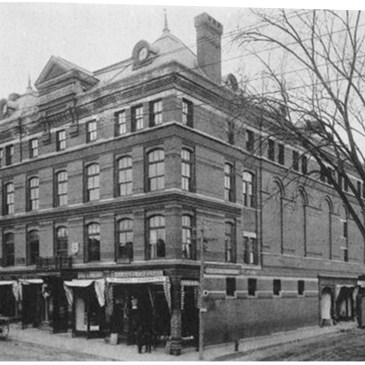
Part 18 – Francis Kimball, Architect — The Loomer Opera House, Willimantic, Conn.

Shortly after Kimball was hired to design the Goodwin Building in Hartford in May of 1879, he was also asked to design a commercial block in Willimantic, Connecticut for Silas Loomer (1824-1899).  Loomer was originally from Columbia, Connecticut and in the 1840’s, he began teaching at Hop River.  He soon set up a small business … More Part 18 – Francis Kimball, Architect — The Loomer Opera House, Willimantic, Conn.
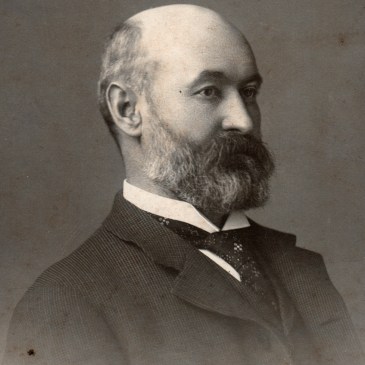
Part 12 — Francis Kimball (1845-1919)

In the summer of 1879, Thomas Wisedell formed a partnership with Francis Hatch Kimball, a successful architect working in Hartford, Connecticut who had recently received a contract to remodel the Madison Square Theatre in New York City.  It appears as though the partnership may have been instigated by Kimball who saw Wisedell’s connections in New … More Part 12 — Francis Kimball (1845-1919)

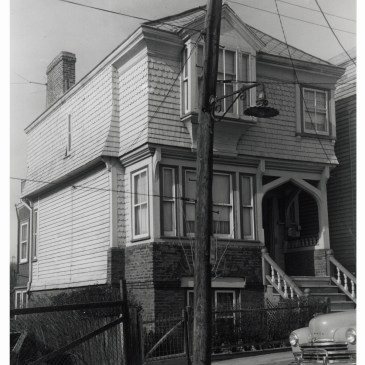
Part 11 — Thomas & Elizabeth Wisedell House, Yonkers, NY, 1878-79. (rewrite)

It was brought to my attention that not enough credit was given to Elizabeth Wisedell in designing this house with her husband, Thomas, thus much of this post has been amended. Since this was a home for their own family, Elizabeth’s contributions, especially regarding decisions on furnishings and decorations would have been instrumental in its … More Part 11 — Thomas & Elizabeth Wisedell House, Yonkers, NY, 1878-79. (rewrite)

Part 3(b) – “Cedarmere,” William Cullen Bryant Residence, Roslyn, Long Island, New York

In 1874, Thomas Wisedell began a smaller, private commission in Roslyn, Long Island, NY, to remodel the house of the poet and scholar, William Cullen Bryant (1794-1878), owner and editor of the New York Evening Post.  Though Bryant was a friend of Frederick Law Olmsted, it may have been through Calvert Vaux that Wisedell was … More Part 3(b) – “Cedarmere,” William Cullen Bryant Residence, Roslyn, Long Island, New York

Part 3(c) – Charles Dana Residence, Dosoris Island, Glen Cove, Long Island, New York

In the fall of 1874, as Wisedell was working on the William Bryant House in nearby Roslyn, New York as well as projects with Frederick Law Olmsted and Calvert Vaux in Washington and Buffalo, he began designing alterations and additions to the Charles Dana House on Dosoris Island (near Glen Cove), Long Island.  Charles Anderson … More Part 3(c) – Charles Dana Residence, Dosoris Island, Glen Cove, Long Island, New York

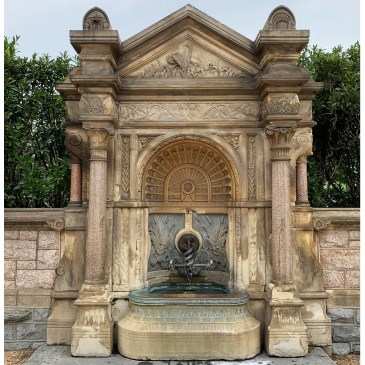
Part 4(f) rewrite – The Fountain, Capitol Grounds, Washington, D.C.

Since writing about the fountain back in May, new information has come to light which changes the timeline of how the western part of the Capitol grounds had developed.  It was previously thought that the fountain was one of the last architectural features to erected, it is now known that that was actually the first.  … More Part 4(f) rewrite – The Fountain, Capitol Grounds, Washington, D.C.

Part 4(a) still continued – Iron Trellis, The East Plaza, Capitol Grounds, Washington, D.C.

When Frederick Law Olmsted created his initial plan for the East Plaza in 1874, he had intended for a seated, iron trellis to be placed along one of the principle walks on the north side of the grounds, near the Delaware Avenue entrance. Like the waiting stations, a second trellis was erected in the same … More Part 4(a) still continued – Iron Trellis, The East Plaza, Capitol Grounds, Washington, D.C.

Part 4(a) still continued – Unbuilt Flagpoles, The East Plaza, Capitol Grounds, Washington, D.C.

While Thomas Wisedell was designing the lampposts for the East Plaza during the fall of 1874 and spring of 1875, he was also tasked with creating two bronze flagpoles.  These were shown on the plan of the Capitol grounds rendered by Wisedell in September 1874 and were to be located on the triangular plots near the … More Part 4(a) still continued – Unbuilt Flagpoles, The East Plaza, Capitol Grounds, Washington, D.C.

Part 4(f) – The Fountain, Washington, D.C.

The boundary wall connecting the two entrances including the ornate drinking fountain at the center of the entire scheme was finally erected in 1881. It is this later date that is of interest since it helps explain why the fountain exhibits a different style than the rest of the decorative stonework Wisedell designed for the … More Part 4(f) – The Fountain, Washington, D.C.